51
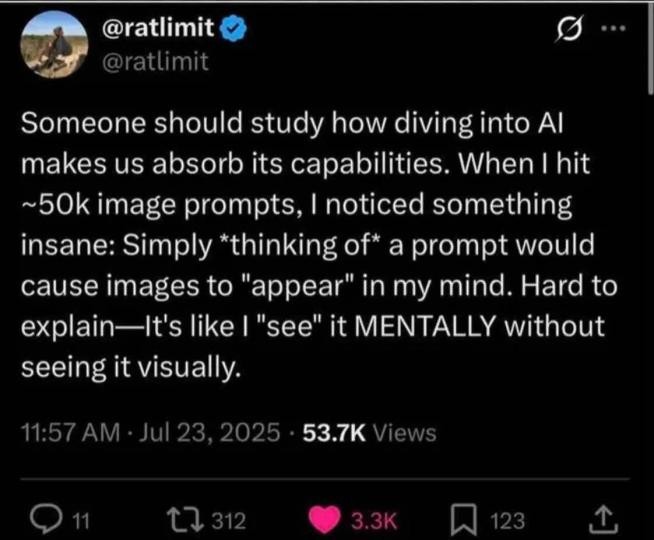
AI bro discovering imagination
(piefedimages.s3.eu-central-003.backblazeb2.com)
A place to share screenshots of Microblog posts, whether from Mastodon, tumblr, ~~Twitter~~ X, KBin, Threads or elsewhere.
Created as an evolution of White People Twitter and other tweet-capture subreddits.
Rules:
Related communities:
Could also be part of a significant portion of people have undiagnosed aphantasia.
Learning that some people can't mentally visualize anything, but pictures of memories that they can't modify since they have no imagination felt wild.
When I learned that there are humans out there who can't picture even simple things within their minds, I felt confused.
I was able to create entire worlds before going to bed when I was a kid, fantasy worlds to explore.
I thought all humans could picture things in their minds.
All people can unless they are in the extreme minority that suffer from highly particular neuropathic disorders that render them absolutely dysfunctional as human beings. Having a weak drive for creativity and imagination is not the same as suffering from a clinical incapability.
Aphant here! I would actually love your theory to be true but unfortunately no amount of training or practicing makes me better or even able to visualise. Believe me, I spent many years trying and practicing art before I heard about aphantasia and realised thats what I have.
If I looked at 10k slop pictures and their corresponding prompts I wouldn't be able to imagine the outputs any more than I already can (which is not at all).
Likewise I can't do meditation or self-hypnosis where the guide says stuff like "imagine you're lying on a beach" etc. At least it makes me immune to those stage hypnotists who try to get someone suggestible up on stage.
It's so trippy to me because I'm opposite of that. If I'm daydreaming, I see the worlds inside my head almost as clearly as the real world, to the point where they overlap. I can be looking at a street in the real world and wherever my daydream is taking me, I see that as well on top of the real world.
I find it both fascinating and hard to imagine (ironically) how someone could see absolutely nothing in their head if someone told them to think of a tree growing out of a lake or a car that is also a three story house.
If there is one thing that upsets me about living, it's that I will only ever experience the world once and through one perspective.
Speaking only from my own experience as someone with almost-total aphantasia (I definitely dream visually, and when I get very tired I can sometimes see fleeting things with my eyes closed, with almost no control over what), I have found I have a very strong spatial memory and imagination. When someone asks me to imagine an apple, I get no picture, but I can still have awareness of/can sense its shape and position relative to me. I can feel a shape spin in my head. It's as though there is some particular step between "add the object to the environment, conceptually" and "render the object" that doesn't happen for me.
So... You kind of percieve a symbolic representation of space, a sort of platonic ideal version? Must be a very different experience for you to read books than it is for me.
I wrote this up for another comment, so I'll put it as a reply to yours, too, so you get a notification about it:
In my time, I have played a fair amount of Dungeons & Dragons (and other such games), including "running" as a Game Master. The planning and narrating of locations is something I feel like would be greatly benefitted by having actual visual imagination. When I learned about aphantasia as a thing (and came to realize that when people talked about picturing something in their head, they were being a lot more literal than I realized was possible), one friend of mine wondered how I could do what I've done running those games, describing places aloud from my head, etc. without visual imagination. I said I don't know, but that he should consider how much better it might have been if I could picture things.
As far as maybe getting you closer to my experience:
Look at some table or other small pieces of furniture near you. Think about what you are doing with normal visual processing - your eyes are getting simple brightness/color signals from incoming photons.
Those get sent to your brain, and a few layers of processing happen - this region is square or rhombus shaped, this region is darker, this part is narrow and tall. Another layer maybe predicts the parts you can't see and gives you a sense of the table's thickness at various points (legs, main surface).
One layer/process considers how the trapezoid shape you see as the surface is actually a square/rectangle, and the apparent width changes based on the distance of that part of the table. All this happens without you having to think much about it, and you end up with not just a simple map of "this square is dark brown, this trapezoid is grayish" but a sense of a whole complex object.
Now, take that multi-layered sense of the table and try to focus just on the physical shape of it, your sense of where each part exists in space. Try to "imagine"/consider the table as an object you sense the presence and shape of, and then also imagine it to be invisible. You still know it's there, you have awareness of where you could walk without hitting it, how you could crawl under it, how far you should lower an object in your hand before letting it go so as to set it on the table rather than either dropping it or slamming it down.
If any of that clicked for you, that probably approximates the experience of non-visually imagining something solely spatially. Basically, everything the visual experience would tell you about the object, except now pretend it's invisible.
Ive only recently been able to visualise things, but only when im close to sleeping. My wife got annoyed at me when I first discovered it because I couldnt stop laughing at the amount of detail I was able to make on a fence. Only problem is now when im awake and unable to do it, im more aware of the ability I dont have.
Also, people who can just make shit up and see it in their heads, how do they get anything done? I feel like id just be imagining stuff all day long
Yep, that's literally what daydreaming is. People do it all the time, especially kids at school. I spent most of primary school exploring fantasy worlds in my head, while the teachers were trying to snap me out of it.