1045
Deep answers
(lemmy.world)
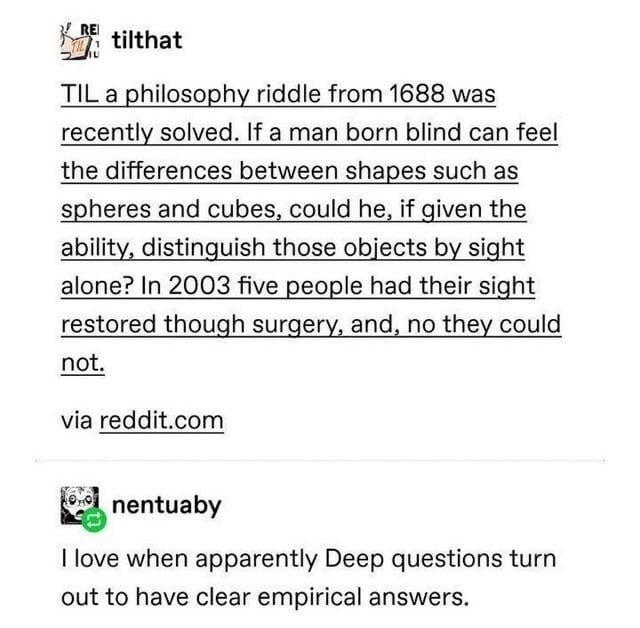
tilthat: TIL a philosophy riddle from 1688 was recently solved. If a man born blind can feel the differences between shapes such as spheres and cubes, could he, if given the ability, distinguish those objects by sight alone? In 2003 five people had their sight restored though surgery, and, no they could not.
nentuaby: I love when apparently Deep questions turn out to have clear empirical answers.
And yet, I feel like I can perfectly imagine what it would be like to lick anything that I have previously touched with my feet or fingers, despite never having experienced the sensation on my tongue before, and knowing that the nerves on my tongue perceive texture entirely different to my hands.
Edit: just scrolled down and saw that people are discussing this exact phenomenon.
In fairness you spend a lot of your childhood licking everything you come across. I bet your tongue has touched many more of those objects than you can remember.
To add to this, we've eaten a lot of spheres and cubes as adults as well, it would be strange if you couldn't tell a cherry from a watermelon cube by feel alone
That's because you have prior experience of both seeing and touching those shapes, so your brain has learned to integrate the different sensations
So you're saying we need to get blind people to lick things before their sight is restored
There are different kinds of tactile cells present both in the human skin as well as in the human tongue. Among those are nociceptors, Merkel-Ranvier cells and Meissner's corpuscles. While the density may vary, e.g., Merkel-Ravier cells are concentrated in the finger tips, those are still contributing to similar sensations wherever you have them. Those are not new sensory "devices" which are suddenly attached to your brain. Your brain is already familiar with inputs from those cells and has learned to interpret their signal patterns. This is why I would say that it's not challenging for you to imagine the perception of texture on your tongue, even though you mainly felt it on your skin before. You can also imagine feeling a similar texture of an object on your arm, even if you just touched it with your feet or hands before. Taste, however, is something different. You probably licked a rock or two when you were an infant or child, and tasted and smelled a lot of the world surrounding you. That's why you might even be able to imagine the taste of objects to a certain degree. (Of course, this becomes more difficult the more complex the taste is and depends on your exposure on different taste components and associations with objects where you typically find those.)
Getting sight at some point later in life, while being born blind, is like plugging in a new sensory device to your brain. It needs time to learn how to interpret the input signals, but after some time of training, it will be able to distinguish colors, shapes, objects, etc.. Having sight is nothing a blind person can relate to via other sensory information in any way, since sight is entirely depending on functional eyes (and specific neural pathways in the brain).
A good example of how the brain adapts to such new sensory inputs is Neil Harbisson.
This is a guy who has a colour-blindness and got a brain implant which coded colour into sound waves, such that he can "hear" colours. After some time of adapting he even started to dream colours as sounds.
https://www.bbc.com/news/av/technology-29992577
https://www.youtube.com/watch?v=mc2fOI9vLzo
Yeah, I'm thinking of it kinda like machine learning. To be able to do something like pick a visual thing to match a tactile thing... you need to have had other tactile<->visual experiences. Knowing what a shark edge looks like or feels like requires you to have touched or seen an object with such qualities. Given enough examples, you can generalize, and make estimations about things you've never touched or seen, but we're not born with any of that.