30
submitted 2 weeks ago by silence7@slrpnk.net to c/climate@slrpnk.net
top 9 comments
sorted by: hot top controversial new old
[-] Quill7513@slrpnk.net 21 points 2 weeks ago

I've stopped eating red meat entirely and only have white meat on rare occasions (working on cutting that out entirely). The thing about grass fed beef instead of feed lot beef hasn't anything to do with the environment, and it never has. It has to do with the quality of life of the animals and how much they enjoy the days of their life as they navigate the world. I hadn't really realized until this moment that anyone thought this was about the environment, though I reckon I shouldn't be surprised. People tend to think any certification or more expensive process is better for the environment regardless of why the farmer is doing it.

So... I guess what I'm getting at is if you currently eat red meat, please cut back. Ideally cut it out entirely. That's personally what I think is best. But if you keep eating red meat, please select lower cruelty options like grass fed beef because you are not the center of the universe and the animal lives that we take from granted matter, too.
[-] wakko@lemmy.world 10 points 2 weeks ago

No shit. The beef is the problem, not what we feed it.

It is far more efficient and ecologically sustainable to get the calories out of the plants directly than to pass it through a cow first.

The fun question is - What does America do with the nearly 30 MILLION beef cows if we stop slaughtering them?

[-] bear@lemmy.blahaj.zone 12 points 2 weeks ago* (last edited 2 weeks ago)

It's not like we're going to stop eating them suddenly, the economics of beef has been pushing it out of reach of more Americans every year.

12% of the US population is eating half the beef, which is in line with the wealthiest 10% driving half of consumer spending in the US.

[-] wakko@lemmy.world 6 points 2 weeks ago

Correct. The question everyone should be asking is why the ~90% is cool with letting that 10% ruin 100% of the planet's ecosystem, of which we have only 1.

[-] reddig33@lemmy.world 5 points 2 weeks ago* (last edited 2 weeks ago)

I’d think letting cattle eat wild grass would take less water and pesticides than corn/soy. Dunno about growing hay.

Edit: Boy is it fun trying to find an unbiased answer to this question. You’ll find a site, but then realize it’s tied to someone’s business. Then you’ll find a site with opposite data and again it will be tied to some bias (like paid for by the beef industry). Best i could figure out — grass fed beef saves water until you supplement that diet with alfalfa (which is common). Corn takes more water than soy, and soy is on about the same level as wheat. And free range grass fed beef possibly has additional benefits to the environment (though with a url like “grassfedjunction” I suspect yet another agenda).

https://www.grassfedjunction.com/learn/environmental

[-] reddig33@lemmy.world 3 points 2 weeks ago

This article is so weird because its like, “go ahead and eat whatever beef you want because cows will still fart so its still bad for the climate.” Such a strange perspective.

A cow’s diet does effect the amount of methane they expel. For example, studies have shown that letting them eat some kinds of white clover, or some strains of seaweed cuts emissions from cows. This research is important because people are going to continue to eat beef. You’d think the article would dive into that.

And no mention of the exhaust from gas-powered machinery used to raise, harvest, spray, and transport the food raised to feed the cattle.

https://8billiontrees.com/carbon-offsets-credits/carbon-footprint-of-corn-production/

Even just growing soy can contribute to greenhouse gas emissions. (Most corn and shoot is raised for animal feed).

https://research.iastate.edu/2024/11/25/growing-soybeans-has-a-surprisingly-significant-emissions-footprint-but-its-ripe-for-reduction/

Of course climate change contribution isn’t the only problem with pen-raised beef either.

[-] Sheldan@programming.dev 3 points 2 weeks ago* (last edited 2 weeks ago)

Who thought that grassfed is better for the climate?

[-] GreyEyedGhost@piefed.ca 3 points 2 weeks ago

Grass fed is better for the environment...if you are feeding them native grasses that aren't watered, mowed, or fertilized on land that isn't suitable for much else in such a way as to not absolutely destroy that environment. Now, how are we going to raise the other cows we're eating, because I suspect being able to raise 10% this way would be a shockingly high estimate.

[-] nodiratime@lemmy.world 2 points 2 weeks ago

Concern trolls, nobody else.

this post was submitted on 13 Jan 2026
30 points (85.7% liked)

Climate

7923 readers
146 users here now

Discussion of climate, how it is changing, activism around that, the politics, and the energy systems change we need in order to stabilize things.

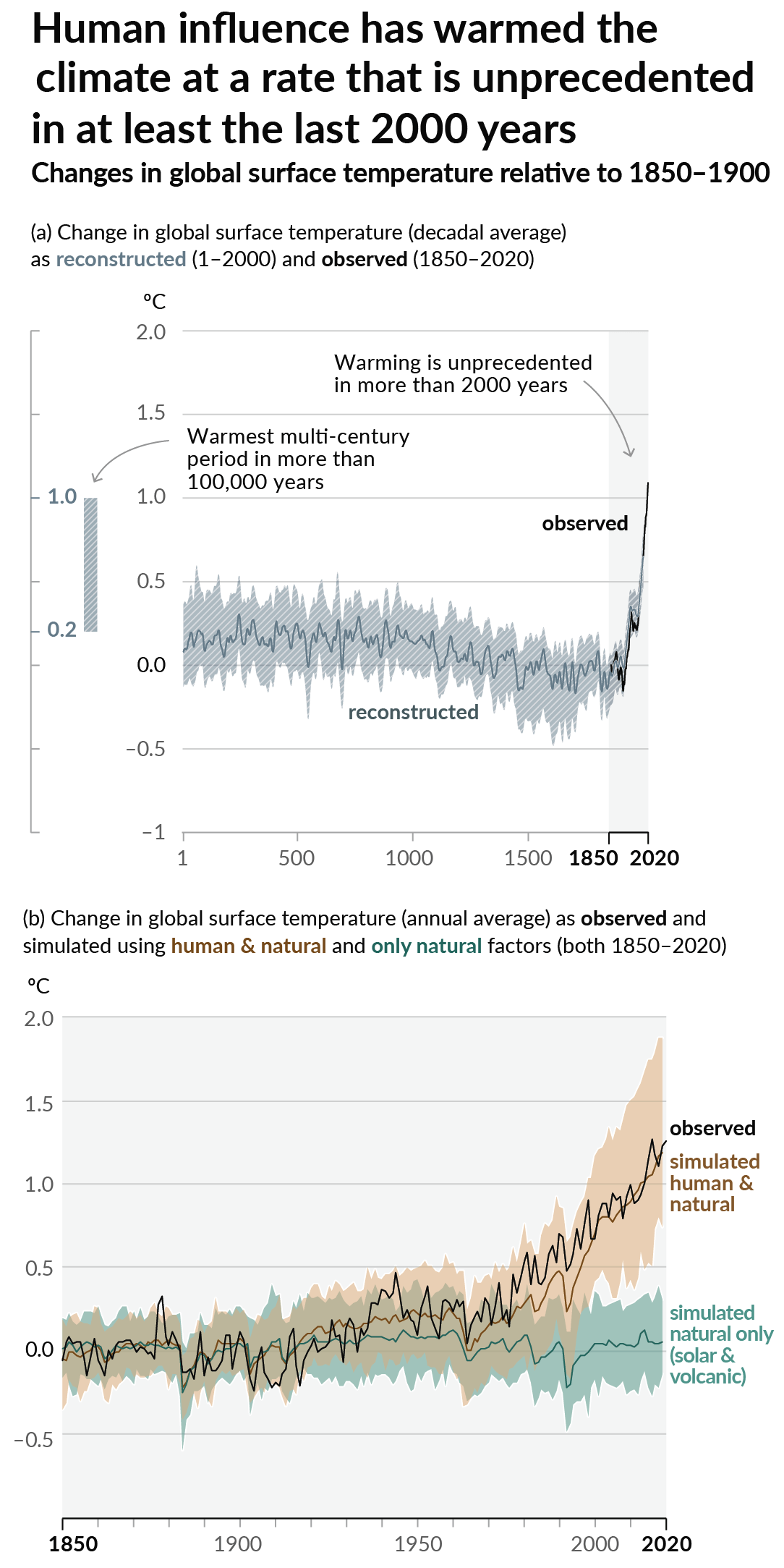
As a starting point, the burning of fossil fuels, and to a lesser extent deforestation and release of methane are responsible for the warming in recent decades: Graph of temperature as observed with significant warming, and simulated without added greenhouse gases and other anthropogentic changes, which shows no significant warming

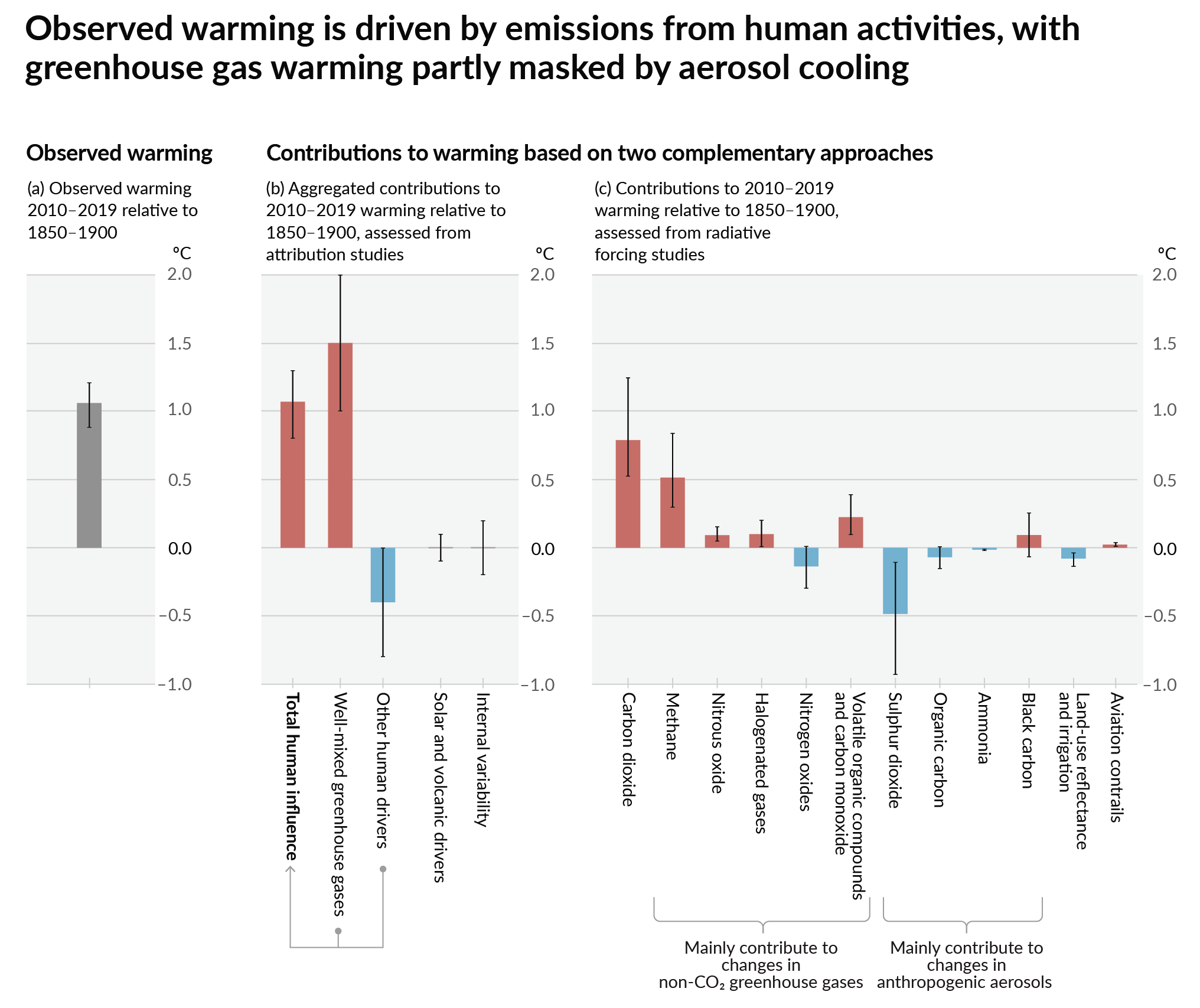
How much each change to the atmosphere has warmed the world: IPCC AR6 Figure 2 - Thee bar charts: first chart: how much each gas has warmed the world.  About 1C of total warming.  Second chart:  about 1.5C of total warming from well-mixed greenhouse gases, offset by 0.4C of cooling from aerosols and negligible influence from changes to solar output, volcanoes, and internal variability.  Third chart: about 1.25C of warming from CO2, 0.5C from methane, and a bunch more in small quantities from other gases.  About 0.5C of cooling with large error bars from SO2.

Recommended actions to cut greenhouse gas emissions in the near future:

Anti-science, inactivism, and unsupported conspiracy theories are not ok here.

founded 2 years ago
MODERATORS