this post was submitted on 30 Dec 2024
1479 points (98.7% liked)
Microblog Memes
11540 readers
314 users here now
A place to share screenshots of Microblog posts, whether from Mastodon, tumblr, ~~Twitter~~ X, KBin, Threads or elsewhere.
Created as an evolution of White People Twitter and other tweet-capture subreddits.
RULES:
- Your post must be a screen capture of a microblog-type post that includes the UI of the site it came from, preferably also including the avatar and username of the original poster. Including relevant comments made to the original post is encouraged.
- Your post, included comments, or your title/comment should include some kind of commentary or remark on the subject of the screen capture. Your title must include at least one word relevant to your post.
- You are encouraged to provide a link back to the source of your screen capture in the body of your post.
- Current politics and news are allowed, but discouraged. There MUST be some kind of human commentary/reaction included (either by the original poster or you). Just news articles or headlines will be deleted.
- Doctored posts/images and AI are allowed, but discouraged. You MUST indicate this in your post (even if you didn't originally know). If an image is found to be fabricated or edited in any way and it is not properly labeled, it will be deleted.
- Absolutely no NSFL content.
- Be nice. Don't take anything personally. Take political debates to the appropriate communities. Take personal disagreements & arguments to private messages.
- No advertising, brand promotion, or guerrilla marketing.
RELATED COMMUNITIES:
founded 2 years ago
MODERATORS
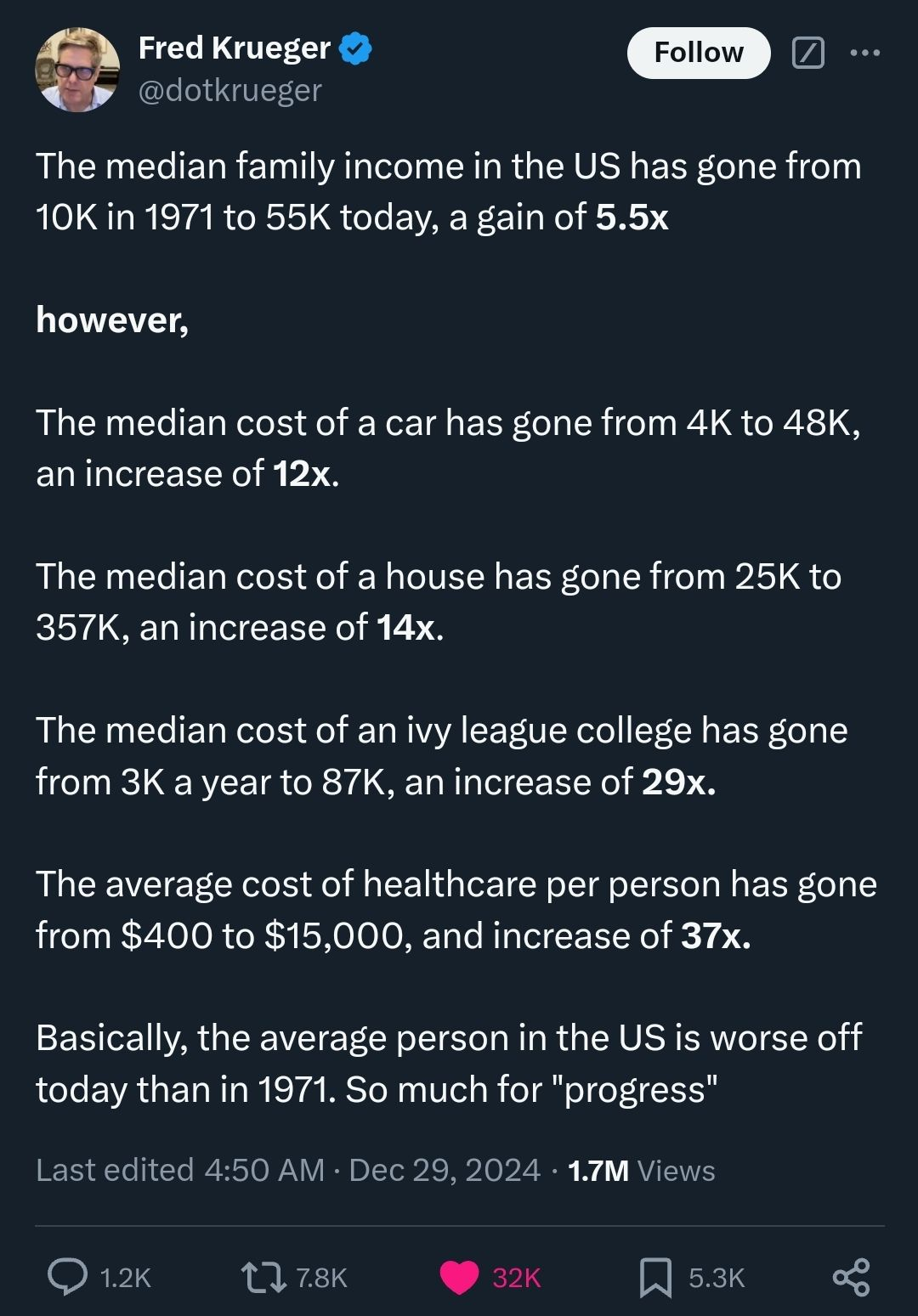
There's another important part of this equation: these are the things being sold. If someone can't afford any car at all, they still wouldn't show up in the entry-level car stats. But I think with how car-centric the US is, there won't be many people going carless? But like you said, if the second hand market is good, everyone could be driving a barely used BMW and they still wouldn't show up in any stats about new cars.
Basically, the only thing these stats tell us is that some people would have to spend a higher proportion of their income if they want to buy these things new. It doesn't tell us if that means they don't buy it, they buy it and go hungry, they buy an alternative, or they buy it without issue (because some other expense is cheaper or disappeared).
Inflation calculations try to account for this by considering a mix of products and services. If everything goes up across the board, people will get in trouble no matter their exact spending habits. You could also look at buying power or discretionary income to see if a population is doing alright.
The prices above increased a little harder than inflation, so you'd expect to see that as a decrease in discretionary income. The same would happen if wages didn't keep up with inflation, which is a happy coincidence? Or exactly what the discretionary income stat is designed to do: show how much financial breathing room people have.