I think the problem is the students are giving too much credence to the monster's monologues, but "He is eloquent and persuasive, and once his words had even power over my [Frankenstein's] heart; but trust him not."
All that aside, you can't look past strangling a 4-year-old boy. It's reasonable to call anything that strangles a 4-year-old boy a monster, even if it felt lonely/abandoned.
And even the monster has the self-insight to know that he's fundamentally evil: "I had cast off all feeling, subdued all anguish, to riot in the excess of my despair. Evil thenceforth became my good."
If you really want an answer, I think we need to start early...
The monster is naive, curious, and good natured at the beginning. Delighted by fire, choosing to touch it - and then feeling pain. No one there to teach right and wrong, or even safe and dangerous. Just a naive child in a grown up body.
He finds a small hovel, and lives there observing. Taking food from them to keep himself fed, later discovering - because no one taught otherwise - that taking from others hurts those people. He doesnt want them to be hurt by him though, so he eats berries and nuts. I think this shows he is good natured, not wanting to hurt others.
Then we have his first interaction with the village. Some run, but others attacked him with stones and other weapons. He even commented not only that he was physically hurt, but seriously hurt by them (I think "grievously bruised" is the right quote).
He hid in a place so far removed from the village that the cottages seemed like palaces in comparison. He understands he looks different than others, but didnt understand how his looks would make him not just shunned, but hated. The villagers based everything on how he looked, and now this naive and good natured being had a direct look at just absolute cruelty.
Skipping ahead, the final part that makes him turn to being cruel himself is being told he will be alone, always.
At this point he hasn't experienced kindness from others, just cruelty. The neglect, the hopelessness, the physical pain from being attacked - this is the only expression towards others he experienced himself.
So the abused becomes an abuser. He takes out the pain and anger on others, showing them the pain he felt. He knew only pain and being alone, and his rage at his creator made him want his creator to feel the same.
I'd say its a pretty obvious tale of victim becoming the perpetrator.
I agree, the creature (monster?) is not innocent, and eventually becomes a monster but Victor himself absolutely is a monster, from the beginning. He gets into an absolute fervor to create life from nothing but cadaver parts, finally succeeds, only to abhor what he created. But then, the creature, seeking guidance and understanding is shunned at every opportunity, treated as an aberration, and vilified by Victor... for simply existing.
The book was a very difficult read for me, as Victor makes the wrong choice at literally every turn, but somehow still places the blame externally onto his creation. How it ended was for the best, for all parties involved.
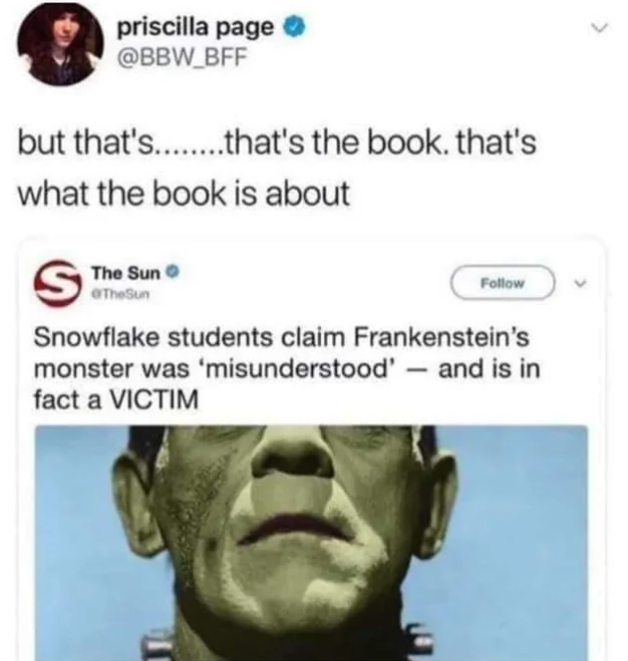
Breaking news: in act of gross defiance, student reads book
I think the problem is the students are giving too much credence to the monster's monologues, but "He is eloquent and persuasive, and once his words had even power over my [Frankenstein's] heart; but trust him not."
All that aside, you can't look past strangling a 4-year-old boy. It's reasonable to call anything that strangles a 4-year-old boy a monster, even if it felt lonely/abandoned.
And even the monster has the self-insight to know that he's fundamentally evil: "I had cast off all feeling, subdued all anguish, to riot in the excess of my despair. Evil thenceforth became my good."
I think too many are equating being a victim with being innocent.
There are two kinds of people in the world, abusers and victims, with no overlap or nuance whatsoever /s
What's the worst thing done to the monster, in your opinion?
If you really want an answer, I think we need to start early...
The monster is naive, curious, and good natured at the beginning. Delighted by fire, choosing to touch it - and then feeling pain. No one there to teach right and wrong, or even safe and dangerous. Just a naive child in a grown up body.
He finds a small hovel, and lives there observing. Taking food from them to keep himself fed, later discovering - because no one taught otherwise - that taking from others hurts those people. He doesnt want them to be hurt by him though, so he eats berries and nuts. I think this shows he is good natured, not wanting to hurt others.
Then we have his first interaction with the village. Some run, but others attacked him with stones and other weapons. He even commented not only that he was physically hurt, but seriously hurt by them (I think "grievously bruised" is the right quote).
He hid in a place so far removed from the village that the cottages seemed like palaces in comparison. He understands he looks different than others, but didnt understand how his looks would make him not just shunned, but hated. The villagers based everything on how he looked, and now this naive and good natured being had a direct look at just absolute cruelty.
Skipping ahead, the final part that makes him turn to being cruel himself is being told he will be alone, always.
At this point he hasn't experienced kindness from others, just cruelty. The neglect, the hopelessness, the physical pain from being attacked - this is the only expression towards others he experienced himself.
So the abused becomes an abuser. He takes out the pain and anger on others, showing them the pain he felt. He knew only pain and being alone, and his rage at his creator made him want his creator to feel the same.
I'd say its a pretty obvious tale of victim becoming the perpetrator.
I agree, the creature (monster?) is not innocent, and eventually becomes a monster but Victor himself absolutely is a monster, from the beginning. He gets into an absolute fervor to create life from nothing but cadaver parts, finally succeeds, only to abhor what he created. But then, the creature, seeking guidance and understanding is shunned at every opportunity, treated as an aberration, and vilified by Victor... for simply existing.
The book was a very difficult read for me, as Victor makes the wrong choice at literally every turn, but somehow still places the blame externally onto his creation. How it ended was for the best, for all parties involved.