58
i++
(programming.dev)
Welcome to Programmer Humor!
This is a place where you can post jokes, memes, humor, etc. related to programming!
For sharing awful code theres also Programming Horror.
Isn't the evaluated value different from the expression?
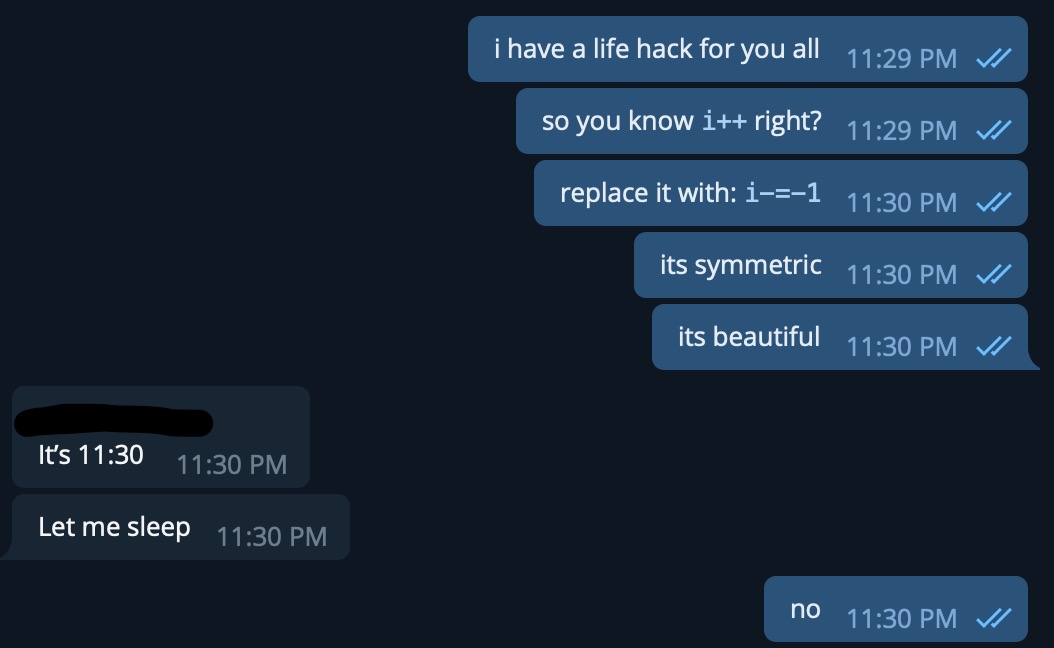
i++returns the value of i before increasing.i-=-1would return the value after it has been increased. Wouldn't it be more correct to make it equal to++iIn the languages I know,
i-=-1orx=3are not expressions, but rather statements, so they do not evaluate to a value.So, this would be a compiler error:
Well, not all languages allow for fun programming :)
I gave it a shot in Compiler Explorer, with the following code:
GCC takes the
i-=-1and optimizes it intoADD DWARD PTR [rbp-4], 1, and changing it around to++iori++makes no difference.So, at least in C and C++, it works all the same. Even on unsigned integers.
It works the same because the value of the last expression in the
forloop is not used for anything. It's the side effect of that statement that counts. Eg, the value ofiis checked the next time the for loop is executed by the condition check. Try replacingiin the condition check instead withi++or++iand you would see different results.Something like:
for (int i = 0; ++i < 10;) { ... }Please explain in less detail to help me understand, internet friend.
And that's why post- and pre-increment is non-existant in Python and Rust. It's an easy source for bugs for a noncritical abbreviation🤷
They're especially also a source of bugs, because they encourage manually incrementing indices and manually accessing array positions, which is almost never actually sensible.