749
you are viewing a single comment's thread
view the rest of the comments
view the rest of the comments
this post was submitted on 28 Feb 2024
749 points (96.2% liked)
Comic Strips
23252 readers
694 users here now
Comic Strips is a community for those who love comic stories.
Rules
-
😇 Be Nice!
- Treat others with respect and dignity. Friendly banter is okay, as long as it is mutual; keyword: friendly.
-
🏘️ Community Standards
- Comics should be a full story, from start to finish, in one post.
- Posts should be safe and enjoyable by the majority of community members, both here on lemmy.world and other instances.
- Any comic that would qualify as raunchy, lewd, or otherwise draw unwanted attention by nosy coworkers, spouses, or family members should be tagged as NSFW.
- Moderators have final say on what and what does not qualify as appropriate. Use common sense, and if need be, err on the side of caution.
-
🧬 Keep it Real
- Comics should be made and posted by real human beans, not by automated means like bots or AI. This is not the community for that sort of thing.
-
📽️ Credit Where Credit is Due
- Comics should include the original attribution to the artist(s) involved, and be unmodified. Bonus points if you include a link back to their website. When in doubt, use a reverse image search to try to find the original version. Repeat offenders will have their posts removed, be temporarily banned from posting, or if all else fails, be permanently banned from posting.
- Attributions include, but are not limited to, watermarks, links, or other text or imagery that artists add to their comics to use for identification purposes. If you find a comic without any such markings, it would be a good idea to see if you can find an original version. If one cannot be found, say so and ask the community for help!
-
📋 Post Formatting
- Post an image, gallery, or link to a specific comic hosted on another site; e.g., the author's website.
- Meta posts about the community should be tagged with [Meta] either at the beginning or the end of the post title.
- When linking to a comic hosted on another site, ensure the link is to the comic itself and not just to the website; e.g.,
✅ Correct: https://xkcd.com/386/
❌ Incorrect: https://xkcd.com/
-
📬 Post Frequency/SPAM
- Each user (regardless of instance) may post up to five (5 🖐) comics a day. This can be any combination of personal comics you have written yourself, or other author's comics. Any comics exceeding five (5 🖐) will be removed.
-
🏴☠️ Internationalization (i18n)
- Non-English posts are welcome. Please tag the post title with the original language, and include an English translation in the body of the post; e.g.,
Sí, por favor [Spanish/Español]
- Non-English posts are welcome. Please tag the post title with the original language, and include an English translation in the body of the post; e.g.,
-
🍿 Moderation
- We are human, just like most everybody else on Lemmy. If you feel a moderation decision was made in error, you are welcome to reach out to anybody on the moderation team for clarification. Keep in mind that moderation decisions may be final.
- When reporting posts and/or comments, quote which rule is being broken, and why you feel it broke the rules.
Web of Links
- !linuxmemes@lemmy.world: "I use Arch btw"
- !memes@lemmy.world: memes (you don't say!)
founded 2 years ago
MODERATORS
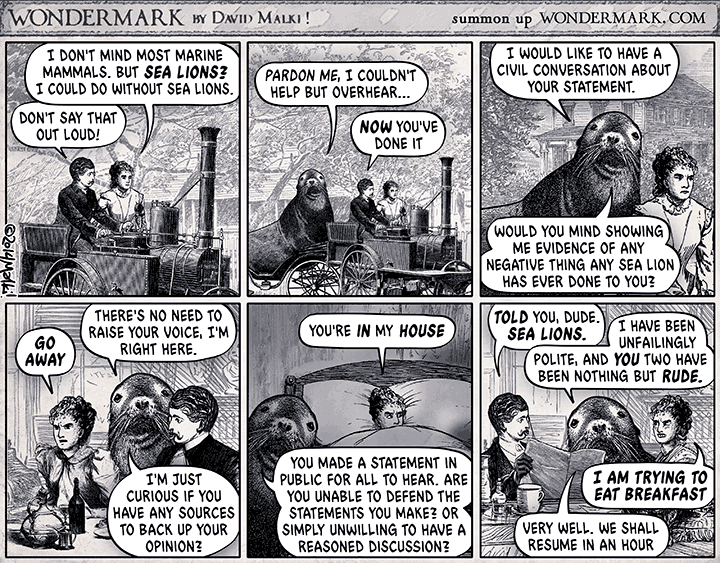
No, a lot of terms for people arguing in bad faith have originated on the internet because there's a lot of different bad faith arguments on the internet.
Confusing sealioning and other bad faith arguing with "people that I don't like" is a classic and common example of the bad faith trope called a strawman.
It absolutely does. You can't have a rational discussion with someone arguing in bad faith. Someone who's wrong or seemingly wrong but arguing in good faith might learn something or cause you to learn something, whereas someone arguing in bad faith is only interested in "winning" and completely closed off to even the most valid counterpoints.
It really really isn't. That you keep going on about this misconception implies that you've often been correctly accused of arguing in bad faith and are trying to fend that off by convincing others that there's no such thing as bad faith, only subjective dislike. Which is objectively wrong.
The real irony is that you're trying to terminate the thought that bad faith arguing exists via a bad faith use of a thought-terminating cliché.
Again objectively false and saying a lot more about how YOU argue on the internet than internet discussion in general.
While that's technically true, it's much easier to know how to deal with something when you know WHAT you're dealing with, whether you say it out loud or not.
That's just ridiculously false. Couldn't be further from the truth.
...arguing in bad faith IS by definition a way of arguing incorrectly.
Sure, but simple doesn't always mean easy. Especially when you have poor impulse control and were brought up to consider it incredibly rude and disrespectful to not answer when someone's trying to explain you something, whether they're right or wrong.
See so my kneejerk response to this on seeing it, is, oh, someone's going, literally line by line of my comment, and, line by line, refuting what I say. That's what I would classically kind of think of as, oh, this is a bad faith argument, especially because you extrapolate from my post and say, oh, you must've been accused of arguing in bad faith constantly, and are trying to convince everyone that bad faith arguments are actually epic and cool! This is not the case, that's not what I'm really arguing. Despite these somewhat clear signals, in my mind, I'm going to respond, because I'm a hypocrite, of course.
I'm not disputing the actual definitions of sealioning or strawmanning, or that these can be potentially useful terms, what I'm doing is I'm saying that people should put more thought into what it is other people are actually doing with their argument, and what it is that they want out of their engagement with other people, rather than just labeling someone else as something, and then going about their day.
That doesn't really help anyone, it's just a kind of self-satisfying thing to do. Anyone reading the comment has to trust that the person doing the labeling is doing it correctly, and to responsibly confirm that, they're going to have to have read the preceding comment and made their own mind up about it. So it's not helpful to just label something as "misinformation", and then move on as though you've provided some sort of divinely ordained moral service to everyone passing by. I've encountered that sort of mentality before, that debates aren't really done out of like, an intellectual curiosity, or to kind of, talk through your own viewpoints while listening to someone else and they're input, they're done for some third party audience. Which I think is, you know, a less helpful way of viewing debates, viewing arguments. Less helpful for a third party, but also less helpful for yourself. If you're doing it correctly, it shouldn't matter much whether or not your opposition is arguing with you in bad faith, because you, and everyone else, should still be able to get something out of it.
I'd also say, a bulk of my point was in the latter half of my comment, the part that you didn't respond to line by line. My point is that, realistically, bad faith arguments can come from anywhere, even from people who insist and fully believe that they're not arguing in bad faith, i.e. people who are actually arguing in good faith and just doing so really poorly because they're dumb. This being the case, that the signals are kind of indistinguishable, and it also being the case that bad faith arguments are kind of, doomed to happen, my advice is that people should either ignore them completely, and not let them kind of, occupy as much free rent as they do, in their minds, or they should work to try and get something out of them despite their bad faith. That was the point I intended to make. Arguing in such a manner, is more beneficial to an observing third party, it can potentially solve the problem of separating signals between bad faith arguers, and poor arguers, and it can help you figure out what your real opinion is on something, and make you better at debate.
Edit: To clarify, what I'm arguing against in my post is people who just summarize someone's argument as "oh, here's a list of all the logical fallacies you've performed", and then they haven't done any of the work to say why that's important, or how those fallacies affected something. I don't think that's a helpful function, to anyone, and it leads to a bunch of people who don't know what any specific fallacy is, other than that it's something that they can just kind of slap onto arguments they hate.
Strawman is a pretty common fallacy that I've noticed this happen to. I'd also like to comment that, you know, sure, am I creating a strawman by arguing against that type of behavior? I don't fuckin know. I was under the impression that a strawman was when you were arguing against someone, and then you basically put words in their mouth and extrapolate positions in their argument that they never really took. When I posted that comment, I wasn't arguing against any specific person, I was just commenting about a general thing I've experienced. I wasn't putting words in anyone's mouth, because I wasn't responding to anyone.
When someone incorrectly labels you as sealioning that’s called wondermarking. So you can smugly ignore the other person, they are just wondermarking.
We're all on the internet, you can look up the actual definition for "strawman" like I just did.
To paraphrase: strawmanning an argument is not so concretely about "putting words in anyone's mouth".
It is the process of debating a newly-created stance/position/idea that is easily disproven and visibly flawed when this new position may or may not be related to anything in the pre-existing debate. You don't have to be 'responding to anyone'; in fact, it fits more if you are not arguing something that anyone in the debate has referenced before.
After the first few sentences I just read ARPARPARPARPARPARPARPARP
anyone else?
Nah, that's just you.
Welllllll,at least now I know. It was way too much to read tho
"cuntiness"
No thanks, I already ate
There's always room for pussy!