28
There's the ideological reasons that all historically conscious leftists know about and while they were the pretexts for the split, I've come to the position over time that they don't represent the core issue that initiated it. As such, there's a fundamental relationship dynamic that should be clarified before anyone gets into studying the deeper weeds of the various grievances that propelled the split. This dynamic is also the principal lesson of value to AES and socialism today which to learn from in preventing such a catastrophic inter-fraternal relationship rupture from repeating itself under the same lines.
As a background, I would argue that the fundamental problem with the entire Comintern movement post-WWII was that it took the system of democratic centralism from the state level to the inter-state level. This was driven by the noble goal of finally breaking down the petty national divisions that bound human society for all of its existence through grasping the historic opportunity presented by the 20th century socialist revolutions and the historic atmosphere of internationalism.
The problem is that, in practice, inter-state democratic centralism led essentially de facto to the leadership of the socialist bloc by the first worker's state, the USSR. This would not be so intolerable if it weren't for the coincidence that nearly all socialist states that came into existence after WWII, with the sole exception of the DDR, were countries that had been the historic victims of colonialism and imperialist control where the indigenous populations had always yearned to finally take control of their own nations. This was true across the socialist world - of Poland, of Czechoslovakia, of Yugoslavia, of China and of the DPRK. The socialist revolutions were therefore also simultaneously struggles for national liberation. For these countries to win their independence and sovereignty - only to immediately be expected to subsume themselves under Comintern democratic centralism as led by the USSR - posed a serious tension that eventually snapped to catastrophic consequences. Comintern internationalism and inter-state democratic centralism were therefore arguably noble ideas, yet also ultimately idealistic, utopian and unfortunately ahead of their time. Implemented in the context of the mid-20th century, they could only end up clashing with the historical conditions of the USSR's new fraternal socialist partners.
No Soviet leader seems to have truly ever grasped this contradiction, including Stalin. The split with Yugoslavia, through his quite heavy-handed attempt to depose Tito within the CPY and then expelling Yugoslavia from the Comintern, was one of Stalin's actual and serious errors. Kate Hudson's work "Breaking the South Slav Dream: The Rise and Fall of Yugoslavia" argues that this was all precipitated by Tito's refusal to submit to Soviet supervision of its foreign policy under Comintern democratic centralism. MLs of the day largely sided with the USSR and denounced "Titoism" for its introduction of market forces as a horrifying betrayal. Tito's refusal to submit to democratic centralism (i.e. the CPSU) was then portrayed as akin to Trotsky's own actions. Obvious, given the conditions of AES today, principled MLs are more sympathetic to the aims of the CPY, but the Yugoslavs at the time were virtually ostracized. Yugoslavia was then isolated from the entire socialist bloc with all Soviet aid withdrawn and it is alleged by Hudson that the CPSU promoted several purges in the other Parties in Europe to remove "Titoist sympathizers."
This inevitably forced the SFRY to turn to the West and exacerbated its experiment with market socialism, which the USSR denounced, into an outright submission to Western capital in many aspects in order to receive desperately needed assistance for its post-war reconstruction, introducing various institutional contradictions that would later culminate in the IMF debt spiral that the SFRY found itself in the 1980s. The refusal by the CPSU to allow Yugoslavia to propose a Balkan federation with Bulgaria was also perceived by the CPY as Moscow's fear of an enlarged socialist state becoming a rival within the Comintern. The situation deteriorated to the extent that the West's scaremongering tactic of the week became that of the "imminent Soviet invasion of Yugoslavia."
The fracture between the CPSU and the CPY echo the later Sino-Soviet quite tellingly and this is likely by its nature indicative of a general defect in Soviet inter-socialist state policy. In 1989, Deng gave an extremely frank speech to Gorbachev during the latter's state visit on the history of Sino-Soviet relations from the Chinese perspective and he himself characterized it like this:
I should say that starting from the mid-1960s, our relations deteriorated to the point where they were practically broken off. I don’t mean it was because of the ideological disputes; we no longer think that everything we said at that time was right. The basic problem was that the Chinese were not treated as equals and felt humiliated. However, we have never forgotten that in the period of our First Five-Year Plan the Soviet Union helped us lay an industrial foundation.
If I have talked about these questions at length, it is in order to put the past behind us. We want the Soviet comrades to understand our view of the past and to know what was on our minds then. Now that we have reviewed the history, we should forget about it. That is one thing that has already been achieved by our meeting. Now that I have said what I had to say, that’s the end of it. The past is past.
More contacts are being made between our two countries. After bilateral relations are normalized, our exchanges will increase in depth and scope. I have an important suggestion to make in this regard: we should do more practical things and indulge in less empty talk.
https://www.marxists.org/reference/archive/deng-xiaoping/1989/196.htm
The Soviet policy of Comintern and socialist bloc leadership through a form of inter-state democratic centralism by design prevented the treatment of fraternal states as equals. There was already the power, resource and economic asymmetries between the USSR and every other socialist state that prevented any claim to equality on material grounds and all of that combined with such a policy meant counterparts like Yugoslavia and later China found it difficult to see the relationship as one between equals. Given that the USSR's socialist partner states were nearly all countries with histories of national subjugation and thus had a particular desire to be treated as a sovereign and independent polity for once, the potential for relationship conflicts was, in a sense, inevitable and such a dynamic of "inequality" was what Deng himself identified as the actual root problem that defined the Sino-Soviet relationship.
To that end, it could be argued that the USSR carried through with such a mentality all the way to the very end with Gorbachev, who completely went over Honecker's head to discuss the terms of selling out the DDR to Kohl and the US directly, something that Honecker's memoirs written in jail (after being sold out by Yeltsin who allowed him to be extradited from Moscow to the former DDR in a perverse BRD orchestrated show trial on his "crimes") bitterly recount.

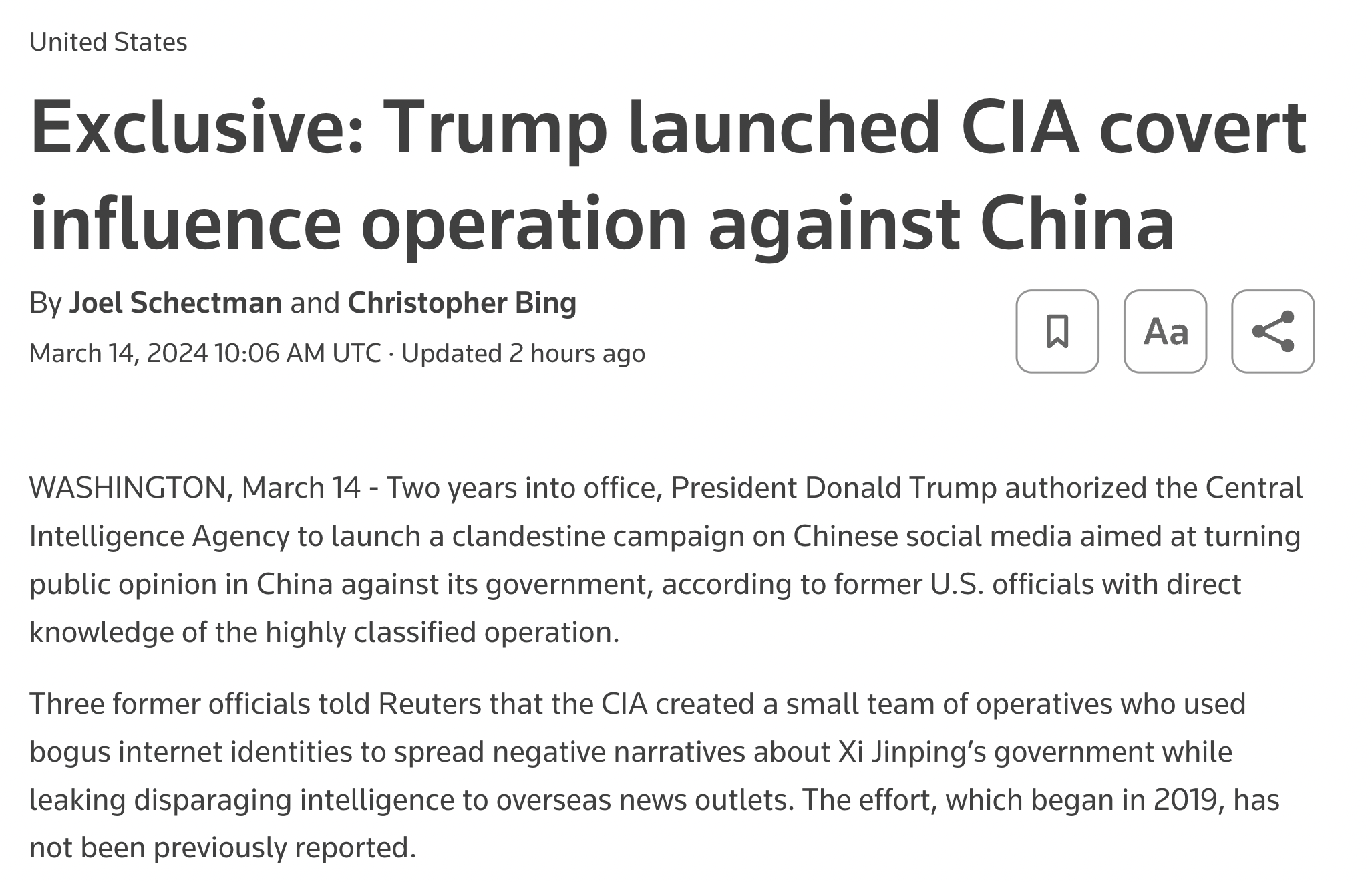
Interestingly, Russian media is corroborating the Reuters report that Putin has leaned into the "DPRK personnel in Russia" topic during a BRICS presser:
I think this sort of "wink wink" non-denial from Putin really does suggest that DPRK military personnel are not just "in the Russian Federation" but somewhere substantive, perhaps specifically, in the Kursk region, most likely observing but also potentially providing auxiliary or technical assistance. The recent agreement that was just signed between Russia and the DPRK was a mutual assistance treaty and something of that sort would provision for the possibility of DPRK military support in the event of legitimate attack, which Ukraine indeed is conducting through its assault on actual Russian territory in Kursk.
This would hypothetically square the hemming and hawing from the West about the topic and is likely why most of the Western narrative on the "DPRK intervention" so far has had this tortured vocabulary of ambiguously accusing the DPRK of entering into the conflict without often explicitly stating that the DPRK personnel are in Ukraine itself. It explains how much of the coverage is more focused on that South Korean comprador president's threats of retaliation rather than taking a microscope to the alleged DPRK act itself.
It's therefore worth assessing this hypothetical scenario properly. The implications of this would be enormous, if true. For Russia, I'd say there's always been a sense from their side that they've been searching for a way to make Ukraine recognize some consequence for taking the fight into actual Russian territory (beyond the historical irony of attacking Kursk). The activation of a mutually defensive pact would be a way to do it, that can also be justified in terms of international law. The ability to reply to the Kursk incursion, which is costing Ukraine nothing but its least prized commodity - its people - by claiming the Ukrainian propaganda stunt triggered a Russian defensive pact clause would be the type of assertive rejoinder sufficient to deflect the passive image of being caught on the backfoot and stuck playing a reactive role, which is the Western narrative being pushed to create through the incursion.
As for the DPRK, if its relationship with Russia really has developed to such a public extent, I'd call this, without exaggeration, the most momentous paradigm shift in East Asian geopolitics since the DPRK's nuclear proliferation in the 2000s or even the collapse of the USSR. Especially if the South Korean lackey leadership is compelled, optics-wise, to respond to the DPRK's potential participation. This would begin a series of brinksmanship that binds the South Korean (and US) side in a Catch-22. Neither South Korean chaebol military boondoggles nor forcibly conscripting K-Pop stars into Ukraine would be ultimately relevant in shifting the fundamental NATO inability to alter the material conditions of the Russian attritional grind against Ukraine.
More importantly, given that the half-hearted character of the US role in Ukraine is being self-rationalized by the Pentagon as purely due to it "saving itself" for the great fantasized showdown against China, the diversion of any South Korean materiel and manpower away from the East Asian theater would be detrimental to the overall US military objectives of being still unable so far to fulfill that "Pivot to Asia." The idea that South Korea entering on the Ukraine side would bind irrevocably it to NATO and thus preventing such a scenario is "vital" can only come from a failure to appreciate that occupied Korea already hosts the largest US military presence on the planet apart from that within the former Axis Powers and therefore it was always going to be made to latch to the US side, willingly or not, when the moment finally comes. Furthermore, the fact that China is still officially "uninvolved" means that the Yoon government in Seoul would be restricted from using this opportunity to fully declare its subservient alignment towards NATO.
The more important factor is that the DPRK, through this hypothetical action, would put Yoon an impossible position. Responding to the brinksmanship would, for one, confirm their administration's tenure as likely the most deteriorated position since the Korean War itself and while the Korean Milei has been all too happy to sacrifice his country for US geostrategic aims whenever possible, something like this would likely be an outcome far beyond the administration's initial anticipations. Responding through parallel support for Ukraine would obviously also deteriorate South Korean relations with Russia and this is the most important thing. The DPRK's bilateral relations has always been, in truth, trilateral where Seoul rears its head akin that consent meme asking "Isn't there someone you forgot to ask?" Seoul has been able so far to leverage this since the DPRK's nuclear proliferation to isolate Pyongyang from its two major partners, China and Russia.
Gradually, this has become a zero-sum game to the DPRK's detriment, as South Korea has been able to leverage its economic relationship with China and Russia to make them reluctant to sacrifice this established trade relations in order to support the DPRK. We can see this similarly play out with Cuba, where despite the desperate current conditions of the heroic Cuban Republic, both Chinese and Russian support is still being limited by compliance to the threat of American reprisal. Seoul sending military support to Ukraine would give Russia a legitimate pretext to justify tanking its economic ties with it and reorientate Russia more firmly with the DPRK, something which previous administrations in Seoul had painstakingly crafted to be impossible for the Russian cost-benefit economic calculus to consider in normal conditions. This would be something comprador Yoon would be made to throw away for the sake of retaliatory optics and adherence to US vassalage, thereby inadvertently rendering renewed DPRK-Russia ties feasible, potentially even to the height it once had been under the USSR. Restoring the DPRK's relationship with Russia from an implicitly trilateral to a definitively bilateral dynamic would end the era of isolation it has been held under since its nuclear proliferation and would thus have a dramatic effect on its material conditions.
Even if Seoul merely gnashes its teeth and refrains from substantive action, this episode has already resulted in the fait accompli of strengthened DPRK-Russia relations. Of course, all of this is merely hypothetical and contingent on the actual circumstances of the alleged "DPRK presence" in Russia, but given a mutual defensive treaty has already been signed, what has already occurred has been a badly needed step forward for the DPRK.
Update from Korean Central News Agency (English Translation by KCNA):