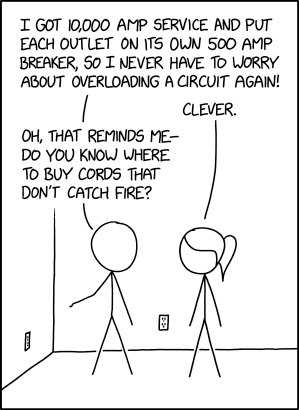
Alt-text should be "Resistance is futile".
"Who did the electrical work in this house?"
"That would be my nephew Thomas, he's very handy."
"When Thomas's house burned down?"
"Oh about two years ago, how did you know."
did xkcd just watch the new styropyro video
Apparently you saw that 400 battery video too.
You break ohms law. Its the death penalty for you.
Good old incandescent extension cords
They're all incandescent if you're not a quitter.
Also everything is a fuse

Wait, I never noticed!
I can use a fuse with a safe value and still get tasty molten cheese every time I need to replace it?
mechanic: So, does it make any noises or can you smell anything burning?
customer: I can't really hear anything, maybe a little hiss or sizzle once in a while. And nothing burning that I can smell. It actually smells really good and I'm getting hungry!
mechanic: aha! I got u fam.
Every circuit has a circuit breaker, it's just that sometimes the circuit breaker is the power cord or the product itself
If each outlet is its own breaker.. what's he running that's goong to melt those wires?
Unless he has some 16 gauge extension cords going to an electric dryer or something...
what’s he running that’s goong to melt those wires?
500A on a 110V (220V?) main is a lot of W.
Yea, but what device draws that much power. In the us, most space heaters are 1200w, so about 10 amps. So he'd need to really have a high load device. You might be able to find some 30amp single phase loads.
Putting them all on their own circuit does so much to actually protect him unless he has various extension cords or those 2 receptacle to 6 receptacle devices.
For 500 amps, he should be running 1000 gauge wire. Which would be so impressive to run since each leg would be almost an inch and a half thick and $50 a foot. Each breaker would be over $2k, if he went with the cheapest 500amp breaker.
In the US, most protection comes from the breaker. It's not common (or at least, not standard) to have overcurrent protection on extension cords, power strips, or even the outlet itself. And for typical wiring and uses, it usually works well enough. But it is possible to connect a space heater or hairdryer (1500w and 1800w respectively, due to the 80% rule for continuous draw) to that standard 16-gauge extension cord, or connect multiple space heaters to one circuit. Some homes are wired.... Creatively.... Making it easy to do. In these cases, you're relying on the 15-amp breaker to trip, which would happen quickly. Not quite as quick, but still happens on a 20-amp. But it might melt a 15-amp receptacle first
If it's a 30-amp circuit, it won't trip at all, unless the outlet melts to a short. And this is all assuming the wiring in the wall is rated for that amperage, which is implied but not stated. There are certainly a number of stories where someone upgraded the breaker to keep it from tripping, but didn't upgrade the wiring.
If we assume he's talking about the wiring in the wall, this gets very simple. I once lived in a place where the upstairs bedroom and downstairs living room were on the same circuit. I currently live somewhere where a single circuit controls ALL of the bathroom outlets (multiple bathrooms), the garage, as well as outside outlets. Apparently GFCI outlets were more expensive than the entire mess of running copper all over the place.
Reminder the size of breaker in the US electric code is to protect the wire and receptcle. After that you're in someone elses hands.
Eh, ~zero impedance house circuits won't do anything bad to normal electronics - it'll just make sure no fires happen in your walls. I do almost all home wiring in 12 gauge and larger for this reason
Actually, the comic only has 500A breakers and don't say anything about wires. Recipe for fire!
I think that's the joke, especially since the alt text asks about getting melted copper off the carpet.
xkcd
A community for a webcomic of romance, sarcasm, math, and language.