328
full egoism
(quokk.au)

I see this is a recurring pattern on reddit.
The west kills 100s, no problem. The oppressed fights back, "why are you guys cheering violence" and similar takes popup like clockwork.
It's almost like there's a conceited effort to make the oppressed more complacent so they have a monopoly on violence.


This is what we should have statues of in our town squares.

"lmao cope"
BANG
"But if you sting me," said the frog, "we both will drown."
"lol," said the scorpion, "lmao."
I would happily kill "holden bloodfeast". I state that boldly.
Genuine question, though, and not one I really have an answer for - at what point do we regard the existence of the tools more dangerous than the existence of the monsters?
That’s always been a valid line of critique. Pursue it far enough back and you end up arguing that agriculture was a mistake and that we should return to the nomadic hunter-gatherer lifestyle.
From what I’ve heard of the lives of hunter-gatherers (lives of leisure, culture, community, and song), it’s hard for me to think of much of a counter-argument apart from modern medicine and especially maternal health care. Everything else comes with tradeoffs.
Sigh.... Alright I'll say it:
Agriculture was a mistake and we should return to the nomadic hunter-gather lifestyle.
Unironically. Not /s.
This was all a horrible mistake.
That’s always been a valid line of critique. Pursue it far enough back and you end up arguing that agriculture was a mistake and that we should return to the nomadic hunter-gatherer lifestyle.
The issue is that that doesn't really solve the problem. The tools of oppression are dismantled, but the tools to combat oppression are also dismantled. At best, you've reduced the capacity of material accumulation to create hierarchies; at worst, you've given all power in hierarchy to slick charlatans and literal strong men regardless of what contributions, organizational or material, they make to society.
It would be like proposing to end violence by destroying all firearms. It changes the form of the hierarchy, the form of the violence, but not the problem of its continuation. And, arguably, could be said to make it worse. "Be not afraid of any man/No matter what his size/When in danger call on me/And I will equalize" hardly applies to two people with clubs; and melee combat in particular greatly privileges those who obsessively practice over those who have only intermittent or brief practice; hence the 'classic' domination of warrior castes in societies.
From what I’ve heard of the lives of hunter-gatherers (lives of leisure, culture, community, and song), it’s hard for me to think of much of a counter-argument apart from modern medicine and especially maternal health care. Everything else comes with tradeoffs.
That's an... extremely idealized view which doesn't match up with mainstream anthropology. Hunter-gatherer societies tend to be more violent than state societies - even accounting for mass warfare - constant splitting and ethnic tensions are inevitable due to the low carrying capacity of a given region for hunter-gatherer societies, and the leisure in such idealized views is often much exaggerated. Hunter-gatherers still spend a great deal of their time working - it's just that it's less time than a traditional subsistence farmer - and more time than a modern 9-5 office job.
The data is not nearly as clear as you’ve implied. It’s much more clear that there was a lot of violence in the early subsistence agricultural period and much less violence in the period immediately prior to that. This is consistent with theories of food storage raiding and warfare between agricultural villages and their nomadic neighbours. It’s also consistent with the emergence of the warrior caste as a specialization made possible by long term food storage, not a nomadic lifestyle.
But anyway, my critique was never intended to be a solution. I don’t deal in solutions, except when I’m doing math. The real world has very few solutions and very many problems with only tradeoffs between opposing interests.
What I’ve heard of Hunter-gatherer lifestyles comes from first hand accounts of people living the lifestyle, both historically (in the North American colonial period) and in the modern day (anthropologists living in Hunter-gatherer villages).
However, Pinker’s main aim is to compare violence in non-state vs state societies, rather than to rigorously estimate rates of violence in the pre-agricultural period.
... most hunter-gatherer societies are non-state societies; most sedentary farming societies are state or proto-state societies.
Source: Hunter-gatherer data spreadsheet, ‘Deaths/100k ethnographic’ tab
Even there, the data pretty unambiguously puts violent deaths in developed countries far below that of even the most peaceful hunter-gatherers.
*The relatively high rates estimated for the End-Paleolithic and Total Paleolithic are almost entirely due to a single site, Jebel Sahaba
...
*The early agricultural archeological dataset consists of non-state agricultural societies from the early millennia following the adoption of agriculture; in a European context they would be described as ‘Neolithic’
Most neolithic European societies were not wholly agricultural as we would recognize them; permanent settlements only become a regular feature in most of Europe outside of the Mediterannean with the iron age.
The methodology to adjust the figures above necessarily involved a good deal of guesswork and is admittedly non-standard. They should therefore be approached with a good deal of scepticism.
That's an understatement.
The chart below compares our archeological and ethnographic data using the common metric of ‘violent deaths per 100,000 people per year’ (which is preferable to ‘% deaths from violence’ as an indication of how violent a population is).
Uh.
*The early agricultural archeological dataset has been converted into ‘violent deaths per 100,000’ using the same methodology as the pre-agricultural dataset. This is problematic since this methodology assumes that early agriculturalists had the same mortality rate as pre-agricultural people. However, we are not currently aware of a more appropriate mortality rate estimate to use for this conversion
...
In order to make this comparison it was necessary to convert the archeological data from ‘% deaths from violence’ into ‘violent deaths per 100,000 people per year’. We did this by using an ethnographic study of average modern hunter-gatherer mortality rates. How accurate this methodology is therefore depends on how similar pre-agricultural mortality rates were to those of modern hunter-gatherers.
...
Ethnographically observed nomadic hunter-gatherers typically exhibit relatively low rates of warfare relative to other societies.
This is not even close to true.
The most common proximate motivations for violent conflict were probably disputes over women and desire for revenge.
...
Regarding the comparison with the 20th Century, one potentially confounding factor to consider is that people in the 20th Century had access to better medical care than hunter-gatherers. Once we adjust for better medical care, we think it is not obvious whether hunter-gatherer societies actually were more violent than the 20th Century (even though they had higher rates of lethal violence).
This is hilarious considering their previous adjustment to deaths per 100,000 people per year over % of deaths by violence.
Where’s your data?
Better Angels Of Our Nature, for one, the source that this paper is attempting to dispute.
I'm only a fifth of the way through the actual report. I'll certainly have more comments by the end.
If you’re a fifth of the way through, then you missed this part:
96% of human history happened prior to the agricultural revolution; if we only focus on the last 4% of human history, we will get a distorted picture of patterns and long-term trends in human violence.
Pinker’s book doesn’t support your argument because it never attempted to do so. It’s answering a completely different question.
Talking about Hunter-gatherers when they were warring for survival against agriculturists (a 10,000+ year gradual annihilation of Hunter-gatherers leading to the present day, where they’re on the brink of extinction) doesn’t tell you anything about what they were like for the hundreds of thousands of years prior.
96% of human history happened prior to the agricultural revolution; if we only focus on the last 4% of human history, we will get a distorted picture of patterns and long-term trends in human violence.
I didn't miss that part. The argument being made there is self-defeating considering that the attempt to dismiss Better Angels Of Our Nature based on a presentist bias is made immediately before using the exact same kinds of 'last 4% of human history' that BAOON used.
Pinker’s book doesn’t support your argument because it never attempted to do so. It’s answering a completely different question.
... have you read BAOON?
From this very paper, citing Pinker's work:
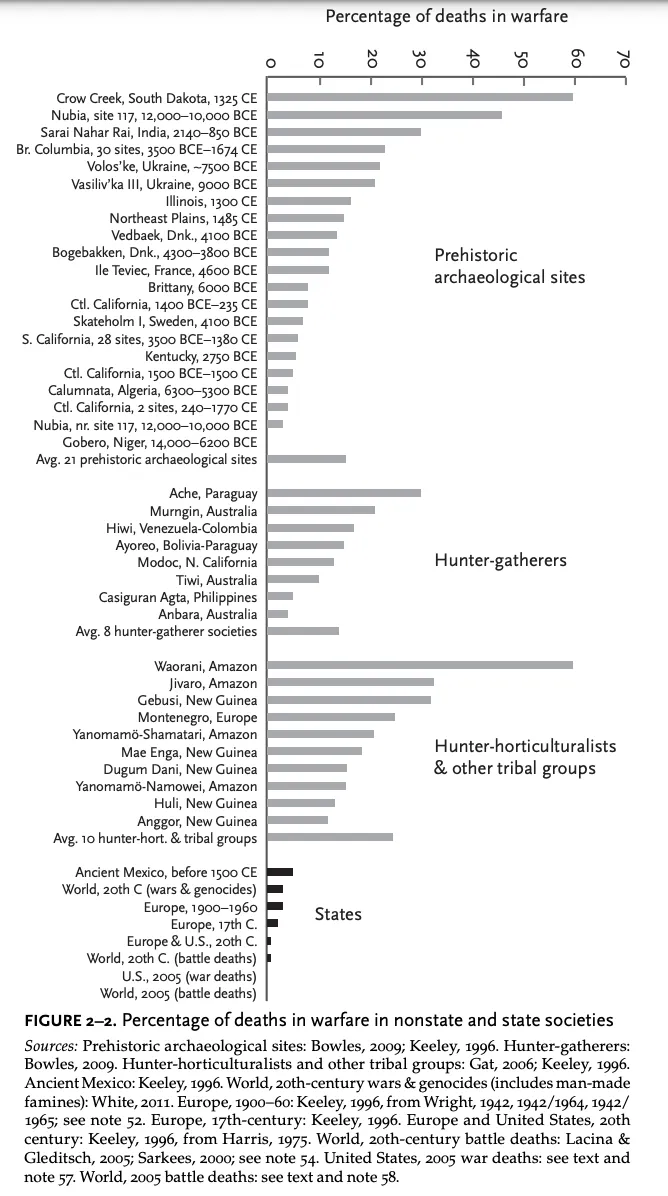
Talking about Hunter-gatherers when they were warring for survival against agriculturists (a 10,000+ year gradual annihilation of Hunter-gatherers leading to the present day, where they’re on the brink of extinction) doesn’t tell you anything about what they were like for the hundreds of thousands of years prior.
In which case I don't know why the fuck you think that this paper, using modern hunter-gatherers who are in almost all cases deeply intertwined with outside state societies, both in culture and material goods, to extrapolate rates of pre-agricultural violence is valid.
Jesus fucking Christ. In a paper about estimating typical hunter-gatherer rates of violence, they cite as a source "Estimated from typical hunter-gatherer mortality rates."
1.4.2. Why do nomadic hunter-gatherers have relatively low rates of warfare?
They rely on a dispersed and diverse resource base which to some degree makes them less subject to sudden, intense resource shocks than farmers
Jesus fucking Christ.
This can't be serious.
They benefit from a ‘sharing economy’ which often extends across large distances, meaning that it is economically advantageous to maintain relations with neighbours (whereas individual agriculturalists typically rely more on their own personal property/land for subsistence)
Fucking what.
Where the fuck do I begin?
Should I start with gift economies being widespread in sedentary societies?
That inter-group resource exchange is much lower in hunter-gatherer societies than in sedentary societies?
That the notion of property is a very late development in sedentary societies?
That transport of goods, and the requisite time and labor necessary, is a major bottleneck for resource exchange, so extending 'across large distances' means that it is not actually fucking economically advantageous compared to sedentary societies?
They live at low population densities so neighbouring groups are often distant, lessening opportunities for conflict (whereas agriculturalists often live very close or even border with neighbouring groups)
They live at low population densities because their form of gathering sustenance can't sustain larger groups. The idea that hunter-gatherers don't 'border with neighbouring groups' is... fuck me, all sorts of absurd.
They are usually egalitarian so they don’t have specialized ‘warrior classes’
Insofar as specialization is not chosen for, sure. But that successful warriors are in the vast majority of hunter-gatherer societies high status and influential by the cultural norms of their society, that doesn't seem like much more than nitpicking over the notion of a warrior caste.
or accord particularly high status to successful warriors (whereas agricultural societies often do)
Oh. Of course. Jesus fucking Christ.
Women have a relatively high degree of political influence and, being generally less aggressive, may exert their influence to reduce violence rates
...
Women have a relatively high degree of autonomy and freedom of movement reducing incentives for ‘wife-capturing’ (why bother to steal someone’s wife if they can just walk home again the next day? Although it should be noted that the large distances between hunter-gatherer groups might offset this factor )
... contradicting their prior assertion that hunter-gatherer societies mostly turn to violence over women.
This overwhelmingly reads like a desperate attempt to justify a preconcieved notion rather than explore data or a hypothesis. I'm not even halfway through, but I'm done with this. I can see why it was published on Substack and not an actual academic journal. I feel like I fucking wasted my night reading this.
All I said was that the data supporting your claim (hunter gatherers are more violent, period) was much less clear than you made it seem. You never successfully showed how Pinker’s book provided any evidence for that claim in the period prior to the agricultural revolution. The paper I linked pointed that out at the outset (that almost all the data is from post-agricultural H-G life). You then had to go off and drive yourself crazy tilting at windmills and attacking arguments I never made.
Anyway, some other points that make you look silly:
You took the term “resource-sharing” to mean “gift economy” which is ridiculous. For Hunter-gatherers, resource sharing is as simple as different groups passing through an area at different times, using the same food and tool resources that area provides, without entering into violent conflict over territories. When you don’t have a concept of “land as property”, you don’t have wars of conquest.
Then you go on to rant about carrying resources being more difficult (duh, Hunter-gatherers follow their resources, not carry them), hunter-gathering lifestyle being economically disadvantageous, and sedentary societies having big advantages here. This is arguing against a claim I never made (that H-Gs are economically superior). I said (at the outset) that the series of developments leading to modern society was actually a series of tradeoffs. That we’ve sacrificed everything H-Gs had (leisure, community, culture, and song) at the altar of economic growth.
All I said was that the data supporting your claim (hunter gatherers are more violent, period) was much less clear than you made it seem.
I agree, and I'll even dig up some sources later to assist that point, as while it's no longer the dominant view, it's more than just fringe. But this paper definitely ain't it.
But also, you explicitly said:
It’s much more clear that there was a lot of violence in the early subsistence agricultural period and much less violence in the period immediately prior to that.
Which is why I felt the need to critique your source so extensively.
The paper I linked pointed that out at the outset (that almost all the data is from post-agricultural H-G life).
And as I noted, immediately uses data from post-agricultural hunter-gatherers in an attempt to 'prove' their own point.
You then had to go off and drive yourself crazy tilting at windmills and attacking arguments I never made.
Man, I'm directly quoting and critiquing the paper, not you. Sorry if it came off as more personal.
You took the term “resource-sharing” to mean “gift economy” which is ridiculous. For Hunter-gatherers, resource sharing is as simple as different groups passing through an area at different times, using the same food and tool resources that area provides, without entering into violent conflict over territories.
... the statement and the point attempting to contrast it with supposed sedentary autarky is quite clearly implying economic relations or resource exchange, not the idea of passing through an area at 'different times'. Furthermore, as the paper itself noted, hunter-gatherers do occupy and effectively claim usage rights over wide swathes of land.
When you don’t have a concept of “land as property”, you don’t have wars of conquest.
I don't really know that "War of conquest" and "War of predominanting resource rights" are really all that different, man.
Then you go on to rant about carrying resources being more difficult (duh, Hunter-gatherers follow their resources, not carry them),
The point was about economic exchange, which requires carrying the resources in order to be exchanged.
hunter-gathering lifestyle being economically disadvantageous, and sedentary societies having big advantages here. This is arguing against a claim I never made (that H-Gs are economically superior).
Like I said, I was critiquing the paper. Irritably. Not trying to ascribe its every argument to you, but to make it clear why I regarded it as a poor source. I apologize, again, that it came off as more directed towards you.
I said (at the outset) that the series of developments leading to modern society was actually a series of tradeoffs. That we’ve sacrificed everything H-Gs had (leisure, community, culture, and song) at the altar of economic growth.
But key to my point is that we haven't actually sacrificed everything hunter-gatherers had, and that modernity has much more leisure, community, culture, and song than hunter-gatherers, pretty unambiguously. The hunter-gatherer lifestyle itself is a tradeoff, and not a particularly favorable one.
When the tools no longer need the monsters to operate them?
But the tools themselves make men into monsters. It's not that exceptional individuals rise to power; it's that only exceptional individuals can wield power for any significant amount of time without being corrupted by it.
Shit, I definitely wouldn't be able to be trusted with power. You know how quickly I'd set up the firing squads? A self-righteous know-it-all cunt like me? I despise authoritarianism, but I would bet you that I would find some twisted pretzel logic to justify it to myself. What happens if I lose the opportunity, after all? Will my enemies be so sparing with these tools? Can I keep my enemies from remaking them? Better to make an end of it while I can, to set things on a firm and defensible foundation for the years coming after me. If everything goes right, if everyone just goes along with my plan... the delusion of every True Believer who ends up in a position of effective autocracy in world history.
Once you have power, once you have opportunity, so precious and so easily squandered by hesitation, you justify anything to yourself to make the most of it while you can - whether in serve of selfish aims or ideological aims. Even the best men can be corrupted by it - it's essentially only a very few kinds of people, not necessarily good, who is not corrupted so. Even men who die with their karma balance books still positive are still often corrupted by power, just not so much that it blots out the good they do.
I wouldn't do any of that. I just need everyone to give me unlimited power with no takebacksies.
/s
Seriously though, this makes me think of Xunzi, Mencius, and their differing views of human nature. A short excerpt for the unfamiliar:
Xunzi's writings respond to dozens of thinkers, often naming and criticizing them directly. His well-known notion that "Human nature is evil" has led many commentators to place him opposite to Mencius, who believed human nature was intrinsically good. Both saw education and ritual as key to self-cultivation, which for Xunzi could circumvent one's naturally foul nature. Xunzi's definition of both concepts was loose, encouraging lifelong education and applied ritual to every aspect of life
Xunzi thought it was the structures of authority that help make us from evil selfish people into a civil society. On the contrary, Mencius felt like it was society that corrupts our intrinsically good nature.
Where do you fall?
If I say 'neither', will I get called out for being roadkill? I'm more 'nurture' than 'nature' on what on a man is.
People generally pursue their own interests. Their interests include the welfare of others, and their own feelings wrt empathy and the like, not just traditionally 'selfish' interests. The purpose of government is to restrict that pursuit. Sometimes that's good, sometimes that's bad. Almost always it's contentious. As a non-anarchist, I feel very strongly that the restriction of that pursuit is especially historically, but still also contemporarily, a net good from a utilitarian and virtue ethics standpoint.
Without a means of imposing conflict resolution on parties which will not compromise to a satisfactory degree with one another, conflict intensifies and escalates. It's exactly this 'ungoverned' condition which leads to the rise of 'honor societies' wherein offenses must be met with irrational escalation, because rational escalation is, ironically, irrational in the face of an inability to guarantee retaliatory capacity.
No government thus makes men worse than their natures, I believe, precisely because we are rational and social animals. The rise of state societies is simply the rules-oriented application of tribal/familial governance to populations where unrelated individuals cannot avoid interacting. When a social unit exceeds the amount in which stable groups of related elders have enough influence to create consensus, strict tribal/familial governance is no longer possible.
Bad government also makes men worse than their natures. The worst governments, arguably, can be worse than even the most chaotic absence of governance, because it has much more room to 'cultivate' specific flaws, like servility or bigotry.
I mean, I was thinking specifically about literal war machines and those getting automated by AI, not so much power being a corrupting force (which it very much is. The saying is true; "Power corrupts. Absolute power corrupts absolutely."). 😅
As an anarchist, I am already against anyone having any power over others, period, because it will almost certainly lead to corruption.
The issue is that everyone has power over others. A man who farms has power over a man who doesn't. A charismatic extrovert has power over the friendless introvert. A man who knows a secret has power over a man who is unaware.
And that to assert that no one should have any power over others, ironically, strips one of the ability to ensure that no one has power over others. Even anarchist polities require people to be able to enforce rules on others; the institutional structures are simply weakened to create fluidity of power and, ideally, thus prevent its abuse.
All systems are compromises between constructing something with the power to achieve its goals (such as preventing the rise of traditional states, for example) and restraining it's own capabilities to prevent it from turning into something else (... like a traditional state. For example.)
Classic Mr. Frog
"Nah, fuck that and fuck you"
Me, in critical support of utter ghouls in WW2, because 30 million dead innocents is still less than 200 million dead innocents: 👍
I'd sooner suffer guilty men, or become guilty myself, than be complicit in a far greater crime. As long as there are exploiters who ruin hundreds of lives, or more, retaliation remains morally valid. This is no personal dispute. This is removing a carbuncle on human society.
Seize the Memes of Production
An international (English speaking) socialist Lemmy community free of the “ML” influence of instances like lemmy.ml and lemmygrad. This is a place for undogmatic shitposting and memes from a progressive, anti-capitalist and truly anti-imperialist perspective, regardless of specific ideology.
Rules:
Be a decent person.
No racism, sexism, ableism, homophobia, transphobia, zionism/nazism, and so on.
Other Great Communities: