160

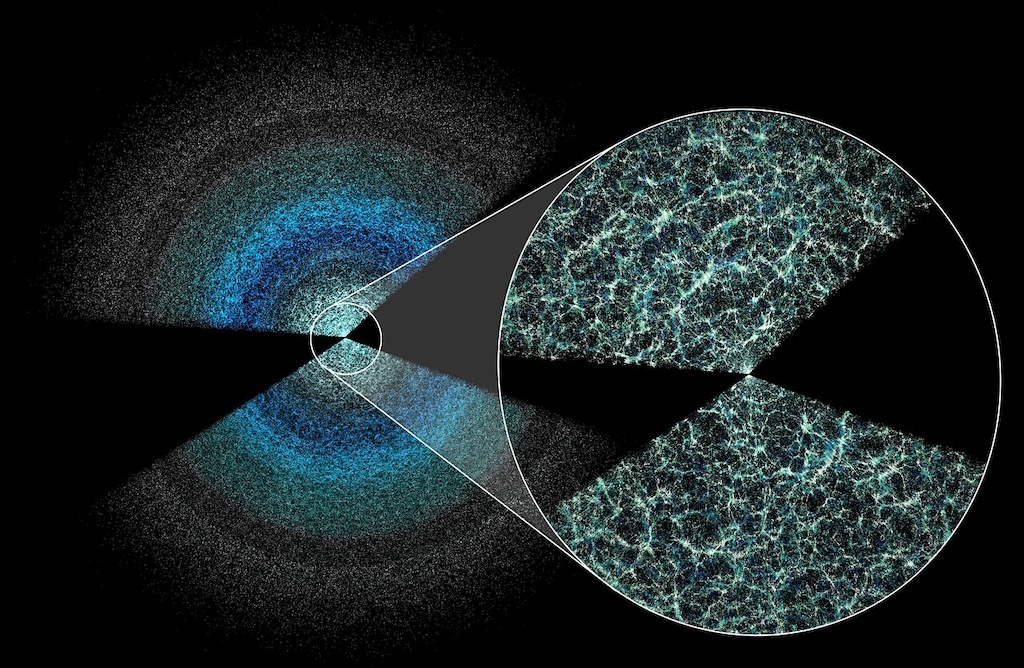
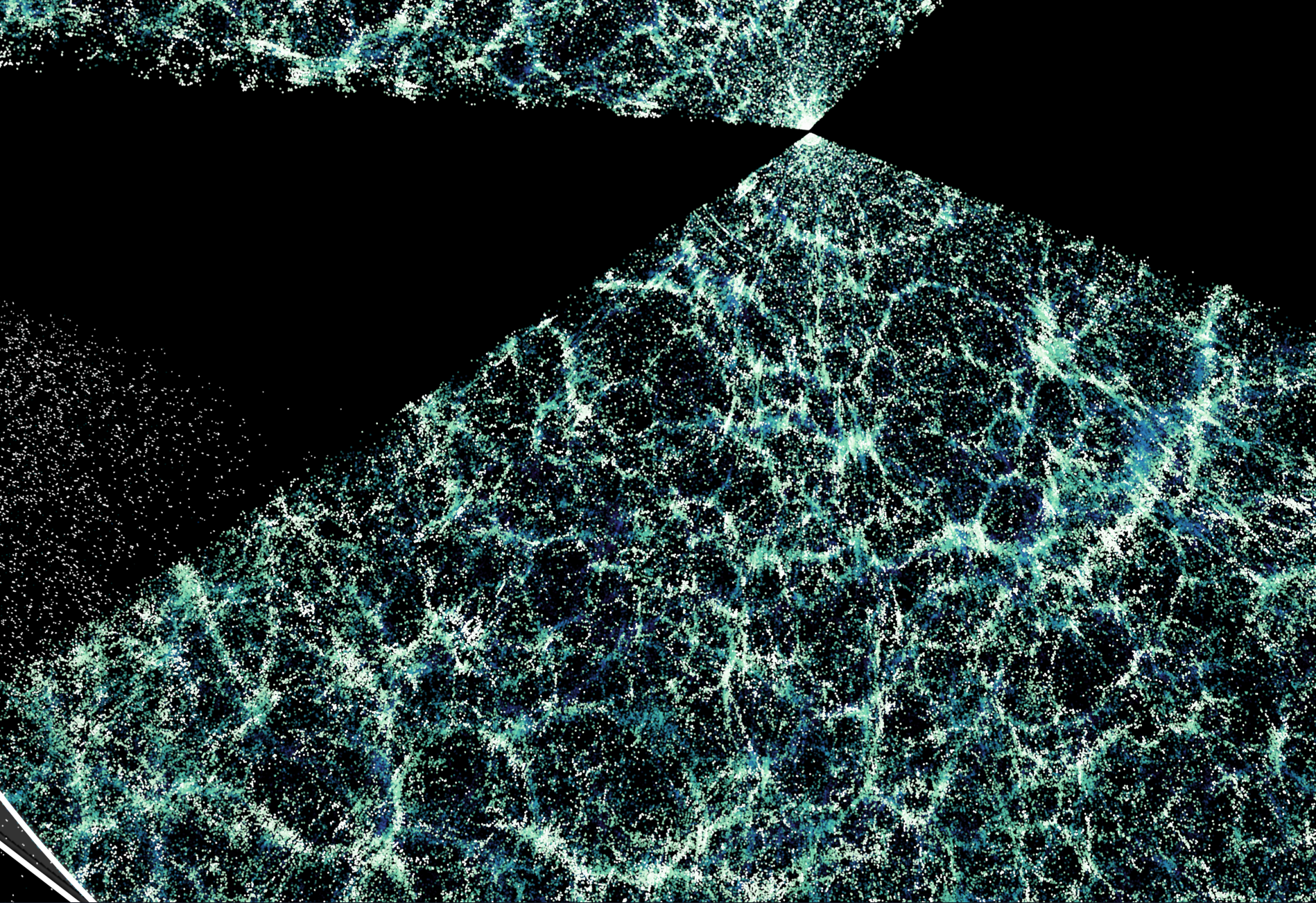
This is a map of the universe. The Dark Energy Spectroscopic Instrument (DESI) at Kitt Peak National Observatory, Arizona, has finished its five-year survey. It observed more than 47 million galaxies and quasars and created a 3D map centered on the Earth. Today's featured image shows a thin slice of these data: the black gaps indicate where our Galaxy obscures distant objects. The feathery web in the inset shows the large scale structure of the universe. Light of the most distant galaxies shown here travelled for 11 billion years to reach the Earth. Galaxies cluster throughout cosmic history under the competing influences of gravity and dark energy, responsible for the accelerated expansion of the universe. Analysis of early DESI results hinted at the possibility that dark energy, described as a cosmological constant by Albert Einstein, may not be constant after all. But we still have to wait for the analysis of the now complete dataset. The nature of dark energy is the biggest mystery of cosmology.
Source

top 28 comments
sorted by: hot top controversial new old
[-] BurgerBaron@piefed.social 34 points 1 month ago* (last edited 1 month ago)
[-] tedd_deireadh@piefed.social 10 points 1 month ago

Thanks for posting that link. Truly mind-blowing results and it's cool to see it visualized.

[-] trailee@sh.itjust.works 8 points 1 month ago* (last edited 1 month ago)

It’s amazing that what looks like dense clusters at this scale are stars still separated by, um, astronomically large distances. It’s also amazing to see this overall clustering operating at those scales. The sparse areas are unfathomably empty.

It reminds me of patterns in soil erosion, with gravity concentrating larger and larger flows of water and correspondingly deeper stream cuts. Also self-similarity at vastly different scales.

[-] murmelade@lemmy.ml 3 points 1 month ago

~~stars~~ galaxies

[-] MalReynolds@piefed.social 3 points 1 month ago

Cool, my first take is fractal dust with some sort of bubble superstructure.

[-] RizzRustbolt@lemmy.world 2 points 1 month ago
[-] BurgerBaron@piefed.social 3 points 1 month ago* (last edited 1 month ago)
[-] Illogicalbit@lemmy.world 22 points 1 month ago* (last edited 1 month ago)

Space is big. Really big. You just won't believe how vastly, hugely, mind-bogglingly big it is. I mean, you may think it's a long way down the road to the chemist's, but that's just peanuts to space.

Douglas Adams, [The Hitchhiker’s Guide to the Galaxy]

[-] RizzRustbolt@lemmy.world 6 points 1 month ago

Also the solution to the Fermi Paradox.

[-] MehBlah@lemmy.world 2 points 1 month ago

Separated by a lot of time and space.

[-] agent_nycto@lemmy.world 1 points 1 month ago

I think the bigness is part of the setup of the paradox. Bigger=more chances of aliens=more chances of an alien species being able to be interstellar.

[-] wopalopa@lemmy.world 15 points 1 month ago

with how big space is. does the map determine if the location is where the thing currently are or just everything we can see at this time.

[-] BB84@mander.xyz 21 points 1 month ago

the latter. the map looks different further away from the center of the circle because further away = earlier time. if they attempted to compensate for how things far away have changed since the light was emitted, the map would look uniform.

[-] certified_expert@lemmy.world 2 points 1 month ago

What do those colored rings mean?

[-] BB84@mander.xyz 3 points 1 month ago

Check this comment https://mander.xyz/comment/26729021

@expatriado@lemmy.world do you happen to know what the less dense ring in the outer part is?

[-] certified_expert@lemmy.world 1 points 1 month ago

Nice! Thanks! I checked the full resolution image. Is each of those dots a full galaxy? That is wild!

[-] BB84@mander.xyz 1 points 1 month ago
[-] BB84@mander.xyz 2 points 1 month ago

My not very confident guess is that it's just to label what kind of galaxies are observed by the instrument at that range. Really not sure about the less dense ring in the outer part though.

[-] ImWaitingForRetcons@lemmy.world 9 points 1 month ago

Because of relativity, there is no difference.

[-] Etnaphele@lemmy.world 1 points 1 month ago

Is there a limit at how often my mind can be blown?!

[-] RizzRustbolt@lemmy.world 2 points 1 month ago

Twelve. Then the next one is free.

[-] BB84@mander.xyz 1 points 1 month ago

what. there definitely are differences between the universe today and the universe billions years ago.

[-] sbeak@sopuli.xyz 13 points 1 month ago

Very insane that we as a species (very very very small) were able to survey the (observable) universe and its structure (very very very big, far bigger than the biggest big we can big of) to such an accurate detail.

[-] Lucidlethargy@sh.itjust.works 1 points 1 month ago

It's a piece of the universe, anyway.

[-] AngryCommieKender@lemmy.world 1 points 1 month ago

Even more insane that eventually, even if life still exists, you won't be able to see ANYTHING outside your local galaxy, because all the clusters will have merged together, and there will be so much space in between that even light can't get between the galaxies anymore.

[-] SpacetimeMachine@lemmy.world 3 points 1 month ago

More specifically, the space in-between galaxies will be expanding so fast that light is too slow to be able to cross it. Functionally making it so there are causally separated bubble universes.

[-] MehBlah@lemmy.world 2 points 1 month ago

The web of creation.

this post was submitted on 23 Apr 2026
160 points (99.4% liked)

Astronomy

6924 readers
52 users here now

A community for sharing astronomy-related news, content, research, photographs, etc.

When sharing photographs and articles, please make an effort to include source URLs.

founded 4 years ago
MODERATORS