114
Scientists know how to phase out fossil fuels. Some countries are listening
(www.scientificamerican.com)
Representatives of more than 50 nations gathered in Santa Marta, Colombia, this week at what was billed as the first global summit on phasing out fossil fuels. A panel of scientists will be advising them
Archived copies of the article:
No they don't. You can phase it out of electricity production through nuclear and renewables, but theres currently no answer for most other usecases
Steel - > arc furnaces, concrete - > clinker free cement, trucks - > cargo trains/hybrid overhead electricity (Germany has one), cars - > electric, planes - > high speed rail where applicable/ electric planes for <1h flights currently, remote locations electricity - > off grid solar / batteries, ore crushing - > electric ore crushers, shipping - > stop shipping fossil fuels is 70% decrease.
Shipping and flights are the tricky ones because the energy density of fossil fuels is hard to beat, but we're still going to replace majority of those.
It's all in the works, just not happening fast enough. Net zero 2050 is still technically achievable, decarbonising electricity and lowering electricity prices is a crucial first step which makes other green solutions more attractive.
A random guy without any scientific thinking surely knows best right?
Am I wrong tho?
Which ones? Personal transport can be fixed with better urban design and EVs for the edge cases. Logistics can be largely replaced by rail, bike, and small EV. That leaves container shipping, which actually mostly moves fossil fuels, interestingly enough. A good amount of aircraft can be replaced with high speed rail or sleeper trains.
"Oh, but what about flights over the water?" Have you ever heard of a "ground effect aircraft?" This isn't even new tech. Google Project 903.
"Oh, but I have to be at a meeting in Beijing TOMORROW!" Yeah, fuck you, you don't. Business has unreasonable expectations that can be brought in to line with reality. Like, is it really worth killing us all to force the world to move this fast? No. This is fucking nonsense.
Between downshifting, designing things more efficiently, and using alternatives, a whole lot of this problem is solved.
And that's literally what "phase out" means. It means you replace a bunch of stuff and then work on figuring out anything that's left. So yeah. You're wrong.
Unless you'd like to explain why you're not.
Personal transport can be fixed with better urban design and EVs for the edge cases.
I'm literally the guy who lives in large EU city with excellent public transport, and who has no car and lives near the metro station to maximize all its benefits.
As a 100% public transport commuter I can tell you, the correct way do develop infrastructure is to have solid mix of car infrastructure with network of busses trams and metro integrated into it. You just can't magically replace cars with busses, trams and metro for everyone. And car drivers will never going to be minority, because it's impossible to replace flexibility of the car.
A good amount of aircraft can be replaced with high speed rail or sleeper trains.
High speed trains have the tiny issue of super expensive infrastructure that has to be built and maintained, while you can make airport almost anywhere. Would I want EU wide unified high speed train infrastructure that allows travel from Warsaw to Paris in few hours? Hell yes I would. But I have no delusions that you can make rail everywhere because costs are just too high, and flexibility isn't good enough for all use cases.
Just an FYI, Warsaw to Paris is in the works. The new EU rules for train operators will allow private operators to operate cross borders so in the future a sleeper train from Paris to Warsaw is going to be a thing. 12h, sleep 8, wait 4. Compared to flying and showing up 3 hours in advance with added to/from airport as 3h pre flight, 2h flight, 1h to/from airport to get to city center you'll have to spend more time waiting in flights with less comfort.
And car drivers will never going to be minority, because it's impossible to replace flexibility of the car.
Helicopters are far more flexible, but you wouldn't make the same argument because it would be absurd. Cars will not be dominant because we will either replace them or society will collapse and destroy the vast logistic network they need to exist.
I haven't owned a car in years. I have two kids, and I'm able to take care of all my needs with a bakfiets and a longtail bike. There are things that would make bikes far more flexible, like more bike cars on trains and metros.
But it's honestly good enough. Sometimes you just don't do things, or things are a bit harder. I accept that trade because I'm not literally destroying my children's future.
It would be easy to ban cars from Amsterdam or Utrecht. They aren't banned in Amsterdam because there are too many people who are too rich to walk. It's not about flexibility there, it's about keeping the ultra rich safe.
Cars are only affordable and flexible because they have been made that way. Roads are massive investments that take away funds from other infrastructure. They are supported by massive subsidies: fuel, infrastructure, military, etc.
The moment you stop dumping money in to maintaining the status quo, even as it kills us, is the moment that cars and planes stop being the best option.
Car drivers are already the minority in Amsterdam. In the core metro area, there's less than .6 cars per household, while there are more bikes than people. If cars "will never be the minority," how are they literally the minority rights now?
What do you mean exactly?
Do you mean there are certain things that will be very unlikely to be electrified, like airplanes?
Exactly. You aren't likely to electrify Boeing 747 Jumbojet. Same goes with marine transport and truck transport.
What? I am not sure your point is clear here.
How are you going to move large passanger planes to renewable power? Or trucks? Get failed Tesla Semi from Elon Musk?
I believe the aviation industry is betting on ESAF which is synthetic fuel derived from renewable energy.
https://www.bp.com/en/global/air-bp/news-and-views/views/what-is-esaf.html
Using Fischer-Tropsch (FT) synthesis
That's completely infeasible financially. What you liked is a propaganda piece.
Even if you used ammonia as fuel, the round trip efficiency is like 17%, steam reforming into regular jet fuel is probably even worse since production has three steps instead of two.
And If you consider cost of electricity alone this turns into a pipe dream
Even if you used ammonia as fuel, the round trip efficiency is like 17%
Do you have any sources backing this up?
And also, I mentioned eSAF, not SAF. There's a difference.
Don't have an article at hand. I've seen this in two places, one article back when I was looking into it, and the other was one of Sabine Hossenfelder videos about fuels.
Numbers in both sources were similar
I think the effiency of eSAF is closer to be around 35-50 %, but I am by no means an expert in PtX (PtL).
But it is still extremely expensive, 6x more expensive than normal jet fuel. And the goal in EU is that by 2030 0.7 % of the fuel mix is eSAF.
I think the biggest challenge is the infrastructure. We are having issues with negative power prices in EU, more eSAF production can be one solution to a more stable grid in places with a high penetration of renewable energy production.
I seriously doubt these are actual round-trip efficiency numbers. Combustion engines have alone only ~45% efficiency and you're adding all loses from the entire production process on top of that.
Again, I'm no expert, but here are a couple of sources on the effiency:
https://montel.energy/resources/blog/what-are-power-to-x-technologies
These articles basically confirm what I said. Round-trip efficiency is horrible.
Especially the table from wiki is telling.

Perhaps we are talking about two different things then. I'm talking about the effiency from renewable energy to eSAF, and it seems like you are talking about the efficiency from eSAF to propulsion energy, which then includes the effiency of a combustion engine.
I think it makes the most sense to isolate those two things, or else the number depends on how efficient the ICE is.
But, you are right that the effiency is really low, so the circumtances have to be there, before it makes sense, and those circumstances are a surplus of energy from renewable generators, which inevitable occurs when there is enough renewable power flowing in the grid.
it seems like you are talking about the efficiency from eSAF to propulsion energy
I'm talking about all chain Round-trip efficiency, meaning from electricity to propulsion. It just happens that eSAF patch is extremely wasteful on multiple steps.
Battery tech is much better but you can't use it for large scale transportation, especially airplanes.
There are also limitations to the storing excess power in batteries. The capacity of batteries is one of the obvious.
Electrolysis is better for long duration storage and for larger parks, and batteries have the limitation that you mention yourself, you cannot transport batteries, but you can transport hydrogen.
you can transport hydrogen.
If you mean transport fuel tank full of hydrogen to power an airplane or truck, it's really awful due to its physical properties. It penetrates materials, hydrogen gas density is horribly low, liquifying requires huge energy effort, and the due to low specific heat it boils away really really fast.
If you want a fuel with bare minimum reasonable properties made out of hydrogen, then you could do synthesis with nitrogen to make ammonia. It's corrosive and toxic, but at least storage requirements are sane. Still it has half of the energy density of gasoline and nitrous oxide emissions are problem when combusting.
Ofc I don't mean transport by trucks...
Have a look at this planned project here that will be using pipeline-based infrastructure for cross-border transmission: https://en.energinet.dk/about-our-news/news/2026/energinet-and-gasunie-deutschland-strengthen-cooperation-on-cross-border-hydrogen-infrastructure-between-denmark-and-germany/
TBH this sounds pretty unnecessary if you have large scale electricity infrastructure already in place. Instead of transporting hydrogen, you can transport electricity for all usecases, not just fuel and fertilizer production.
Discussion of climate, how it is changing, activism around that, the politics, and the energy systems change we need in order to stabilize things.
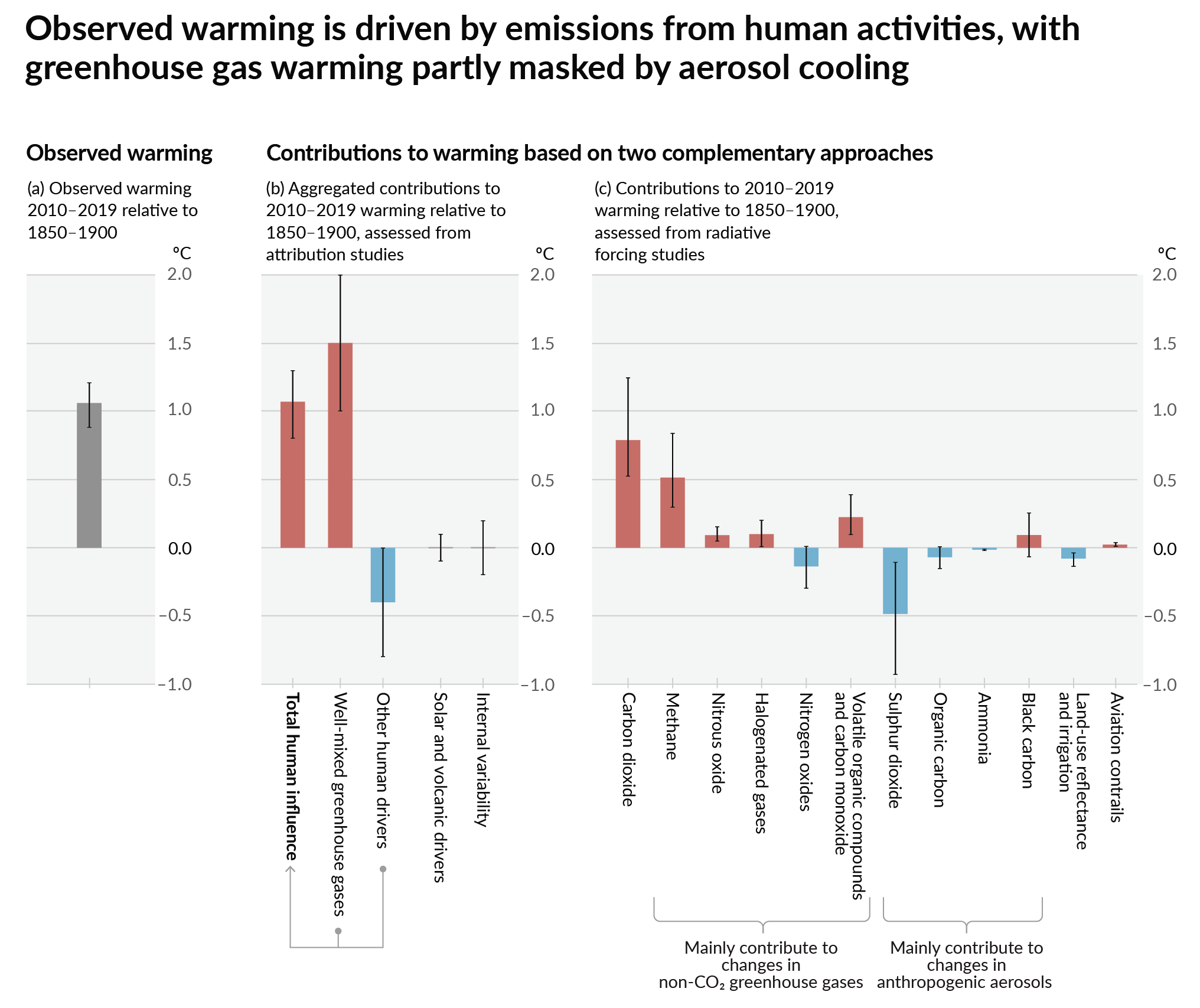
As a starting point, the burning of fossil fuels, and to a lesser extent deforestation and release of methane are responsible for the warming in recent decades:
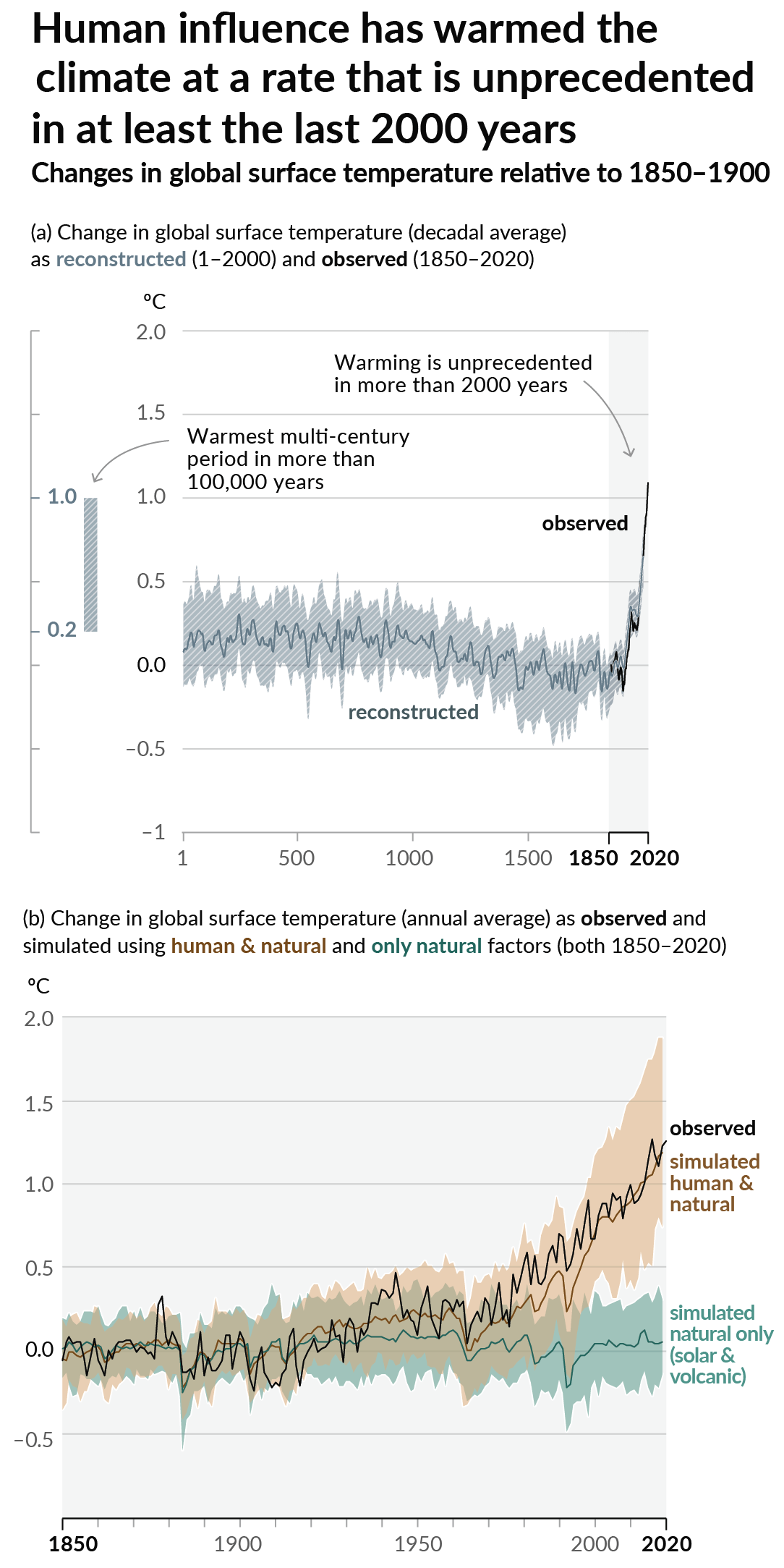
How much each change to the atmosphere has warmed the world:
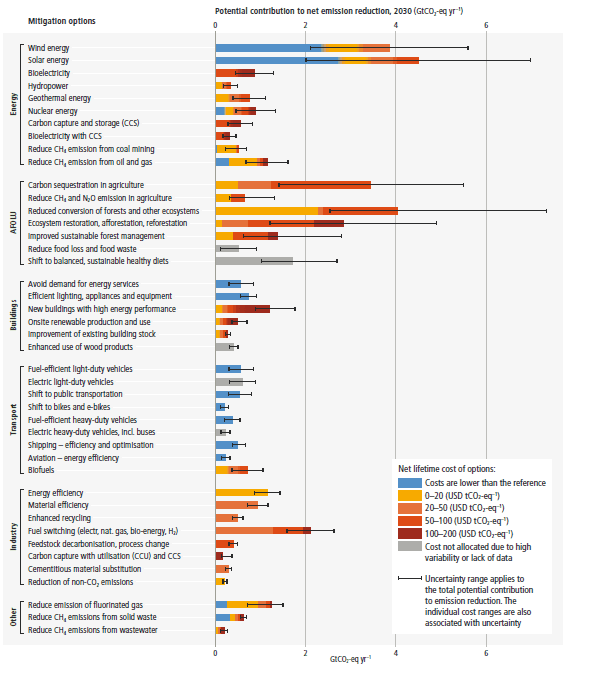
Recommended actions to cut greenhouse gas emissions in the near future:
Anti-science, inactivism, and unsupported conspiracy theories are not ok here.