There's nothing non-intentional or implicit about denying the franchise to noncitizens. For the vast majority of countries, that is the way citizenship is expressly designed to work as an in-group. Citizenship is generally meant to discriminate against outsiders.
Easy if you go step by step and don't accidentally skip anything. Archinstall will get you to the same result with lower risk of failure, in a tenth of the amount of time spent. And unless you install operating systems for a living, it doesn't matter how you get there. Source: Installed Arch on about a dozen different devices, twice without Archinstall.
If you're looking to learn something, do Linux from Scratch instead. The process is way more granular, way more documented, and way more educational than parroting the steps of installing Arch from the wiki.
Nick Cage: Is that supposed to be me? It's...grotesque.
I'll give you $20,000 for it.
Malazan Book of the Fallen was like this for me. Great worldbuilding. Big ideas and loads of characters. Lots of obscure detail, all the way down to potsherds and verdigris.
When I finished, I had a powerful impulse to reread the series immediately after finishing it.
It got a lot of press when it first showed up and it was a strong default suggestion for new users for well over a decade.
I used it for several years and I initially jumped ship to Xubuntu, so it was clearly good enough for me to want to use something similar at first. The distro-specific changes (snaps, etc.) are more likely to alienate experienced users, whereas new users are less likely to object to things like snaps.
I don't use anything Ubuntu-based these days, but it has everything to do with my specific needs/preferences. Nothing directly to do with the decisions that get bad press among long-term users.
I always assumed that a lot of this boils down to semantics and trademark law.
OpenIndiana is a direct code-line descendant of Unix System V through OpenSolaris via Solaris. Thank you for that, Sun Microsystems. I understand (but haven't looked) that a lot of code these days is simply ported over from BSD or Linux. If you compare the source code to an old copy of the Lions book, you're probably not going to see any line-by-line overlap. Thank goodness - we shouldn't be literally running old operating systems from the '80s. I don't think that OpenIndiana is Unix-certified by the Open Group (Trademark).
The BSDs started out as a sort of 'Ship of Theseus' rebuild of an academic-licensed copy of Unix around the time that AT&T was getting litigious and corporate Unixes (Unices?) were starting to Balkanize.
GNU/Linux started out as a work-alike (functions the same but with totally different code) inspired by MINIX, which in turn was an education-licensed Unix work-alike designed to show basic operating system principles to students. I think that one or more linux-based operating systems have obtained UNIX certification from the Open Group, just like Apple did for MacOS (paying money and passing some tests). It doesn't seem like any of them are still paying to keep up the certification. Does it matter if they did at one point?
Going back to proprietary corporate Unixes, I believe that IBM AIX and HP-UX still exist as products. They started out as UNIX and have been developed continuously since then. They are both Certified Unix. By now, their codebases probably diverge substantially both from one another and from all of the Unix-likes. IBM also has a mainframe OS with a fascinating history that has nothing to do with UNIX. It is Certified Unix because it passes the right tests and IBM paid for certification. It is not UNIX code and doesn't descend from UNIX code.
Simple as.
Realistically? For mainstream search? In anything like the top-level results that most people bother to read?
Nowadays, you need to pay Google more than the SEO companies do. Either that, or hope that people specifically search for lemmy posts as part of their search request.
What are you trying to build? A work laptop that you're going to take on trips, a gaming computer, a server? Something else?
For you, what is too much hassle? Are you a new Linux user or an experienced user with no spare time? What are you accustomed to doing when you install an operating system and what do you expect to be preinstalled?
What is your favorite colour?
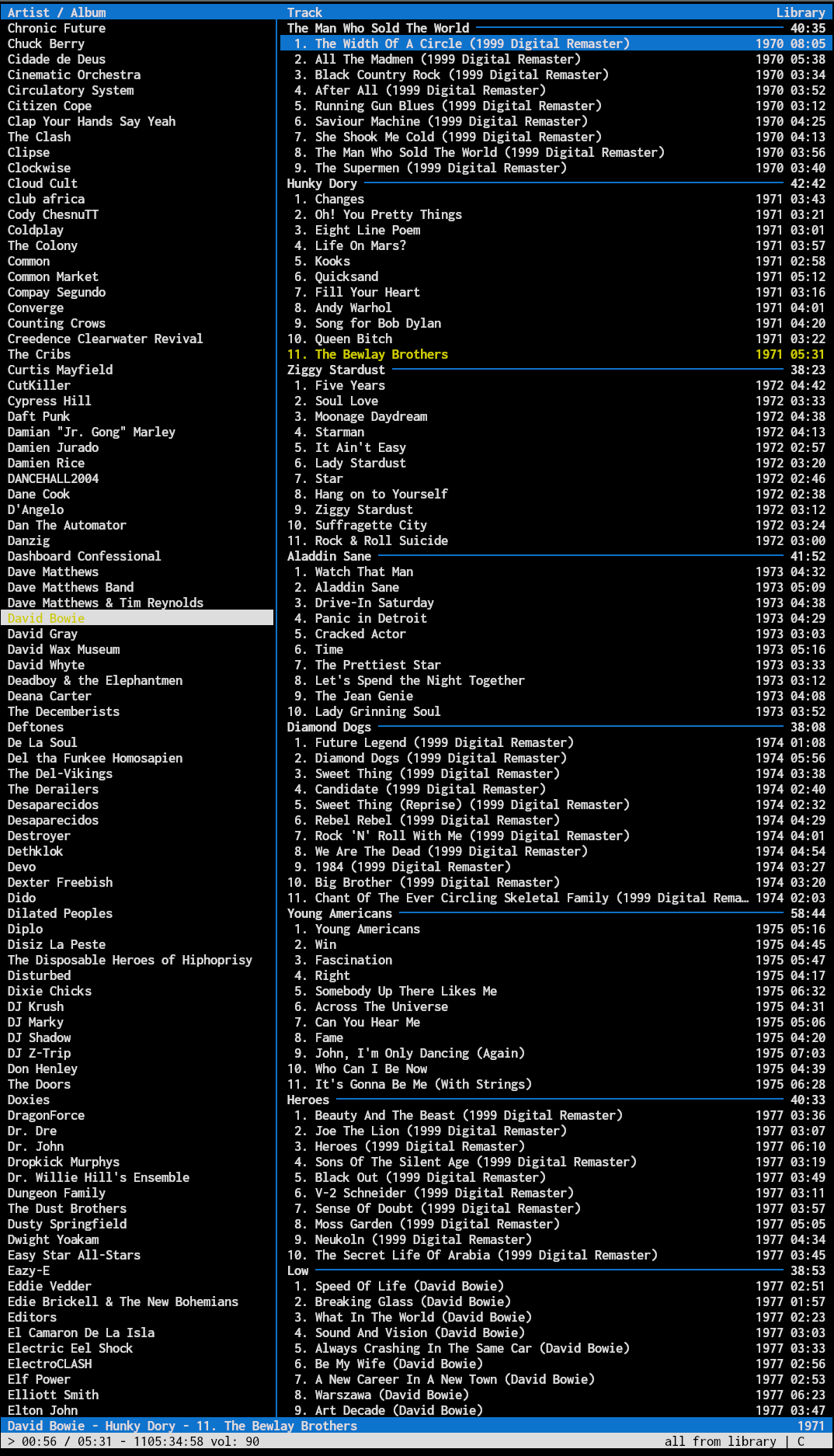
I tend to go with stock cmus on linux, with mouse support turned on. It also works as an interface if I'm in a hurry and I want to ssh into another computer attached to speakers. Not pretty, not fancy, but quick.
I did a Sweet 16 bracket elimination contest for regional IPAs a few years back just to force myself to identify the 'good' ones and eliminate bad ones. Even after doing that, I do a little dance any time there's something else available.
A few enemy tears are just fine in a gin martini, either directly or as an olive brine additive.
bismuthbob
joined 2 years ago
If the lessons that I've learned about lightbulb replacement are applicable, then the nationality of the developers on the bus will impact the answer to your question.