93
The anti-minimalist backlash is the bigger story behind Oxygen’s revival
(filipfila.wordpress.com)
It's time to bring back this stuff!

Was the compiz fusion cube minimalist or maximalist? I used to wow my non-linux friends with that thing.
I think there's one more big angle to modern design minimalism. It gets out of the way.
Every day, we are bombarded with millions of design elements. If they would all scream, show themselves, try to be special, many would get overwhelmed, overloaded, overburdened. The classic design screams individuality, impression, emotion. The minimalist one is there for the function without distraction, like a quiet servant - there when you need it, out of sight elsewhere. It's a design philosophy of an age when everything is at your fingertips.
With that said, and with my strong preference to modern, minimalist designs, I appreciate the effort others put into making their computing experience truly reflect their workflow and intention.
overall i enjoy what you said, but ...
"like a quiet servant - there when you need it, out of sight elsewhere"
this doesnt at all reflect my experience with oversimplified things like gnome or libadwaita. things specifically are not there when i need them. thats the whole problem.
edit - formatting
I feel like the problem of GNOME is not minimalism - it's lack of proper customization. It's a minimal setup that works for GNOME devs, but not you.
Personally, I enjoy using Adwaita apps under KDE. Adwaita works great with the "one app - one purpose" philosophy, while KDE allows you to make global arrangements the way you like, so that everything you need is at your fingertips, and everything you don't is out of the way. You can customize KDE to look in a way that compliments Adwaita, and it looks and works very well.
This is also exactly my problem with minimalist systems. That, and things being hardcoded in a way I don't like and not having any reasonable recourse to change it.
One good thing about minimalist GUIs is they're much easier to optimize. Of course, you can still fuck it up, especially if your name is Microslop. Amazing how relatively demanging monochromatic rectangles with no animations can be.
You don't have to optimize rounded corners, blur or fancy animations if you don't code them in at all. Not necessarily the best approach, but at least there's a positive. Everything can be messed up easily, but not everything can be done right easily.
you would think so, but somehow that never seems to be the case in practice. software has just been getting way more simplified visually while also getting way heavier with the likes of electron, GTK4, QML, etc.
for example, gnome-calculator uses nearly 300 MB of RAM on my system. that's significantly more memory than my entire desktop environment (trinity). in the '00s everything was plastered with glossy skeuomorphic textures, 3D animations, transparency with blur, etc. and running all these different glossy programs together on one system still left you with a smaller memory footprint than gnome's calculator.
we are fucked and our UIs don't even get to be pretty anymore.
UI's peaked with the CLI. It's all been downhill from there
It doesn’t feel like it was made with the idea of being anything more than a clean product that gets the job done
I mean, "clean product that gets the job done" is fine with me. Let people theme/customize and it's win-win IMO.
I also always find the minimalism vs. maximalism debate interesting for usability. Lots of minimal designs are so flat that you can't tell a button from a label or icon.
At the same time, iOS' new Frutiger theme regularly confuses me with its transparency, e.g. yesterday I saw that the silent-mode notification had a ➋ inside. It was centered and everything. Then the notification went away, but the ➋ stayed, because it was from an app icon behind.
I wish, we could throw out the bad eye candy, like transparency, while keeping the good parts, like 3D buttons and such. I feel like this kind of neo-brutalist UI design isn't the worst direction to go in:

(This particular example isn't perfect, like the buttons are flat, while there's useless shadows around the boxes. But yeah, could just move those shadows to the buttons and it would still look fine.)
Is that a mock up you made or something that exists?
Check this one out: https://store.kde.org/p/1985239

It's a mockup I found on image search (from searching "neobrutalism GUI" or the like): https://www.magnific.com/premium-vector/hand-drawn-neo-brutalism-ui-elements-collection_186004756.htm
And yeah, that theme you linked is already pretty cool. Not terribly enamored with the retro aesthetic personally (especially with bad contrast like here), but if that can be done with KDE/Kvantum, then an actual neobrutalist theme, or just one with the papercuts fixed, is likely just as possible...
Our monkey-brain has put millions of years of evolution into a vision system designed to pick up 3d cues from our environment so we can use our fine motor skills to manipulate small objects. It's a fantastic piece of wetware that uses shading and colours to pick up 3d hints about the objects we deal with daily and - once you're a few years old - it's completely automatic and requires no effort to use.
And then we remove all the 3D cues and skeuomorphic hints from our computer systems so that now the previously subconscious "monkey-click-button" process is now a foreground task where cognitive energy is burned up to identify the correct UI element to manipulate.
I should be able to shift the mouse pointer and click a UI element out of the corner of my eye. I shouldn't be required to look at and then parse a 'flat' UI to determine if this element is a button or just a panel with text. GUI elements should map to recognisable physical objects wherever possible, and where they are more abstract (eg wifi icons) they should be clearly distinguishable from others in the icon set. You're burning up cognitive energy needlessly otherwise, and that's why I dislike the monochromatic new age UI/icon sets.
Checkboxes that look like left/right toggle switches are the worst. And the only way to know whether left or right is on is colour?! Can you please get in the fucking sea?
Isn't left=off and right=on?
I believe that, but... why should that be the case? It's a convention without a reference or motivation. I remember when they were new and I really had nothing to refer to and just having no idea whether they were on or off. The fact that I've got used to them now isn't really that forgivable. In contrast, checkboxes not only have convention behind them, but mimicked filling in paper forms which many people were and are familiar with anyway. The idea that "filled" is on and "empty" is off seems inherently more intuitive even if you've never filled in a form if you just know that the concept of forms that you fill in exists.
Of course, a checkbox is better.
Thank you! I do not understand this. One way is blue and the other way is green.... I have had to go into another panel where I know how I set something before, and look how the check boxes are there in order to discern the correct way to use them.
It's nice to be able to know that they take effect immediately though, instead of needing to click a submit button.
Real checkboxes can also take effect immediately, and have much better visual cues. The submit button was intended to save older computers the extra monitoring load of having to keep track of the state of every control all the time—it has nothing to do with control styling.
I mean, they can, and they can also be made to be mutually exclusive - but it's better to use radio buttons in that case. If that pattern is used, there's not really a good way that a checkbox will take effect immediately beforehand, or whether it will require submitting a form, except scanning the full page to look for such a button.
Eh? What do radio buttons have to do with anything?
The styling of a UI element - whether it's a box that gets an X or tick in it, versus a little thingy that moves left and right - is wholly unrelated to any aspects of implementation, including whether the effect happens immediately or not.
I was trying to make the point that the way a control looks gives you some information on how it will behave, because software has generally been consistent with associating those looks with those behaviours.
So if you see multiple options with a circle in front of them, selecting one, then selecting another will usually deselect the first one.
On the other hand, if those options have squares in front of them, selecting one, then selecting another will usually result in both of them being selected.
And in both cases, usually they will be part of a form and will only take effect when you submit that form using a button.
On the other hand, something that looks like a toggle usually takes effect immediately on toggling.
Of course it is technically always possible to have each of those behave like any of the others, but you will be breaking conventions if you do so. Styling is an affordance to inform the user about the behaviour.
Taking effect instantly is not really indicated by the control shape; it's indicated by whether or not the form has a button equivalent to "apply". Settings pages with checkboxes that applied immediately have been common for years; this distinction is not nearly as clear cut as you make out. I suspect what is going on is that both toggle switches and the removal of a separate apply step has gone on gradually at the same time.
But a good thing to think about is all the other controls: drop downs, text entry boxes, date pickers - these have no second version which might apply instantly or not! So it's a mistake to think that information is conveyed by the look of the control.
Well, I'd encourage you to keep an eye out; I think you'll find that the majority of controls on the web behave as I described. And I think that's a good thing, too: it's far quicker and easier to be able to deduce behaviour from the control you're handling at the moment, than having to scan the complete context. And especially if e.g. you're visually impaired, the latter can be a major hassle.
(And indeed, the other controls you mention almost never apply instantly, so their behaviour is still predictable. When they do, they'll often still have some other affordances to indicate that they do apply instantly.)
GNOME settings pages don't have "apply" buttons. When do you think a selection from a drop-down or numerical selector takes effect?
Yes, most settings now take effect immediately, and that's great. (I think KDE still prefers a separate "apply" step though). That is (still) separate from the decision of how to style something which turns something on and off, which is what I'm complaining about. I don't take any issue with having things apply immediately.
You raise visual impairment, which is exactly why I'm complaining. Look at the image and tell me, which of the controls is on, and which is off?
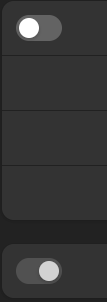
True, there are exceptions (that's why I keep saying most), and I think the pattern is more common on web than on desktop. (Though I think Gnome also compensates a bit with their boxed lists as an additional affordance.)
Note that I am 100% on your side in saying that there are annoying toggle boxes that are unclear. In your image, I can only tell that the second is probably on because the right-hand side is usually used for the on state in LTR locales. But they can be better, e.g. with an on/off label integrated. Ironically, GNOME has a toggle to enable this:

So (unsurprisingly) I modified the image to make my point. I don't know whether you will find it convincing with this revealed: I flipped the image because I too understand now (I did not when these switches were first introduced) that right = on. And I also desaturated the image to mimic colourblindness (achromatopsia). (Indeed, when they were first introduced I remember them being two shades of grey...)
I actually love that design, it's minimal without being corpo-slick. Is it just a mockup or is there some way to make all my computers look that way?
Well, this kind of design language is actually referred to as "neobrutalism", so you might find a theme under this name. But from what I've seen so far, it's mostly a thing in web design at this point...
Just think of how long it takes to craft a skeuomorphic icon compared to a symbolic monochrome one.
About the same time.
To be fair I'm not too fond of extremely colorful icons. They do have their place, but in most interfaces I do prefer flat or slightly shadowed icons.
I value more the UX of the interface than the design of the icons, tough the icons are indeed important. Painting icons over KDE does not really change how you interact with KDE.
I don't particularly like KDE, but have not found a better DE anyway.
A dislike of minimalistic interfaces is not the only reason that I am using twenty-plus-year-old styling (older than Oxygen, even) on a DE of the same vintage, but it is one minor reason.
I am curious about what are your major reasons ?
The largest one is probably the lack of churn. I don't have to relearn what things look like or how controls function every few years (or where settings have migrated to, or how to accomplish random-obscure-thing-I-might-need-to-do-once-a-year). It lets me get on with whatever I sat down at the computer to do in the first place, which was almost certainly not tinkering with the DE.
It's also light on resources, since it dates to the days when a single core and 1GB RAM was considered a pretty decent system.
(Note that TDE, which is what I am using, is still well-maintained—it's just that the people working on it consider keeping the original look and feel to be one of their goals.)
Thanks for posting @SocialistVibes01@lemmy.ml, that aeticle was more interesting & thought invoking than I thought it would be.
I'm using XFCE with a theme that feels like it's from the 90's and thinking about it, it does feel better to use than all the modern craziness that Microsoft has been doing in the last few years. I hated the Metro era...
I'm also using XFCE but with the Materia theme, because the visual noise of pseudo-3D overstimulates me and i like clean lines.
Minimalism in GUIs, maybe (still, give me CLI any day). But minimalism in housing and infrastructure is absolutely critical and they are absolutely not equal to software. We need to be as efficient as we can because I don't know if the author has noticed the state of housing in the world. How many more "boring, dull" buildings could be built for the same price? How many more if we copy pasted the same designs instead of demanding everything be unique? (But god forbid they be too different from the existing style or else the NIMBYs protesting minimalist buildings complain about that too.) The people who "prefer" the visually complex building have never been homeless in the back alley of that building before, nor have they ever been priced out of their neighbourhood by gentrification when their boring gray building gets torn down to build the pretty building.
i understand where you're going but that it's because we're fucked up by capital, but once you get past that... i don't see china having a lack of beautiful architecture that blends modernity with traditional style and everything in between. sure, if the us decides to build housing for the people, do whatever you can to make that possible, but it's not like we only need to do that.
Literally one of the first complaints libs have about Chinese cities is "copy paste skyscrapers everywhere." They have some variety in parts of the city but most of the residential areas are still "boring" and "homogeneous" and "designed to kill individualism" according to Western internet geniuses.
Evidently they've never visited one of those suburban subdivisions in their own country where all of the houses are built to the same blueprint. Same effect, slightly different scale.
Also, Chinese cities don't give a shit if you decorate the outside of your unit. HOAs do.
From Wikipedia, the free encyclopedia
Linux is a family of open source Unix-like operating systems based on the Linux kernel, an operating system kernel first released on September 17, 1991 by Linus Torvalds. Linux is typically packaged in a Linux distribution (or distro for short).
Distributions include the Linux kernel and supporting system software and libraries, many of which are provided by the GNU Project. Many Linux distributions use the word "Linux" in their name, but the Free Software Foundation uses the name GNU/Linux to emphasize the importance of GNU software, causing some controversy.
Community icon by Alpár-Etele Méder, licensed under CC BY 3.0