11
Comrades in the US: Your task is to spread counter-psyops! Encourage soldiers to sabotage and defect! Defend Iran's sovereignty!
cross-posted from: https://lemmygrad.ml/post/11613039
Play here: https://prolewiki.org/fire/sim.html
idk why i built this. it's funny.
If you want more flags you will have to ~engage~ and write a comment for the algorithm. Who should we add next? You decide!

So Square Enix did it again... they sprang one of the best games of the last few years without any noise and made Paranormasight 2 (The Mermaid's Curse). Amid 7 years of nonstop RPG releases and remakes, these two titles stand out as something you'd never guess they'd do, especially since it's a limited budget game (there's only about 20 names in the credits, compare to the AAA size that usually involves hundreds of people).
What can I say? They nailed it again. If you remember I talked about paranormasight 1 a few months ago here, contrasting Famicom Detective Club to it.
Paranormasight 2 hits just as right - and it's no surprise, considering how closely it follows the formula. Yet even as I thought I knew how to watch out for the tricks the game would pull, I still found myself taken by surprise most of the time.
It's a game that engages you, the player, to participate in its story and not just consume it. It rewards your deductions even if they're wrong or incomplete yet, and then likes to recontextualize them - what you thought you knew for sure turns out to be something else, things like that. This hasn't changed from the first game, and the enigmatic Storyteller even makes a return to carry you through this story. Although I will say I did make some correct deductions far before the game needed me to, but it really didn't spoil or ruin anything.
And like I said in my review of the first game, this isn't a game about the supernatural. At its core, this is a story of human drama and correcting the errors of the past. It starts with a young man wanting to find a mermaid because he believes his mother, who has disappeared five years ago during a storm at sea, might have been one. But then it turns out there's also in folklore "fish-mermaids" and "human-mermaids" - and yes, the difference is important. It is said that eating a mermaid's flesh can grant anyone immortality (apparently this is true in Japanese folk stories), but actually it might only be 800 years and actually there might be other conditions as well, possibly. Maybe. Also there's dead bodies washing up on shore after an underwater pit opened up, and an unknown girl mysteriously arrived on the island where most of the game takes place just two months ago... also you should probably learn the Heike clan's lineage and some centuries later an island in the bay of Ise disappeared under the waves never to be seen again. I'm sure that's nothing though right?
And this is just the prologue, I'm not even spoiling anything. This is how the game starts you, and it's up to you to figure everything out piece by piece. It starts with a very strong supernatural/horror vibe (don't worry there are no jumpscares), but that's really not where the meat of the game is. I like this approach; the supernatural serves to sublimate and elevate the underlying story, not to pull a red herring like many other games do. In the first game, you the player learned that curses that could kill people were real because the prologue had you use them liberally. It left no doubt in your mind that you had to suspend disbelief and whatever the game was throwing at you was going to be the truth. In the second game, they expedited this a little and there is some dissonance in the beginning, where people who would have no reason to believe in the supernatural instantly believe you.
Still, the dialogue hits all the right notes. It will make you laugh, it will make you cry, it will make your heart palpitate. You can be having a completely normal conversation in one moment when it suddenly turns into a tense standoff.
The story chart has come back, this time with 4 pairs of protagonists instead of just 3. It was a bit harder to follow in the beginning especially with all the history you're suddenly fed with, but it mellows out as the game goes. This is a series that plays with what a game means, and although there is less of that in this sequel (the first game had you actually use video game mechanics to progress), the story chart remains relevant. But it did get confusing a little in the beginning trying to put events in their linear order, when you're jumping all around both in time and protagonists.
The game definitely strings you along exactly as it wants to, and you're just here for the ride. But you gotta trust that it will bring you where you need to be in due time. It's a beautiful story, much like the first game, and very bittersweet. I remember reading a while back we don't like finishing things because it means it has ended and we have to move on. We'd like things to remain in a metaphysical state, never budging, so that we don't have to say our goodbyes.
Mind you, I haven't actually finished the game yet - I decided to pace myself for this one, and play a couple hours a day. Judging from the steam reviews it seems to be around 12 hours long like the first one, and I'll reiterate what I said about the first one too: I am ready to play 12 hours more lol. But I guess this is what the game teaches you in a way, things can't last forever. Even immortals die eventually.
Well, a big theme of the games like I said is correcting the errors of the past, i.e. having agency to change things. Which I think is a powerful message to convey; too often protagonists are passive in the face of what happens around them, being carried by the waves without even attempting to swim against the current. So it's refreshing to have a story that says, it's never too late to make things right. This is why Paranormasight is about deeply human stories at the end of the day even if they rely heavily on the paranormal.
And that's where I am too. I'm in what I believe to be the final stretch of the game, and half of me wants to finish it as soon as possible and the other half wants to take my time so I don't have to move on too quickly. Mind you as a mostly visual novel-type game, you won't have a lot of gameplay either and it's a lot of reading, so it's perfectly fine to take breaks and chip slowly at it. Otherwise it is a lot of sitting there and pressing A to continue.
Oh one last thing. I don't think it has much bearing really but, the island they say is fictional is actually real and the pictures are clearly taken from there lol. Here's a reddit post: https://old.reddit.com/r/ParanormasightHonjo/comments/1rg2wkz/the_completely_fictional_kameshima_island/. I think it was more of a liability thing to rename it and treat it as fictional but I think it's also a caution against not treating all the historical elements the game tells you as true lol.

Comrades in the US: Your task is to spread counter-psyops! Encourage soldiers to sabotage and defect! Defend Iran's sovereignty!
Just saw the game came out yesterday and of course I had to try it. I finished the two tutorial missions and the first real one, which was more of a speedrun.
The game is more of a side-scrolling platformer. I only go by the first line usually before trying a game, so I was expecting more of a stealth/tactics game. Levels are divided into two parts: the casing, and the escape. During the casing you progress through the level and set up what you need for the escape. During the escape (after you grab the artifact) you are being chased by attack drones and have to leave through the escape route as fast as possible.
The platforming uses a parkour system in 2.5D where you gain a speed bonus if you press X while vaulting over an obstacle. It offers suitable verticality to follow alternate routes and get a better escape time.
The game gives short history lessons on the artifact and the culture to which it belonged, but nothing too deep. Could be a good primer into African cultures if you don't know anything about the continent, giving you a foundation to do further research.
The first real mission for example has you get back the silver bull of Dahomey, which you can see here https://www.metmuseum.org/art/collection/search/318416 in higher res than the game's (and yes this is the Met Museum lol)
I assume the gameplay opens up more later. The first three missions were a bit underwhelming: you have 2 tutorial missions (why?) and then the first 'real' mission can be escaped in 33 seconds, so it's kind of more tutorial. A lot of cutscenes too, hopefully they wind down later on. It's the old adage: show, don't tell.
The escape portion is kind of a speedrun, and you are rated on time taken to escape at the end of the level. So you better set up everything beforehand so you can escape as fast as possible. Reminds me of teardown in this regard. Apparently in later levels you have to grab more artifacts but the first one will trigger the alarm, so you have to figure out a route first.
The most unrealistic part really is the heist team has a French guy helping them lol.
If you play on linux: Unreal Engine doesn't play well with the compatibility layer. In your wine config, replace dll "winmm=n,b" (winmm.dll replaced with native, builtin) and the game should work. Thank you deepseek for finding a 10 year old Russian forum thread that had the fix lol.

Practice proper discipline. Don't share unsubstantiated news, don't believe unconfirmed reports. 10 Twitter accounts reposting the exact same video is not confirmation of events.
Don't trust the enemy to tell you what's happening, wait for confirmation from blue side. In a revolutionary situation we carry on as usual and wait for our side to give the go-ahead on how to react. Practice it.
And yes I call it The Séance at Blake Manor and not of blake manor just because I think it sounds cooler.
I started by writing an entire review of the game, only to realize that I can't be that charitable to the game or its story. And yet, I appreciate all the work the devs must have put into it. Blake Manor offers no less than a cast of 25 characters all with their motive for murder and story arc, and that alone must be underlined. If you know me you know I love convoluted stories so of course when you tell me there's 25 subplots that tie into the main plot, I'm intrigued.
But the game fails to deliver on the technical presentation. It get slower as you play (probably a memory leak), the lengthy loading screens get obnoxious considering this is a 2025 Unity title with very small maps (and very little in those maps, as characters stand in one spot and never move), and lots of typos; too many to count, which is always a grade down on text-heavy games.
The game tries to build a bigger setting despite happening all inside this admittedly large manor, by tying it to Ireland, history, large families, folklore, and even the world - mentions to Egypt and China are made. But, it doesn't engage with these ideas fully. Characters ultimately have very little to say or do - most of the clues you will find by investigating their rooms, and finding the master keys to the four wings of the hotel so you can go into their room is a huge part of the game.
You arrive at the manor at the request of an anonymous benefactor who wants to know what happened there to Evelyn Deane, and you are left to your devices - or most of them. Some people say the game is very on-rails but I don't think that's quite the right word. But, it's also true you don't necessarily have to think to solve the game, you can just trudge on and skip the dialogue and still make it to the end.
As the weekend goes on and you investigate her disappearance, a lot of different elements start to converge around her. Everyone hated her, and I kinda hate her too. It's a tough balance to strike: you want characters to be suspects, but you also don't want to make the victim too much of a jerk. But Evelyn was both. At this point if I was the detective I would be ready to pack it in and just say she went home or something, that's how unlikeable she was.
For a story that revolves so much around its murder/disappearance victim (for now I'm still investigating a disappearance, not a murder), we also hear a lot about Evelyn but see very little of her. That's to be expected obviously, but it creates a dissonance and breaks the immersion. I'm not sure how to explain it, but it kinda falls flat I guess to be told so much about this person but never actually meet her or hear from her directly.
I did like the Eldritch artefacts being mentioned, and I kinda want to have a game that revolves around that. For example there is a storyline about an Egyptian vase that makes people obsessed about it. They can think of nothing else and will search the world until they can lay their hands on it. It's also painted in a portrait of one of the previous Blake Marquise, some one or two generations prior. It already has someone under its spell and they want you to destroy it so as to free them. That was the best storyline, but once it's over it's just over - you never need to interact with the character ever again or anything. I would have loved more of that. A whole game around a bunch of cosmic artefacts hidden in a manor each tied to a different guest.
And I think the game would have also benefited from more room to breathe. With everything happening over 48 hours in-game, it has to move quickly. But this is a big story, and it needs room to breathe and be able to pace itself.
Anyway. Despite its shortcomings, I still recommend Blake Manor. Why? Because we just don't have that many modern mystery adventure games to sink our teeth into. I can only hope the devs take what they learned from this game into the next one if they ever make a sequel. Hopefully they add fast travel in that one.
As much as I worry the payoff will not be satisfying, I still want to see it to the end and judge for myself how it all ties in together.
Otherwise I would also recommend Lorelei and the Laser Eyes. I think it's the closest game I know to Blake Manor and you will instantly see the difference.
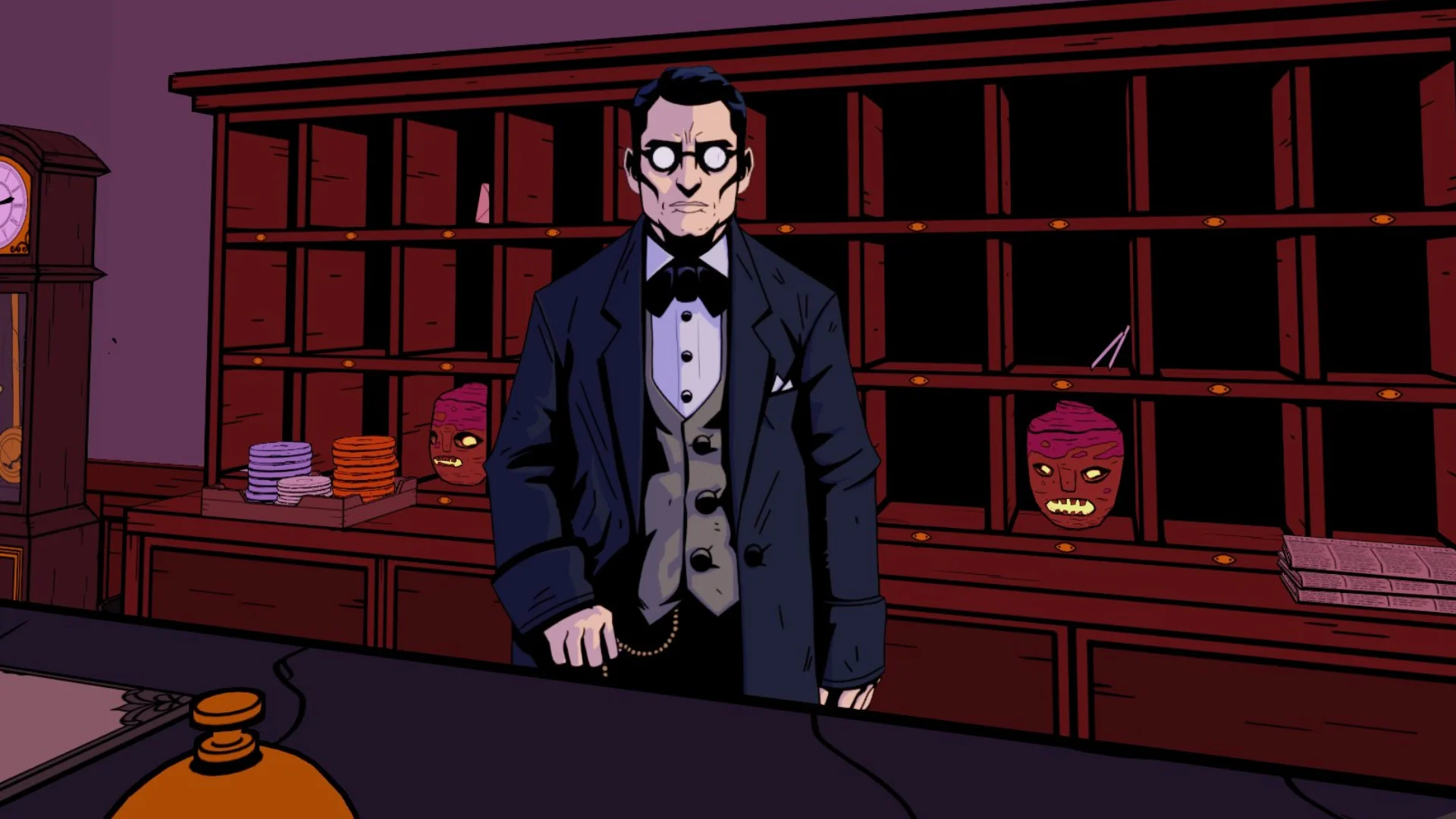
This is it. My ultimate review. You knew it was coming eventually.
Is there anyone who hasn't played Ace Attorney though? I have to imagine there's always someone.
I've been playing the Ace Attorney series (or Phoenix Wright in Europe) for decades. I remember trying it on an NDS emulator way back in 2005 when I could barely get 5fps on it.
When I say decades, I mean decades. It's a trilogy I come back to every 2 or 3 years - it's the perfect wind-down games that you can play while falling asleep because it only moves when you do.
Ace Attorney is a visual novel at heart. It took me years to realize, but that's why once I did I started looking for more visual novels in this style. I realized I didn't dislike visual novels necessarily, I just needed the right ones in the right conditions.
When I say Ace Attorney, I mean the original trilogy: Phoenix Wright Ace Attorney, Justice for All and Trials and Tribulations.
In my opinion, the original trilogy is meant to be played as one game. It's not that each game builds off the last (though they do follow a precise timeline over a few years) - in fact, each game is separated into 4 different cases that have little connection to one another, except through Phoenix, the titular lawyer, and the prosecutor for the game.
But the reason you play through all of it is for the fifth case in Trials and Tribulations. The one that ties everything together between the prosecutors and Phoenix's own past. The entire trilogy is very good, but what you really look forward to is that fifth case. It's full of plot twists following the short-mid-long formula, as I call it. Give readers short-term problems, mid-term answers, long-term plot twists. Things that you thought you figured out get recontextualized with a twist, and then twisted further at the end. Stuff that you already solved and moved on from comes back in a different way, or only fully makes sense later.
What's funny is every time I replay the trilogy I think differently of it. Years ago I thought the twist in the last case was incredible. Then I replayed the games at the beginning of this year and thought it was good, but not amazing or anything. I think it means different things depending on which era of your life you play it. With that said due to my latest playthrough, I think ever17, Virtue's Last Reward, and Paranormasight's twists are better.
But this last case, case 5 on game 3, is still incredible. It's a very nice farewell to the trilogy, the ending that ties everything together and a way for Capcom to thank the players for sticking with them for so long. The only drawback is that it introduces pivotal characters only for this case or game, so the effect is kinda lessened because you didn't grow with them over several games. You do get to know these new characters and appreciate them, but I can't help but think how much cooler it might have been if they had made an appearance in other games, even briefly. I don't want to spoil it but it's basically about Phoenix's past even though you never, ever heard about it before in any of the games. So it's kinda dumped on you as "this is how it is now".
What is Phoenix Wright even about anyway? He's a fledgling lawyer in the first game, barely 24 and bumbling his way to victory. But, he never gives up, no matter how bad things get for his client. And he always seeks the truth, no matter where it might take him. And in the end, against all odds, he makes it out.
You can clearly tell they got more comfortable writing Ace Attorney games as time went on. The first game is shockingly short, though it can be explained by needing to get people acquainted with the mechanics. I think we all thought we were gonna need to learn law to play it at first lol. It's a visual novel where you progress by presenting the right evidence on the right statement, so two conditions. There's no alternative routes or endings, it's pretty straightforward. As they got more comfortable they started making the games harder and introducing new mechanics. The second game was kinda weaker for using not only evidence but profiles - meaning you can present either a piece of evidence, or a character profile on a statement. It makes the game needlessly harder and they correctly removed it for the third game.
These stories live and die on their characters, and everyone in Phoenix Wright is larger-than-life in their own way. At its core it's drama between Phoenix and the prosecutors. The first game is actually pretty down-to-earth and, like I said, absurdly short. I think the third game is about as long as 1 and 2 combined, or at least it feels like it. The characters get progressively more outlandish as time goes on, but it works. Except for the circus case, I hated everyone there and the music too lol.
It's a VN with gameplay, what can I say. you investigate the area of the crime and because this is Japan, everybody hates defense lawyers and nobody will help you. Then you get into the courtroom with a half-baked case you didn't have enough time to prepare for, while the prosecutor has an airtight confession you didn't hear about. Everything is stacked against you, but you still manage to carefully pick apart witness statements until you somehow stumble upon the truth. The real truth. Every one of the 4 cases in each game is different, introducing different characters and a different murder, and every case has its unlikely ending.
It's solid gameplay but it does get a bit stale after a while. They started to introduce new mechanics to vary it up but nothing major before the Apollo trilogy. If you're stuck on something, you're stuck. You won't progress until you find the right combination. But it's alright, just take a break and come back when you feel refreshed.
I guess we need to get into the Apollo Trilogy now.
So game 3 was the farewell to Phoenix, the fledgling lawyer full of piss and vinegar we came to know and love. The trilogy was released between 2001 and 2004 - we only came to know it in the west on the Nintendo DS in 2004 or 5, but it originally came out on the GBA in Japan. It was only in 2007 that Capcom published the first Apollo Justice game, still using a 2D engine but native to the DS this time.
The first Apollo Justice game was perfectly fine. I found it a bit too 'out there' for me, like it was trying to emulate the spirit of the original trilogy but didn't quite get it. The prosecutor was just boring, he's a german playboy who also plays in a rock band and moonlights as a prosecutor in his off time, yawn. Even at 16 I didn't really find it interesting. The game introduced a mechanic during court battles where Apollo can tell the witness is lying and you have to move over a closeup of their sprite while they talk to find the micro gesture that gives it away. This is what I said by the normal gameplay gets stale and they want to freshen it up. But this is less puzzle and more reflex gameplay. I don't know, I didn't really find it engaging.
It's still a good entry, though many people didn't like what they did to Phoenix. What do you mean he left the job? What do you mean he's a pianist? He has a daughter and she's a magician?? Stop!!
I think many of us would have just wanted more Phoenix adventures, and Apollo is not different enough from Phoenix to warrant being a main character imo. They even look similar, and Phoenix barely makes an appearance.
But that was that for a long while, and the future of the series seemed uncertain. After 2007, Capcom published Miles Edgeworth Investigations 1 and 2 only in Japan. They've released an official english port in 2024 but the crafty ones knew how to get a rom and the english patches. They're solid games, they play differently. 1 is just okay, 2 is much better - but you have to play both to get it.
Then they also made a Prof Layton crossover in that time and Phoenix just looks weird in 3D - unfortunately, they'll use this model for the next 2 canon games. It was also a solid game, though it was kinda unfit for Phoenix and focused more on Layton and Luke. It introduced the five witness thing, where you question 5 witness at once instead of just one. Again, kind of adding gimmicks and seeing what sticks. It was still fine, it's just not one I readily come back to playing.
It was only in 2014 that we were graced with a new main series game, Dual Destinies. And... thanks but you can take it back ._.
I tried playing Dual Destinies earlier this year after I finished the trilogy. I couldn't do it. I really couldn't. And apparently it wasn't the first time I gave up, because I saw there was a mid-game save in my 3ds from years ago.
Where to begin? It introduces another MC, Athena Cykes. I like her, at least she's different enough from Apollo and Phoenix, but it's kinda just too much. You play Athena and Apollo is your sidekick, then Phoenix is there (with his horrible 3d model) to help out at times, then there's an anime cutscene where Apollo is wearing bandages while looking wistfully at a bombed courtoom. What are we even doing here? Literally just give us more Phoenix that's all we want 😭
It's a mess. you have the Apollo microgesture mechanic, and Athena has a widget that allows her to calm other people's emotions. I still don't really get how that works. So if they're 'happy' during a witness statement when they should be scared you can point to the contradiction, I think. Like I said, just adding gimmicks so it varies gameplay a bit but it's just getting to be too much.
The story was so bad. So it's the dark age of the law or something, but it's never really explained what that means or how it impacts your cases. they also did it in game 2 already. Someone detonates a bomb in a courtroom, so now there's terrorism in the ace attorney series when before you defended a children's show star or a famous cat burglar. The second case is about a yokai in a rural village and idk, they tried to do something scary? It's just very topical to Japan. The third case is when I gave up, it takes place in a school that makes judges prosecutors and defense lawyers lol. you know, instead of studying law and then choosing a path or becoming a judge after years of practice, you can just go to trade school for it at 17. The prosecutor is not interesting. His whole thing is he plays 'mind games' with the judge when you just want to move on. Godot had a cool laser mask and a jazz soundtrack. There's no competition.
And it's long. And pointless. I stopped when I realized I didn't really care about any of what was happening. I wasn't invested. The terrible 3d models didn't help.
But then something peculiar happened. Capcom made The Great Ace Attorney.
I say peculiar because the first one came out a year before Spirit of Justice, the last of the Apollo Justice trilogy. It took years to get it in the rest of the world - a fan translation project was in the works in the late 2010s and only got the first game, and most of the second game, out before Capcom decided to release all the Ace Attorney games and spinoffs to the rest of the world. You can even get them on Steam now.
The Great Ace Attorney starts in Meiji era Japan (so 1870s or so), though most of it takes place in London with an ancestor to Phoenix. Sherlock Holmes is in it.
It was amazing. The models looked much better - it's a theater play. It's much more focused on the story, and it's long. Very long. I started playing the two games back to back early in the year and it took me months to finish them. By that time it was already late spring. They're not even particularly difficult games, they're just that long to read through.
The only downside I would say is they should be played back-to-back, because the first game ends with cliffhangers and more questions than answers, and the second picks up right where we left off. They are one big game, but thankfully now that they exist in a bundle you don't have to wait 4 years to get the conclusion to the story.
The characters are endearing again. They're fun. Sherlock Holmes is as much of a fool (affectionate) as Phoenix and Naruhodou (the ancestor) are, they pair well together. The ending though is, I mean, there's not really any twists or anything. Actually the second half of the second game is full of twists in rows, but it was also kinda predictable and idk, it didn't hit me as hard as the first trilogy did. But they did fix what I said about the original trilogy's twist: in GAA, you are introduced to all the characters over the two games, it's really a one-shot story. Even people that don't seem connected at first have their role to play (when we met miss Tusspells I thought wait, what is she doing here? Why are we investigating this? but it pays off and makes sense).
The story structure is really interesting. In the original trilogy, the cases start with a murder and you being introduced to your client right away. In GAA, there's more breathing room before the case actually starts. And even when it starts there's some "side quest" that take you away from the investigation. Even when a theft happens and you think that's gonna be the case, no, it's not. It really takes its time more, which is enjoyable. You end up with a LOT of evidence in your folder, more than in any other game combined.
I don't necessarily wish for more GAA games because I think they basically told the story, though I loved Susato's character and I would totally play a game focused on her, but if they finally made a new ace attorney game, I just want Phoenix back where we left him off in Trials and Tribulations with what they learned from GAA. Pretend the whole AJ timeline was just a dream or something. Alas, with how many games there have been and how long it's been since the last one (almost ten years), I'm not sure we'll ever get that.
You still have months of games ahead of you if it's your first time playing the series.
If you want to play the games:
There are iOS and Android ports as well but I can't say if they'll work on modern devices. You're better off saving your money there.
Reminder that I made a switch emulation guide in another post. On my snapdragon 8gb device Great Ace Attorney worked perfectly, though I had to be careful of overheating.

This is a midgame review as I've done before. I try not to write them because it forces me to finish the game, but I have to start with the elephant in the room: I'm not sure I want to finish this game?
Famicom Detective Club is an old series from Nintendo - as the name implies, the games originally came out on the Famicom, the Japanese NES, and didn't make their way to the rest of the world until the 2021 remasters that gave them a full makeover for the Switch. The first two games, The Missing Heir and The Girl Who Stands Behind, came out in a bundle, and were followed in 2023 by a new title, Emio the Smiling Man.
It's an absolutely beautiful remake. The picture attached (from Emio) doesn't do it justice - you need to see this animated. To me this is really the next stage of visual novel graphics. A lot of work clearly went into this, especially with how many different scenes there are (sometimes the camera even switches in a scene, showing a different perspective just for the sake of it. They didn't have to go that far!)
Unfortunately, beyond the surface, you are quickly confronted with an adversarial game.
I bought the bundle when the remakes came out, and already felt the stories were a bit... retro? Nintendoesque? The Missing Heir really wasn't anything to write home about. The game wasn't too long (as expected as it was a NES game and a cartridge back then was like 48kb of space) and the twist was long predictable. I mean, the heir is missing and you wake up with amnesia at the bottom of a cliff. I followed it up with the Girl who Stands Behind and to be honest I don't remember any of it lol, I'll have to play it again. Or maybe I never did - I have it on my switch but I legit do not remember anything about it.
The Girl Who Stands Behind though marks the DNA of the series. From then on, the games started to follow the "urban legend comes true" formula. TGWSB starts with a (fictional) urban legend about a girl who stands behind you in the school corridors and kills you or something. For context, Emio also seems to take place right after the other 3 games (there were 4 games in total before Emio, but only 2 have been translated to English. One was on satellaview and hasn't been preserved) so it's set in the 1980s with the same protags as the previous games.
Emio continues the formula with a fictional urban legend about a man wearing a paper bag with a smiling face drawn on it. He is called Emio by the children for the initials of Smiling Man in Japanese. He finds crying girls and asks them if they want to stop being sad. If you say yes, he kills you and puts a paper bag on your head with a smiling face drawn on it. I don't know, I just don't think fictional urban legends are interesting. The point of an urban legend is that you don't know if it's real or not. A fictional urban legend is obviously not real. It also lacks the memetic factor where it morphs or gets fleshed out with time, instead it all comes from a writer who simulates a legend from their room.
I had higher hopes seeing that Emio had been developed in the 2020s. Instead, it seems to want to follow the formula to a T. The themes are certainly darker - the missing heir was kinda "childish" not as a pejorative, but moreso that it really felt like I was playing detective instead of being a serious investigator. You're 17! What are you doing investigating a murder! You have math class!
Emio though puts you right in the action with the discovery of a dead 15 year old boy in the first minutes of the game. This is where the game started to irk me. I thought, does he need to be 15? Does this story need to happen with children? I'm not against exploring these themes completely, just that I didn't really trust Nintendo to handle it appropriately. That's not exactly their area of expertise. My suspicions started to mount even more when they introduced a character that's suspiciously silent on a missing girl, a student at his school. I thought that's a red herring for sure, it's too big. They want you to think he's a predator, and I didn't really like that either. Again, it needs to be handled carefully. This guy digs a deeper grave for himself every time he's asked about the girl when the only question the detectives need to ask is "stop playing around, you realize this is making you the prime suspect, now tell me what happened between you and this girl?" I'm not at the reveal yet but I'm sure it's something mundane like he was harsh to her but didn't intend to. He's the "loud guy who cares a whole lot" trope.
In terms of gameplay, the game also started to lose my interest. It's come to a point where I don't really want to play more. I don't trust Nintendo to give me a satisfying story (the whole "oooh urban legend comes to liiiiife" bit is really not doing it for me sorry, at least use a real urban legend for it like bigfoot or something). The gameplay takes place through a menu - reminiscent of Portopia again; after all, both series started out in the same era. Except Detective Club has no puzzles or thinking involved.
So it gets me asking, do you really need gameplay? I would have been fine with it as a kinetic VN with just text. That's what it is at its core and in fact it would have been more expeditive. You find yourself going through menus over and over again because you only get like 3-4 lines of dialogue upon clicking the right button. So you have to click it again and again to get the full dialogue, until the character has nothing new to say, then use Think to know what to do next, then click some buttons again and again. Oftentimes you have to Ask->Think->Ask, which is why Think is not a hint system but an integral part of the game. There's no deducing involved or puzzle solving, just tap Think to know what to do next. A kinetic VN would have removed that artificial brake.
Speaking of, there's too many protags. You have MC-kun, whom you name (so I'm not sure if he's the same MC in the remasters, legit don't remember), Ayumi, who is a staple of the series, and Utsugi, the detective agency owner - but he's conveniently always on a business trip somewhere. Again, it feels like they haven't really left the 1980s mystery game design school despite over 40 years experience gained since then. Emio was the same writer as the original games! He's still at Nintendo! Periodically, you come back to the detective agency and have to answer a quiz on the facts of the case so far, except you can't really fail it. This reminds me of Jake Hunter, a terrible detective series also from the 80s, so I have to assume the quizzes that made sure you were paying attention were commonplace back in the day. But this is a 2023 game!
You switch between Ayumi and the MC but it's not really a perspective switch, since they always meet up later to discuss what they each learned, thereby repeating what you just played through. It also seems like everything happens to them, a pitfall I wrote about before. They don't really investigate so much as people tell them stuff. If you want a real character-driven story, play Dynasty Warriors: Origins. It's literally a retelling of Romance of the Three Kingdoms but there you go, that story structure was perfected 600 years ago already.
In terms of other characters they're kind of caricatures. It's expected and even useful to exaggerate their traits a bit but they're all kind of "too much". I can't help but think obviously one of them is hiding their true motives and this will be the big reveal. "You thought I was the calm quiet one, but I'm actually the killer hahaha" or if not the calm one, then the energetic go-getter. It's just too obvious.
The games are also very linear, another part of the Com Club formula. It's not like Ace Attorney where you have to move between locations and investigate hotspots; you are presented with a single screen (though again it looks gorgeous all the time) and have to use the right menu buttons on it, that's it.
All of this gameplay slows things down a lot. Some chapters really don't add much and I think the game could have been condensed more, probably. I'm only midway through, so maybe there's gonna be some funky perspective switch down the line or something.
It's come to a point I don't really care about being spoiled. Yes, it does remove part of the fun - being told "it was like this" just doesn't have the same impact as getting invested in the story - and this is why I wouldn't say too much about ever17 either in my review. I could give the plot twist away and what the story is really about, but then it wouldn't have the same impact to you as it did to me. You'd say "oh, okay". But it also feels like Emio does its best not to get me involved in the story. I mean the game gives you a cellphone and the first two times you have to use it to progress, it's out of battery. Can we focus?

(Paranormasight screenshot; you play in a first-person perspective and can look 360° around you).
Instead, I can't help but think Paranormasight did it much better - Square Enix finally made a good game again. I seriously loved that game. It has similar themes - it starts with the 7 urban legends of Honjo, a fictional town (I think?), except there's actually up to 15 legends, but the people refer to them as 7. It was also a VN. It takes places in the 80s. But wow, that game was great. In fact, I thought it was too short. The urban legends were actually real in that game, which I think elevates the story. That is, it wasn't "oh the supernatural is fake it was just a normal murder" (which why even have that dimension in your story then?), no, the game literally gives you the power of one of these legends at the beginning to tell you all of this is happening. It's also a superpower that basically lets you kill anyone, and so you think damn, if I have that power from the beginning, what else is out there that's even worse?
It's not that I like supernatural stuff particularly, it's that if done correctly it introduces a new dimension to your story. Famicom Club has the same roots, but no supernatural - this isn't a plot twist or anything, it's the formula. At the end of the day, it's a routine police case. Some feathers get ruffled and people move on.
Instantly the scope feels large in Paranormasight. You have a codex with info about the 7 mysteries (or more, remember) and you can't help but think you're gonna get to the bottom of it by the end of the game. But then other stuff happens outside of the 7 mysteries. So we have to solve that too. It feels lively.
Paranormasight also looks gorgeous, though the art direction is very different. It features a non-linear story through the eyes of various characters (narrator switching), unlocking chapters in a flowchart as you progress through each narrator's arc and perspective. And it makes you think to figure it out, especially the 7 mysteries of Honjo which are delivered through clues that you have to solve. It also has tragic stories with high school students, but it handles them with care - I was very happy with how they handled the subject matter in fact. It literally uses game mechanics as part of its storytelling. It recontextualises things you thought you knew in its own mini-twists.
Paranormasight also has SEVERAL protagonists, but they are different enough that you never get lost on who did what, they all have their connection to the events (what's the connection of ayumi and mc-kun aside from the fact their agency was hired to help investigate? Utsugi, the only one with some connection to the case, is almost never around), and they are mostly split into groups so that it's easier to keep track of. The game has a flowchart mechanic with each protag/group on a different line, and you can switch at any time. I never felt lost.
The flowchart mechanic can also be used greatly for pacing, like it did in Virtue's Last Reward. It can put a lock on the next chapter of the story to force you to go play another part, discovering important information before continuing. It feels less forced - Det Club switches you between MC and Ayumi's investigations linearly, and it feels like "why do I care about this meeting in a café I didn't even learn anything". But if you "choose" to play it so you can unlock the next of Ayumi's chapter after the café, then it becomes less grating.
The paranormal is not a stand-in for deus ex machina if you want to use it in a story; it's here to bring your down-to-earth parts of the story to a higher level and give them deeper meaning. Paranormasight is ultimately not about investigating the 7 mysteries of Honjo but about fixing the errors of the past. I don't trust Detective Club to achieve that because you are literally 19 year olds on the case of a dead teen. It's also not a game for children; the rating is M and it will traumatize children if they play it. So why are we playing as a kid? He would barely be old enough to play his own game!
I especially liked the prologue in paranormasight. I guess I'll put it in a spoiler
paranormasight prologue
It starts at night in an abandoned park and has some light horror elements to it (the game makes you literally turn around expecting to see a ghost there). The person you were there with suddenly dies gruesomely, you gain the power of the mystery of Honjo, and you kill every other protagonist. If you collect enough souls, then you can revive any person of your choice. This section serves as an introduction to everyone that's going to be important in the game and sets the tone for the rest of the game. The prologue ends with your death, and the real story begins: you get to choose which of the three perspectives you want to start with, all three people you briefly met in the prologue.
All good horror is about family drama at its core, or at least human conflict. My only complaint of Paranormasight is that it was too short - it's still a solid 12 hours, but I would have wanted 12 more.
Play Paranormasight.

As time goes one has to look at more and more niche games to find their fix.
Finishing up with the Portopia Case, I looked online for something else to grind my teeth on, and landed on the Painscreek Killings. A cold case mystery game that promises investigation, deducing, and puzzles -- and there are not many of these games. Another really good one in the genre is Lorelei and the Laser Eyes. I probably won't write a review on it, but I can recommend that one eyes closed (pun intended).
The Painscreek Killings is a bit older, coming out in 2017. So I'm almost 10 years too late. You begin only knowing two things: you've arrived in Painscreek, and Vivian Roberts died here. Your employer wants to know who killed her.
One reason I'm talking about it, aside from the fact that I want to popularize deduction games (they still don't really have a proper genre name!), is that it really reminded me of Portopia. It's open world and non-linear - something that I thought about often as I walked through the idyllic rural town of Painscreek. Seeing all the Japanese names in the credits I figured oh, there might be something there. Portopia is so famous in Japan it's unlikely there's people who haven't at least heard of it there.
It's open-world and non-linear from the start. You can explore the sheriff's cabin you spawn next to, or just head straight into town. You can even leave immediately, which ends the game with an email from your boss asking for the killer's name—a neat touch, though I accidentally triggered it and alt+F4'd to avoid spoilers.
So you walk around, taking in the sights and wondering where you'll even being, and then... she appears. Scary ghost lady.

There she is officer, she did it. Arrest her. I'm getting out of here.
Yeah, there's a ghost in this game. I could kinda tell from the atmosphere (love a good creepy atmosphere that only hints at things) but it's jarring, in a good way, to come out of a house and see this shadowy figure staring at you from across the river. It also changes the entire tone of the game.
I have to admit from this point on I got spoiled a little as I looked online to make sure there were no jumpscares lol. I will list the spoopy events in a spoiler at the end if you're like me but want to play the game.
The story relies heavily on diaries and documents, which eventually shift from letting you piece clues together to outright telling you "hi it was me i did it". This exposition dump makes the writing feel hamfisted. I've also always found these documents in games funny. Like when you think about it, everyone left town but conveniently left behind the diaries that incriminate them so you could piece the story together.
Due to this the game overstays its welcome a bit. The story is not particularly difficult to piece together - I got most of it by the midway point, but still had to keep going. The game repeats a lot of stuff you've already figured out (because it's non-linear and you need the clues).
So there is a walking sim aspect to it. The thing with non-linear storytelling is at some point you've gone as far as you can on a lead and have to look somewhere else. So you've done everything you could in one location, which means going to another location. You find a clue there and it brings you back to the location you were in before because it opens something up. See what I mean? You do a lot of back and forth the more you progress through the game. Like I said at some point I was ready to turn in. It wasn't a mystery anymore and I wanted info on other leads.
I had to pick up a walkthrough for a bit of it. It completely ruins the fun because you might just have missed a clue to know the solution to the code or where to find the key, but at the same time, you kinda have to pixel hunt. It's not as bad as in some games but for example I could not progress at some point because I forgot to check a drawer in a much earlier location. I would have never caught that by myself, there's literally dozens of places to go back to. The lightning engine is not great and you can definitely miss stuff because of it. There is also one puzzle that has a clue in the same room but wow, first of all you have to notice it, second of all you will have no idea how the two fit together.
Oh yeah, and take notes so you can keep track of things.
At the end, you can leave the town, or you can achieve the 'true' ending, and... guess I'll put it in spoiler?
true ending
The chase was just dumb lol. I knew it was coming because I looked it up. I liked the health bar popping up, the notice "You cannot save from now on" and how it was announced, with the sound of the door. But you're unbearably slow even when sprinting and obviously the killer is not any faster than you or you couldn't win. The ghost lady guides you but... badly. Instead of appearing and pointing the way left or right, she just appears in front of you. Okay thanks but where do I go after that? It was kinda long, though I won on the first try. The killer's model is kinda funny when you look at it. Looks like a 15yo hacker, with his black hoodie and jeans lol.
I would honestly prefer an ending where you just leave in your car and submit your story to your editor, and then there's an epilogue or something based on what you found out.
Despite what I'm saying, it's still a recommend from me. There are things that could have been improved, and I believe they did incorporate the feedback into their 2023 game Scene Investigators (notably that game lets you piece together the scene from just the clues), but it also does a lot of things right. For example I really liked how the town was laid out and that even some doors that could not be opened could still be interacted with. It gave a sense of scale. I liked the nonlinear attempt, even if it didn't hit the mark all the time. I liked the atmosphere as well. I liked that there was no time rush - I would have actually appreciated if your character could sit down on chairs while I was writing down my notes, just so it didn't feel like I was standing in the middle of the hallway with my notepad.
But in terms of lasting impact, I think I will forget about it soon. I'm still thinking about Ever17 and that was a week ago already. Feels longer.
And here are the sightings if you're a scaredy cat like me. I can't help it there's too much materialism in my body.
ghost lady sightings
As far as I can tell, the scary events are here:
Otherwise there is nothing scary. The hospital lights stay off for a long while but nothing will pop up or appear, not even in the creepy sewers.
At first I was like holy shit but upon reading, it's very different from what the headline makes you imagine. DPRK destroyed roads on their side of the border that connect to ROK through the DMZ. It's a defensive measure that signals they don't intend to use the roads either for the foreseeable future.
Wishing her gold after what she endured.
being gay is bad, amirite fellow liberal?
That's the point! Ukraine really sees itself as the center of the world currently, and anyone who is not cheering for them, they think is against them. Reddit country.
Winning behaviour is when you antagonize a third of the world's population lmao
Reported for being "clearly propaganda" 🤓
(notice they don't dare say it publicly in the comments)
Liberals (passive supporters of capitalism) only have two responses when they meet something that conflicts with their worldview: either they pretend it doesn't exist or, if they are forced to reckon with the fact that it does, they will bend over backwards to try and prove that it's not actually what it says. See how the USSR wasn't "real communism" -- something only liberals say, I have never heard a communist ever say that.
They are in the first phase right now, where they can pretend I'm wrong and not describing reality. Thus they retain the moral high ground as described in the post.
When have "libertarians" ever won a physical fight anywhere lol. We have actual revolutionaries who fought on the frontlines like Che and Castro, Lenin, Ho Chi Minh, Mao.
you have this goofy cartoon
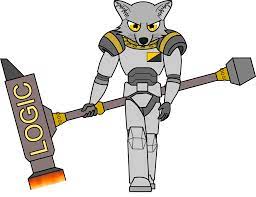



the communists discussing Stalin have managed mass production of tanks meanwhile the anarchists are still sitting on the ground (presumably because they didn't find anybody who likes building 100 chairs in their spare time). MLism undefeated 😎