117
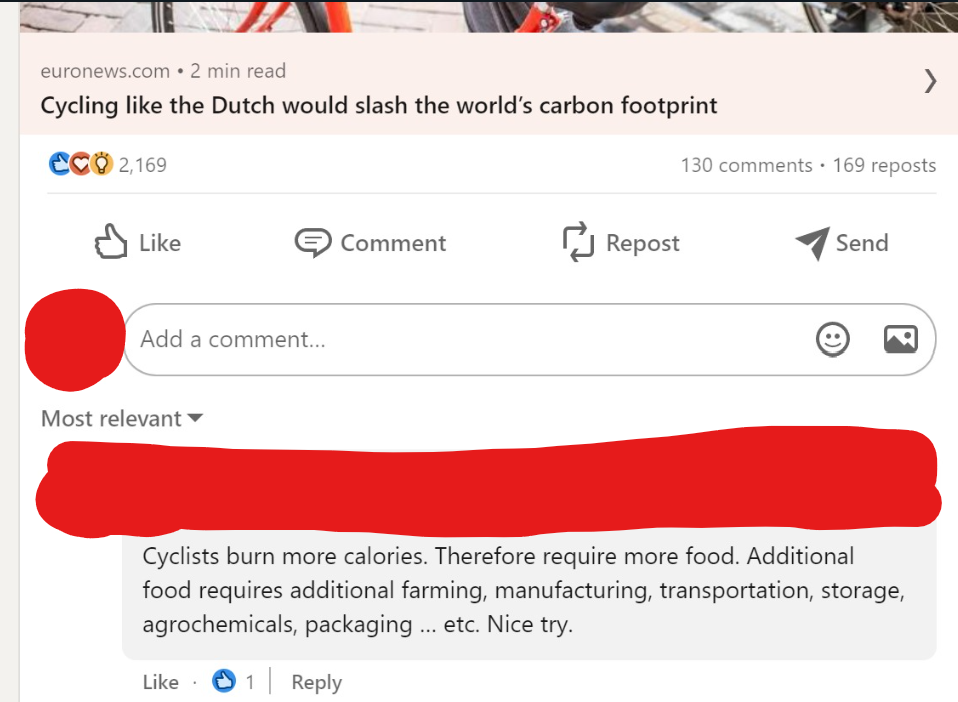
This has to be satirical
Wait until he finds out how many calories gasoline has
That's why I drink a can of gasoline before every run
You should see how many calories are in plutonium and uranium. If you eat a pellet of either one it will be the last meal you'll ever need in your life!
That's cute. No other personal vehicle beats the caloric efficiency of a bicycle, and it's not even close. They're very literally one of the most impressive feats of engineering that human kind has ever invented.
You know you're on the right side when you're arguing against humans exercising more!
They're always more concerned about being right, instead of correct. :p
Alright, I'll take the bait. Let's do some recreational math
This web page contains average passenger car fuel efficiency broken down by year. The most recent year available is 2016, so we'll use that: 9.4 km/L or 22.1 miles per gallon. A gallon of gas has about 120MJ of energy in it. So, an average car requires about 120,000,000 / (1/22.1) = 5.4MJ per mile
This web page has calories burned for different types of exercise. I separately searched and found that the average adult in the US weighs around 200LBS, so we'll use the 205LBS data, and I'm going to assume that "cycling - 10-11.9 MPH" is representative of the average commuter who isn't in too much of a hurry. That gives us 558 calories per hour, or 55.8 calories per mile (using the low end of the 10 to 11.9mph range). That's equal to about 0.23MJ per mile (as an aside, it's important to note that the calories commonly used when talking about diet and exercise, are actual kilocalories equal to 1000 of the SI calories you learned about in school.)
Moral of the story: an average bike ride consumes around 20x less energy than an average drive of the same distance.
We also gotta keep in mind that cycling makes people healthier, so it has that benefit, and that it can also potentially replace some exercise people would be doing otherwise, in which case you're basically moving for free since you would have expanded those calories anyways.
You mean I don't have to drive to the gym anymore if I cycle to work?
Worth noting that cars can fit more people in them than bikes can.
So with that in mind, clearly the true moral of the story is that clown cars are the most efficient method of travel.
Holy shit what kind of cars does that study take into account/what type of vehicles do people drive‽ (Granted I do not know how fuel [in-?]efficient worries/trucks are but O.o)
And yes I am aware that 2016 is 9 years ago now, but I know I am driving badly when my car consumes slightly more than half as much fuel as this average and I am rapidly thinking about just how much money some people/companies are spending on gas!
No one tell them how many calories are in a tank of gas
I'd like to see his diet and shape, but already have an idea about it
Well one of those is very likely "well rounded"
Every type of anti-environmental person seems to just have no grasp of numbers as a concept. I worked in wind for a while and one coworker was a guy taking a break from the oilfield. He really thought he had something when he was like 'golly is that an oil based lubricant? in a supposedly green energy? hyuk hyuk looks like oil isn't going anywhere.'[this is barely an exaggeration he was a walking caricature of a hick] Just absolutely 0 ability to perceive a difference between burning 100 gallons a day of something vs using 10 gallons a year.
Similar vibe to "you claim to be vegan and yet you eat bread, and some field mice probably got killed when harvesting the wheat to make it. Checkmate, I've just invalidated your entire belief. Why aren't you ordering the steak now?"
And yet cyclists still consume less per day than that 400 lb dude in an F150.
Now imagine what this guy would eat if he was cyclist. Checkmate again. You libtards are so easy to burn.
You don't get it, a healthy menu consumes much more volume of food that needs to be transported, per capita. Imagine if everyone ordered a head of lettuce instead of a sneakers bar. How many lettuce trucks we'd need??? It's just not sustainable.
My cabbages!
Trains are very energy efficient. Is this person advocating for putting trains on every road?
Ohh noooo. I guess if it's the only way.
I hate to be that guy, but this is true. Before you pull out your pitchforks, read this explanation.
I take a bicycle to essentially all of my local errands, so I thought it would be cool to write an app that calculates how much CO2 emissions you've saved based on the number of errands you've run by bike (by distance). I wanted to consider everything, like food intake, emissions associated with manufacturing, etc. To be clear, the exact emissions varies wildly depending on what numbers you plug in, but it almost always comes out in favor of a passenger car. To be clear, this only considers CO2 emissions, and ignores noise polution, microplastics, and other potential environmental issues.
Long story short, if the following things are true, you'll probably release less CO2 by taking a car:
These assumptions do make quite a few concessions, but I think it's fair to say the majority of Americans fit these criteria.
In order of CO2 emissions per mile using the same assumptions as above (lowest to highest):
This is not me suggesting cars are better for the environment overall, but it's an uncomfortable fact that humans are wildly inefficient at converting chemical energy into kinetic energy. Just think about the fact that when you burn 1000 extra calories per day, a significant portion of those calories had to be driven hundreds of miles on a diesel truck after spending months/years being grown on a farm.
Here's the factors I considered. Let me know if you can think of anything I missed and I'll re-run the numbers:
Here's some things I did not consider:
I guess the moral of the story is that being vegetarian is significantly more impactful than cycling to work (I say as a non-vegetarian cyclist).
My understanding is that humans pretty much use about the same amount of calories a day, whether sedentary or not. If you spend more on exercise, your body spends less on other things.
https://www.science.org/content/article/scientist-busts-myths-about-how-humans-burn-calories-and-why
The amount your body uses just to stay alive dwarfs what you'd burn from adding cycling to your day.
Edited to add the "much" that I somehow deleted.
One other interesting thing is brown fat. Dr Karl told this story loads of times on the 5live science podcast, so it's bound to be in one of the 2010 or 2011 episodes.
Iirc: a group of women went to Antarctica and put an a lot of body fat beforehand. But even after that, the cold was so enough to make their bodies turn their white fat into brown fat and they lost a ton of weight.
Not the Dr Karl episode: https://www.bbc.co.uk/programmes/articles/5nrBw8X5NhXxv04J7H1vn2J/the-body-fat-that-can-make-you-thin
So the answer is live somewhere freezing for a bit if you want to lose weight.
(In my case, for some reason eating chocolate helps keeps my tummy fat down. I ballooned after giving it up, even though the rest of my diet was the same.)
Cyclist burn more calories
So does jogging, swimming, dancing, and...sex? Anything that isn't sedentary lifestyle gonna burn more calories. But OOP doesn't need to worry about any of those.
If you drive in a 25 miles per gallon vehicle (pretty standard) you will burn the equivalent of 1100 calories per mile. Assuming an active person who rides their bike a lot eats around 2500 calories a day, and they ride to work every day, and they live 5 miles away. In the car you would burn about 11,000 calories a day, in the bike you would never burn more than 2,500 and that ignores the fact that actually most of those calories have nothing to do with the biking.
Also, one year of an average American driving (around 14,000 miles) would have the equivalent calories of giving 16,000 people a proper meal.
I read a carbrain article a while ago that tried to argue that cyclists create more CO2 than a car.
So to compare that they assumed that
And with that setup the cyclist actually created more CO2.
The author seriously booked that as a win for the car, claiming that cycling is not always better for the environment than driving.
This is why ebikes produce less CO2 per mile than regular bikes. Even if you're getting your electricity from coal, battery and motor efficiency are so much higher than food digestion and muscle movement.
The ebike starts life from the factory with a higher CO2 cost, though, and it never quite catches up over its expected life.
Both are orders of magnitude lower CO2 than a car (both production cost and per mile cost). The lifetime CO2 cost of an ebike vs normal bike is so small, and the gulf between either of those and a car is so big, that anyone pointing to this in favor of cars is an idiot. If an ebike is what gets you to bike more, do it. Any movement from cars and onto bikes is a huge win, battery or not.
I seriously doubt that it would be better "even of you get your electricity from coal".
I did a project on coal plants in college. Our research showed that a single coalplant in Germany (as of 2012). Produced more pollutants in 1 month. Than every single registered vehicle in Sweden combined, over a whole year.
I'm not trying to say driving a car is better If you could take a bike. Don't get me wrong.
I just think you're underestimating just how incredibly bad coal power is.
You would be better off charging your batteries from a diesel generator, than from electricity produced by coal.
A place to discuss problems of car centric infrastructure or how it hurts us all. Let's explore the bad world of Cars!
1. Be Civil
You may not agree on ideas, but please do not be needlessly rude or insulting to other people in this community.
2. No hate speech
Don't discriminate or disparage people on the basis of sex, gender, race, ethnicity, nationality, religion, or sexuality.
3. Don't harass people
Don't follow people you disagree with into multiple threads or into PMs to insult, disparage, or otherwise attack them. And certainly don't doxx any non-public figures.
4. Stay on topic
This community is about cars, their externalities in society, car-dependency, and solutions to these.
5. No reposts
Do not repost content that has already been posted in this community.
Moderator discretion will be used to judge reports with regard to the above rules.
In the absence of a flair system on lemmy yet, let’s try to make it easier to scan through posts by type in here by using tags: