1235
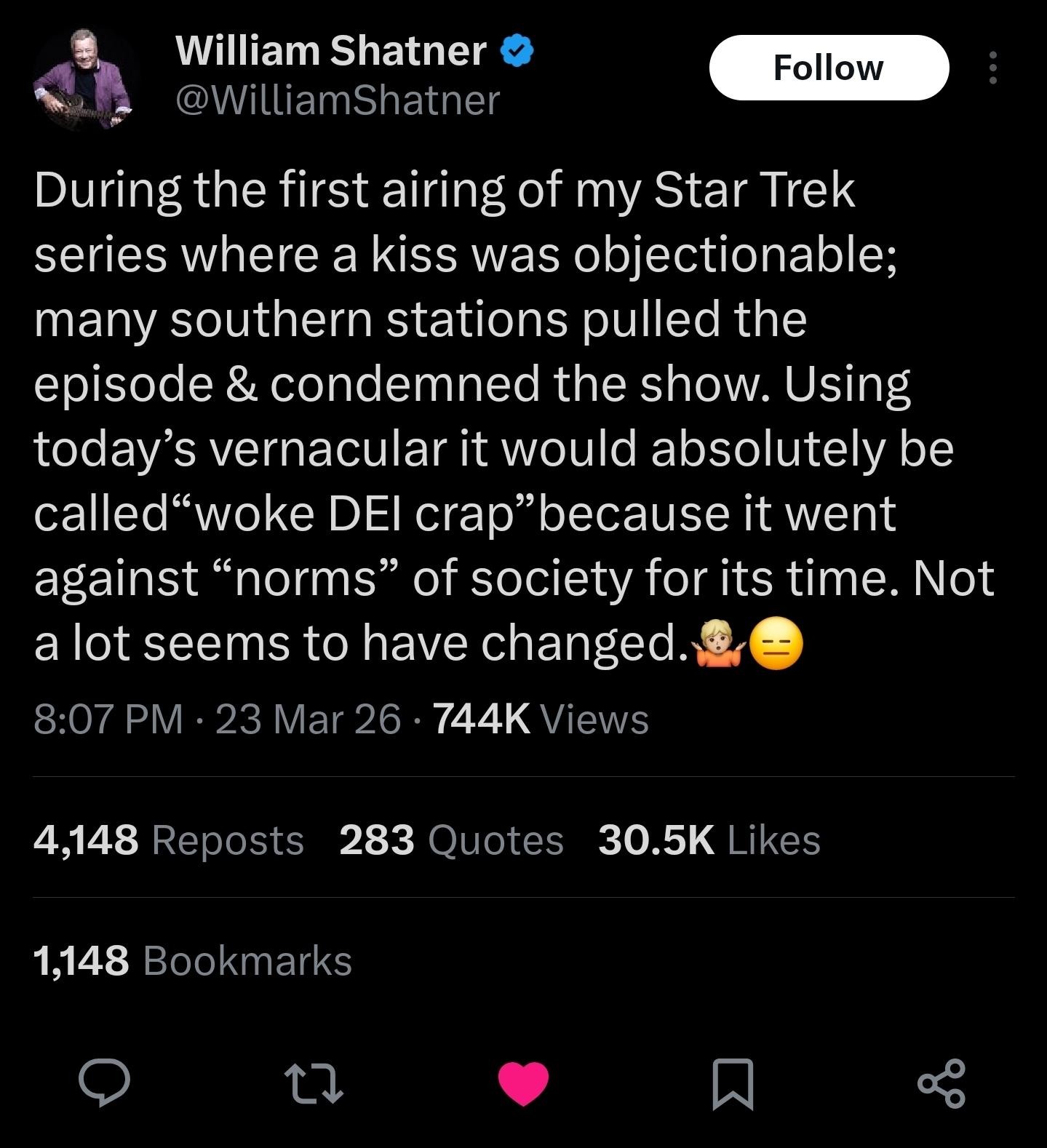
It's sad that people completely misunderstand what Star Trek is about.
(media.piefed.world)
r/startrek: The Next Generation
Star Trek news and discussion. No slash fic...
Maybe a little slash fic.
Rules
1 Be constructive
All posts/comments must be thoughtful and balanced.
2 Be welcoming
It is important that everyone from newbies to OG Trekkers feel welcome, no matter their gender, sexual orientation, religion or race.
3 Be truthful
All posts/comments must be factually accurate and verifiable. We are not a place for gossip, rumors, or manipulative or misleading content.
4 Be nice
If a polite way cannot be found to phrase what it is you want to say, don't say anything at all. Insulting or disparaging remarks about any human being are expressly not allowed.
5 Spoilers
Utilize the spoiler system for any and all spoilers relating to the most recently-aired episode. There is no formal spoiler protection for episodes/films after they have been available for approximately one week.
6 Keep on-topic
All submissions must be directly about the Star Trek franchise (the shows, movies, books, etc.). Off-topic discussions are welcome at c/Quarks.
7 Meta
Questions and concerns about moderator actions should be brought forward via DM.
Upcoming Episodes
| Date | Episode | Title |
|---|---|---|
| 02-19 | SFA 1x07 | "Ko’Zeine" |
| 02-26 | SFA 1x08 | "The Life of the Stars" |
| 03-05 | SFA 1x09 | "300th Night" |
| 03-12 | SFA 1x10 | "Rubincon" |
| TBA | SNW 4x01 | TBA |
Upcoming Trek
Strange New Worlds (TBA)
Starfleet Academy (TBA)
In Development
Untitled comedy series
Wondering where to stream a series? Check here.
I mostly agree, but with shows like Starfleet Academy, the writing is bad in part because of the forced inclusive themes. You're broadly correct: these could be handled with tact for a better show. I still think these themes are handled best when they give the audience room to consider nuanced and complex ideas. Don't shoot me, but instead of a classic New Generation episode I'm going cite an episode of The Orville - "About a Girl". Bortus and Klyden have a baby, who is born female. They try to argue that she should be allowed to remain female, but ultimately the court rules that she undergo the Moclan gender reassignment procedure.
This touches on contemporary issues but also doesn't present the situation as "this side is 100% right, and this side is literally Hitler." The audience is actually left wondering, where does this sit in the contemporary debate? If a child is born one sex, should they be given the right to remain as that sex? Or should a court be allowed to step in and reassign sex? The episode also brilliantly explores the difficult dynamic between Bortus and Klyden, and doesn't portray one as a cartoon villain and the other as a male Mary Sue.
This is where New Trek fails horrible. Zero nuance. Everything is presented in the first 10 seconds as "this is good, this is bad. Accept the message we are feeding you are you are a bad person." That's not Star Trek. Most importantly, that's not interesting. It's not good storytelling. It might appeal to people who really like circlejerking about that particular issue, but that's a minority of people.
That's a lot of words to not provide a single example from a show of what makes "forced inclusion" different than "inclusion"
EDIT: Before anyone bothers clicking through the replies, he never actually explains himself or why he's parroting a common right wing buzz-phrase to discourage the presence of minorities in media.
Someone asked that question two hours ago and I replied with two examples. It's underneath my comment. I'm not sure which application you're using to browse Lemmy but you should be able to see it.
I saw that but I didn't see anything about what makes inclusion "forced" in one series but not in another.
I thought I did a reasonable job of explaining the narrative distinction in my comment. Maybe you could be specific about which part you don't understand, or which part with which you might disagree?
yeah sure so im curious to know what "forced inclusion" means and how we're supposed to tell it apart from regular inclusion.
Which part of my explanation did you not understand or disagree with?
Your explanation didn't explain what "forced inclusion" means and what makes it different from regular inclusion. Maybe you could give an example of each from Star Trek?
I think it did. If you disagree please tell me how. I provided two examples.
Your two examples didn’t explain what “forced inclusion” means and what makes it different from regular inclusion.
"Nuh uh" isn't an argument. If you won't read the comment then I won't be able to give you a meaningful reply.
Your examples provided made no mention of "forced inclusion" or what makes it different from regular inclusion.
I clearly explained the distinction despite not using the term "forced inclusion," which I didn't raise. You did. I can't reply qualitatively unless you explain which part confuses you.
...this you?
What does “forced inclusion” mean? What makes it different from regular inclusion?
Yes, in response to this comment.
I didn't raise the topic. I replied to it. I presume you can see that comment? Are you using an application which truncates the discussion? If you disagree with something, feel free to tell me what :)
You introduced the term “forced inclusion”. What does that term mean? What makes it different from regular inclusion?
I can't speak for the other poster, but the way I see is is that "forced inclusion" is where the script directs viewer attention to it in a protracted, unnatural manner that is not pertinent to the plot. For instance, the script may be as blunt as a character saying "Wow, I can't believe you made it this far despite being a [marginalized out-group]," or it could be a little more subtle by offering a stereotyped representation of [marginalized out-group] without any kind of deeper exploration. i.e. Tokenism
Star Trek, for the most part, dove into social subjects deeper, more meaningful way than other media at the time. Like other users have pointed out, TOS confronted racism and gender roles head on by placing a black female character on the bridge. By never drawing attention to those traits, the show issued such a strong rebuke against racism and male chauvinism that no more needed to be said. In my view, that is inclusion that is not forced upon the viewer; it is implied, but unless the viewer is explicitly looking for it, they'd never notice.
Ok makes sense but did SFA do that? If so, when?
Can you give me a practical example of Starfleet Academy lacking the kind of nuance you would like to see?
A specific example would be “Vox in Excelso.” Jay-Den learns the Klingons have become an endangered people after the Burn, General Obel Wochak rejects the Federation’s offer of asylum on Faan Alpha because accepting it as charity would dishonour them, and the episode resolves that by staging a fake battle so the Klingons can claim the planet “by conquest”. To me, that lands too neatly. The episode tells you very quickly that the Federation position is the sensible one and the Klingon objection is mostly pride that needs to be worked around, rather than really sitting with the possibility that their view of dignity, sovereignty, and survival might have more weight than the script gives it.
Another example is “Ko’Zeine.” Darem is pulled back to Khionia for an arranged royal marriage to Kaira, and the episode is clearly building toward the conclusion that suppressing your real self for duty and tradition is tragic and wrong. That is a fair theme, but the show signals the moral endpoint so early that there is not much room left for genuine ambiguity. Kaira ends up being understanding, Jay-Den is framed as the voice urging honesty, and the traditional path mainly exists to be rejected. Compare that with something like older Trek, where you were more often left to wrestle with whether duty, culture, and individual freedom could all make a legitimate claim on the character at the same time.
So when I say the show lacks nuance, I do not mean it should avoid these themes. I mean it too often starts from the answer and then builds the episode backwards, instead of letting the conflict stay uncomfortable long enough for the audience to think. And when the story concludes, they make it VERY clear which way the audience is expected to land. They do not allow for any ambiguity or moral disagreement. They present the "right and true" path, and make it clear that any deviation is wrong and immoral.
I am not disagreeing with you, but old trek does this all the time.
In season 5 episode 17 (the one with the J'naii androgynous race) the setup is exacly the same as Ko'Zeine: from the start you get the answer that suppressing your true self is bad. The J'naii are seen as bigoted and the federation position as the right one. I do not think there is any ambiguity about which side the viewer is supposed to take. The only difference is the end result. Or look at how Dr. Crusher treats Klingon ritual suicide in season 5 episode 16: their culture is treated entirely as a stubborn, barbaric hurdle to be overcome by the 'sensible' 24th-century human perspective.
And TNG is also full of examples of "the federation knows best". In Season 7 Episode 13 the federation works around a similar problem with the forced migration on the holodeck. Or Season 2 Episode 18, where the enterprise force the merge of the Bringloidi and the Mariposans. Or when in Season 1 Episode 8 we dismiss Edo society position immediately as immoral despite them living in a paradise society.
That's fair, and to be clear, I do not think the point is that old Trek was always perfectly nuanced and new Trek never is. Of course old Trek had plenty of episodes where the writers clearly had a preferred moral conclusion. The difference, for me, is in how often it still let the opposing view feel internally coherent, emotionally serious, and worth wrestling with before the resolution arrived.
Take The Outcast. Yes, the episode clearly wants you to sympathise with Soren, but the J’naii are not just framed as sneering idiots for 45 minutes. Their position is tied to a broader social order, Riker cannot simply speechify it away, and the ending is bleak rather than triumphant. Same with Ethics. Crusher is obviously the more humane voice, but Worf’s position is not treated as random barbarism. It comes from honour, fear, identity, and a real cultural framework, which is why the conflict works at all. You can disagree with how those episodes land while still admitting they spend more time inside the conflict.
That is really my criticism of newer Trek. It is not that it has politics, or even that it has a preferred answer, because Trek always has. It is that newer Trek too often signals the answer immediately, flattens the dissenting side into an obstacle, and then resolves the issue in a way that feels morally pre-approved. Old Trek could be didactic too, but it was more willing to leave the audience sitting in the mess for a while. That is the distinction I am getting at.
I understand your point, but I think you are having a lesser opinion of new trek because you are missing some of the messages they want to share with the viewer.
In Ko’Zeine the conflict is not between self and tradition, but more about the internal conflict of Darem. The enemy here is his own crippling self-expectation, not society. I think this conflict resonate a lot with modern morality topics such as LGBTQ+ acceptance.
In Vox in Excelso is the same: the fake battle is a compromise. Both the federation and the klingon knows it is a farse. But they go with it anyway as a way to preserve their own self representation in a post burn galaxy. To me Vox in Excelso is political realism. The klingon are not treated as an obstacle to be tricked, but as political partner in a mutual charade. In the episode this is explicitly framed as a klingon solution to a klingon problem.
Either way, I feel the narrative is pre-approved, telegraphed at every opportunity, and leaves no room for ambiguity. I'm sure this theme does resonate with some people, but it's not good storytelling. It doesn't resonate beyond that small group.
Re Vox: I agree with your description of the storyline, and I am not disputing that is how the story was told. My point of contention is that the correct outcome was pre-approved. We all knew the "right" choice from the moment the choice was presented. There was never any doubt that the Klingons were wrong. Never any sympathetic exploration of the reasons for their cultural beliefs. Never a moment of critical self-reflection for the viewer. We were told up front "the Klingons are wrong, and we are going to take you on a journey to show you WHY the Klingons are wrong, and how we solve this problem of them being wrong." It is more akin to an action movie than a Star Trek episode. We all know who the good and bad guys are, and we're just excited to see shooty lasers on our journey to the foregone conclusion.
I appreciate you referencing the Orville's most pivotal episode. And honestly, the twist involving Klyden's reasoning for reassigning Topa, as a trans sci-fi nerd, broke my heart.
Spoilers about the most crucial arc of the story
That's the perspective that a lot of people don't have when they see that episode. It's easy to take Klyden's lawyer's argument as legitimate when he makes the point of comparing it to the cultural version of a cleft lip.And then Haveena walks into the room. And she proves, conclusively, that she is a woman and she would never choose to be anything other than what she is. That her gender is a gift. And then, later on, we see the hidden planet of the female Moclans, and it is so radically different from Moclus that you'd hardly believe this is the same species.
We see Moclan men testing weapons anywhere they please above civilian airspace, and the backdrop is an industrial wasteland because they never developed ecocentrism... because safety laws, industrial regulation, and other 'soft' ideas went unobserved and unvalued.
Contrast the Hidden Planet, and we see Moclan women, dancing in a style that they invented, revering the planet that protects them. We see women warriors carefully watching the Orville's crew as little girls play in the street. It feels indescribably very... honestly, African. I can't put my finger on why, but it does.
All of those differences are deliberate. And they were set up very, very early.
I agree completely with your point about the Orville. It was really well done.
I don't agree with your assessment of New Trek, however. I know it's all very variable and I don't want to generalise, but even if we accept this:
Then, I have to point out the obvious: if it's so lacking in nuance, then yes, if you don't accept it you are a bad person. For example, if it's saying, "gay people are ok and normal", there's no subtlety to that because it's not something anyone in the future will hopefully give a shit about. And if someone in their society did, then yes, they would be in the wrong. 100%.
But this is exactly my point. "Gay people are ok and normal" shouldn't be a plot. It's like a "murder is bad" plot. Yes, murder is bad. We know. That's just not an interesting theme to explore. Maybe if it were presented as a trolly problem, where a crew member were forced to kill someone in order to defend their own life, or the life of a friend, that could be an interesting plot. Forcing the viewer to explore the tension of morality between killing or being killed, or taking an innocent life to save another innocent life. That could be interesting television.
We could apply this to a "gay" plot as well. What if the crew met a civilization that were on the brink of extinction for some reason, and they had outlawed homosexuality for reasons of survival. The crew could explore the tension between individual liberty and existentialism. Someone might argue, "our civilization doesn't deserve to survive if we strip people of such basic human rights." Another might argue, "if our civilization is to survive we must make hard decisions as we have always done during war and other crises." They might argue it's only "temporary," and someone else might argue, "it's been 30 years!"
The issue is driven by one-dimensional plot.
Trek expresses gay people being normal. It's explicitly not the plot. There's no plot point about it. The plot is about kids (for a certain Steve McQueen value of "teenager") being in school and battling Space Foes. I'm picking on "being gay" as a point because I imagine it's what the people who cancelled the show had an issue with, but I could well be wrong.
There was no exploration of the things the right-wing hate in Academy. They just exist. There's no ongoing plot about anyone's sexuality, or if you think there is then it's dwarfed by the same plot with other straight characters.
It sounds so much like saying you can't have a gay character unless there's an interesting moral plot point about why they're gay. That's not what Academy did.
If these themes are ancillary and not the one dimensional focus, no problem. In Ko’Zeine, the entire episode arc hinges on Darem being gay. It is the plot. To make it worse, there was never any ambiguity. The writers telegraphed the “correct” outcome from the beginning and never let the viewer stew in any kind of reflection or moral dilemma. We knew exactly what the outcome would be and the only reason we watched was to see how we would reach the only “right” conclusion. That’s not good storytelling. It’s a poor choice of plot. So would be a “murder is bad” plot. The issue isn’t a gay character existing. We have plenty of examples of gay characters existing in media in which “the right” takes no issue. See Six Feet Under, Will & Grace, Willow in Buffy, Remy in House, and a thousand other examples.
The issue is the poor writing. I levy similar criticisms of any writing like this. If these episodes revolved around “I’m short,” or “I’m ugly,” or “I’m fat,” they would also be uninteresting. There needs to be more complexity and moral ambiguity to provoke thought. I don’t watch Star Trek for the flashy lights. I watch it for the interesting dilemmas. Academy is the very lowest brow Netflix slop I could imagine.
None of that episode hinges on Darem being gay, though? What would have changed if he was straight? It's not the plot. The plot is that he has responsibilities to his home world and has new found family with Star Fleet.