43
Finally, someone asked the most important question for the fediverse!
Finally, someone asked the most important question for the fediverse!
Although Paramount+ now streams all the live action Star Trek shows in Canada, BellMedia’s CTV Sci-fi Channel has continued to provide linear cable programming for many of the Star Trek shows, including Strange New Worlds.
It wasn’t clear whether Starfleet Academy would also be available on CTV in first run. It’s now appearing in the television listings with a double episode premiere starting at 9:00 pm Eastern Time.

Treklit has some great offerings. The Relaunch universe books in particular developed coherent serialized storylines and a group of strong authors. There is also a deep library of standalone books from across all eras of the franchise.
By contrast, serialized Star Trek is struggling onscreen. Of the current era, only Prodigy has excelled in serialized storytelling.
So, why not look to the books? Not just to lift an idea like Control or the end of the Borg, but to actually tell a coherent narrative across a season or season?
On Netflix, Prime and Apple, it’s become established that successful streaming shows are often based on novels and novel series. Those streamers have come to understand that novelists, not scriptwriters, excel in laying out long form storytelling, and resources are often better put in having the screenwriters adapt than create from the whole cloth.
Reading a recent interview with Mick Herron, author of the critically acclaimed and popular Slow Horses on Apple, with a second show based on his other books launching this fall, I was struck by the interviewer’s assertion of this truism.
I thought about several of the non franchise shows I enjoy and how many of them are more or less faithful adaptations of books.
I was also struck by the thought that both Skydance and Paramount are quite capable of producing excellent book adaptations for Netflix and Apple. Murderbot is a very current example.
So, what’s holding back Star Trek from exploiting the Vanguard series or the Starfleet Core of Engineers books?
Why insist on giving showrunners resources to keep retelling franchise stories with legacy characters and tropes?
Why not exploit that IP that Paramount already owns by adapting the best of decades of TrekLit?

This really is a great piece.
Interesting first-person perspective on Carney as a fellow graduate student at Oxford.
But it was the latter half of the piece, that reflects on how Canadians who study in the UK or US are constantly subjected to overly aggressive declarations that deny Canada as a nation, which really hit home for me.
As a Canadian who attended graduate school in the US, I experienced almost verbatim every denial and put down in this piece.
And so many more constant and dumbfoundingly bizarre nonsequitur microaggressions. (One of the American I shared office space with lashed out that Canadians didn’t have any ‘real’ Black people so we had to borrow them from Jamaica to compete as athletes in Track and Field.)
So many of these offensive remarks were self contradictory - e.g.,
Canada doesn’t exist as a nation or culture but at the same time Canadian students are vocally criticized for being ‘so nationalistic’
there’s no need to include Canada in a listing of macroeconomic indicators of major economies because it’s ‘just a regional economy in in North America’ but only the US indicators are included. Meanwhile, California is profiled and discussed as a separate economy because it’s ‘so large’.
or a renowned professor who I worked for as a research assistant observing at some random point when he realized where I had done my undergraduate degree ‘Oh, you went to a real place’ - which given how difficult it was to get into that school and program, should never have been a question.
Several Star Trek licensed games are on Steam, now at a significantly discounted price for the annual Star Trek Day celebration.
These include the MMP Star Trek Online, but also single player games Star Trek Bridge Crew and Star Trek Resurgence (a choose your own path role play game).
We’d waited until Resurgence came to Steam, because we did want to buy it from Epic, but decided to be even more patient and wait for a sale so we could get it for our teens as well. I’ve been playing in parallel with one of our teens and debating the impacts of our very different choices.
I have had Bridge Crew since 2022, but we got copies for the teens yesterday. One is into it. It requires running an Ubisoft account synched to Steam which can be annoying, but otherwise G2G.

Having reached my exasperation on the total lack of information from Bell Media on a Canadian release, I asked @GoodAaron@mastodon.social if he or the Hagemans could share any information. Here is his reply on Mastodon.
It’s great to have EPs who will engage with us.
I’m still gearing up my recipes for a Star Trek Prodigy Soirée for the premiere!
In case you haven’t seen this, CBS entertainment sponsored a social media influencer to develop watch party ideas for the Prodigy Season 1 finale Supernova Soirée .
I’ve been experimenting and building on some of these ideas for the premiere of season two. One of Canada’s favourite ice cream brands has this interesting suggestion for A triple-berry yogurt sorbet float punch that seems very Star Trek Prodigy themed.

Clearly, the ability to be outside in appropriate clothing for activities isn’t being mandated. This is where a temperate climate enables ridiculous practices to persist.
All I can think about when I see this image is how in Ontario, the responsible provincial ministry requires all schools and ‘day nurseries’ (read day and after school care) to put the kids out in the yards twice a day unless the weather conditions are severe (Less than -20 or more than +30 Celsius.).
Parents are responsible to send their kids with suitable clothing for the cold. One rarely sees little girls in skirts in schools unless they are wearing tunic dresses over leggings.
In an earlier era, pre 1970s, when skirts were mandatory for girls, that meant switching to pants or snow pants from the skirts 3 times a day to go outside in winter (two breaks and leaving end of day).
The Directors Guild of Canada (Ontario) ‘Hot List’ compilation of Ontario-based production information has been updated with a new CBS Studios show ‘Ivory Tower’ to begin Accounting & Art Department preproduction in March.

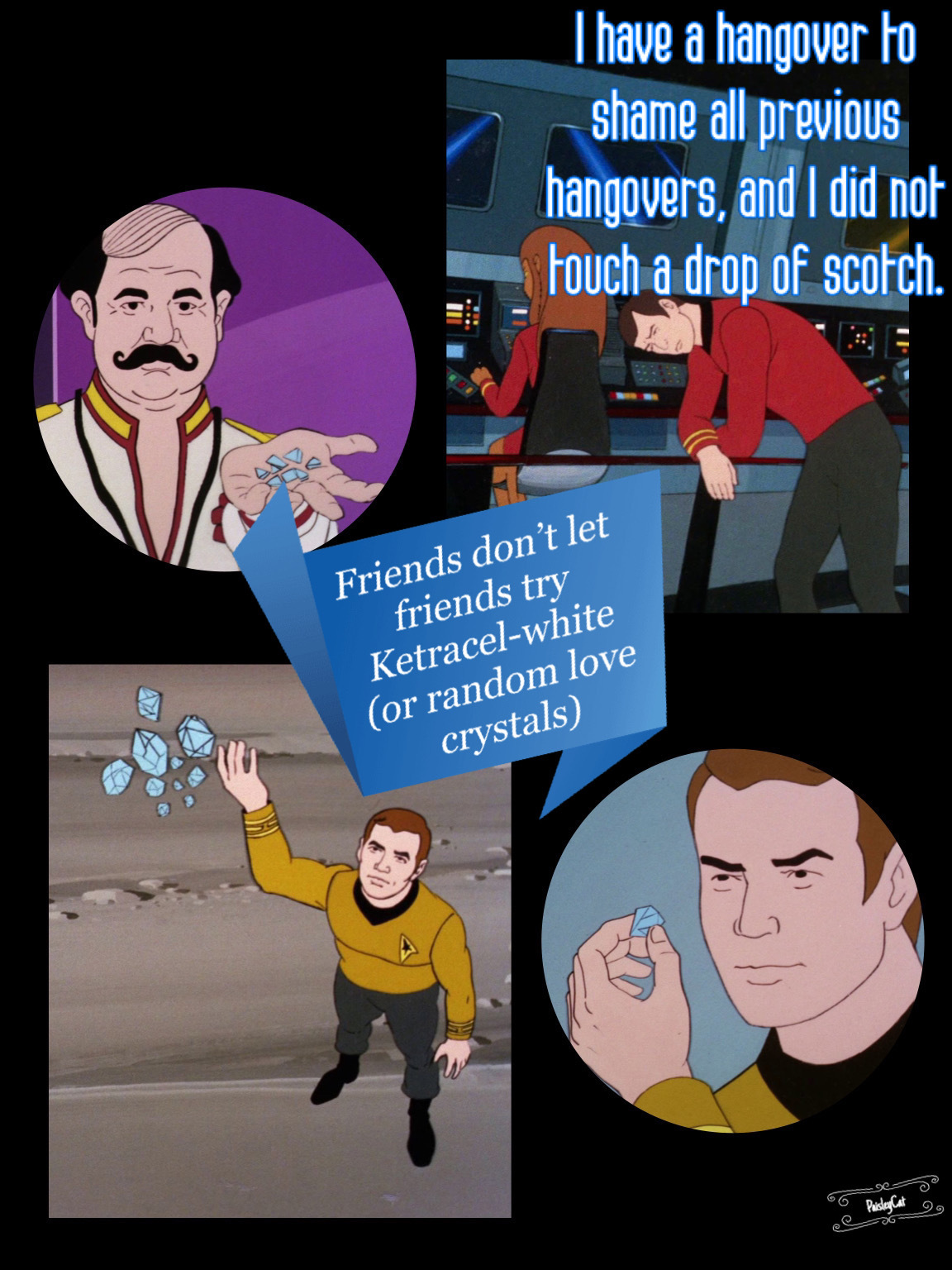
While all TAS episodes had some kind of moral lesson, S1 E10 was an outright criticism of substance use.
M’Ress and Scotty, unwittingly exposed, end up enamoured then incensed with one another. One is never sure how different that is from a Caitian’s usual romantic style.
Chapel comes off badly in this one. As Spock puts it “A few moments of love, paid for with several hours of hatred.” It’s all the more poignant given SNW’s deepening of their backstory.
Going to be that person and suggest the OP try Voyager.
It seems to be the most accessible of the older shows for younger, newer viewers. It was the most watched of all the classic shows on Netflix.
It covers all the classic tropes and provides endless fodder for memes here.
It’s uneven throughout its entire run, but also has some of the very best episodes ever. New fans really attach to the characters, and there’s no refuting that it unabashedly leaned into the weird.
There was a reference in Discovery season one or two to SQL, as if it was cool. Sigh.
That was likely added to quell reactions to a woman as a first officer. But the Network had notes even so on how negatively test audiences reacted to Majel Barrett’s Number One.
Roddenberry tried another tack with blonde, beehived, Whitney in a miniskirt as Yeoman Janice Rand. She was supposed to be a woman main character but even that was too much for the executives and she was written out by the end of the first season.
They do have these platforms, but many people have become dependent on Facebook, Instagram and Twitter to link to information.
So the territorial government is literally posting on Facebook, Instagram and Twitter telling people how to search for CPAC Canada and CBC Radio so they can find the sites.
Compare that to the duty of all broadcasters in a public emergency to carry the key evacuation information on radio and television and tell people where to get more detailed emergency instructions.
I understand your reaction.
For me, this is in many ways a less dark and cynical take than DS9 In the Pale Moonlight and certainly the Section 31 references.
What was critical here was the difference between the journey of individual traumatized officers who had been forced repeatedly to take actions in wartime that compromised their values, and brought out capabilities they never sought to own, vs Starfleet leadership taking cynical action. It’s also a direct outcome of Starfleet’s cynical actions in having M’Benga develop the serum and then use it.
Starfleet’s postwar directive, and Pike’s insistence on pressing it with his senior officers, created the immediate crisis.
However, we need to take account of the fact that it was the ambassador’s own repeated insistence on confronting, engaging and attempting to recruit M’Benga to assist in his mission that led to the break.
M’Benga seemed to be processing his trauma and managing it as well as he could. He wasn’t at the point of exposing the ambassador’s deceit although he appeared to have been contemplating it.
It was the ambassador’s decision to seek M’Benga out again, in his own safe space, his private office, and own refusal to take M’Benga’s rejection that seemed to take the contemplation to action.
The cover up by Chapel and M’Benga is serious, and in the case of M’Benga this is the second case of his hiding something of significance from his captain. He’s an understandable but grey character, and we will have to see where the show takes him.
In Chapel’s case, we have been shown that her bright effervescence hides much darker experiences. It’s now easier to imagine how she will evolves to the very restrained version of herself in TOS.
I feel this is a very authentic portrayal of the chronic legacy unaddressed of trauma in individuals, how a military service and society will need to move on after a society-wide war when its individuals are not yet ready to do so, and how disasterous the potential outcomes when the divide been societal and individual needs in healing are ignored.
It’s not the 24th century Starfleet we’re seeing where there has been a long period of peace and officers can be treated effectively for trauma before returning to duty and it locks in with chronic effects.
I agree that it does not show Pike’s leadership in a positive light, but I find it realistic. What it does show is the gulf between war veterans and those senior officers who, while veterans of other kinds of conflicts, were not involved.
Starfleet needs senior officers, without direct personal history, like Pike to lead the peace and move forward, just as the western allies needed to find a way with some German leaders and scientists after WW2. But not every individual at the front can withstand the stress of that direct engagement with a former enemy.
Starfleet’s order to force veterans into direct contact with a former enemy was psychologically unhealthy and unrealistic, but a value-focused officer like Pike would not have the insight to see that.
This gulf was underscored at a personal level by Chapel’s conversation with Spock, when she could not share her experience with him and he could not ease her pain. The scene between them was an essential confirmation.
What I found interesting is that Number One had the best read on the situation. She saw the pressure the ambassador was putting directly on the veterans in the crew.
As the executive officer, it’s her job to manage personnel, to assess readiness, to deliver a functioning ship for the captain’s command. She accurately saw the problem and recommended action to mitigate the situation by reducing the time to deliver the ambassador to Starbase 24.
What she was not able to do however was to convince Pike to stand down a bit on Starfleet’s toxic order to require veterans of the war to show acceptance of the ambassador. Nor did we see her attempt to try to convince Pike. He was leading from his values and unable to really take measure of its impact on the individuals.
I find it interesting that this show is giving us episodes that show the negatives of Pike’s command style as well as the strengths. While we’ve seen the negatives in Kirk’s and Picard’s temperament’s and command styles acknowledged in the movies and in Picard, this seems to be the first time we’ve had it done with a hero captain in an ongoing television series when he’s in active command of the ship.
She’s a more seasoned pilot by far than early Tom Paris.
But she’s exactly what I expect and know experienced combat pilots to be like. Some are sober and subdued like Sulu or Detmer, but the in your face types are common and tolerated.
I’ve seen a great amount of curmudgeonly criticism of this episode in other places.
Can’t understand it really. There really seems to be a contingent of fans that just don’t want to have fun.
I’m so very glad to see that Prodigy’s excellence continues to get the acknowledgment it deserves from within the creative community.
This Individual Achievement award is determined by the animators’ guild not an open Emmy vote. Having the winner for each of the show’s two seasons demonstrates the respect the work has within the animation community.