51
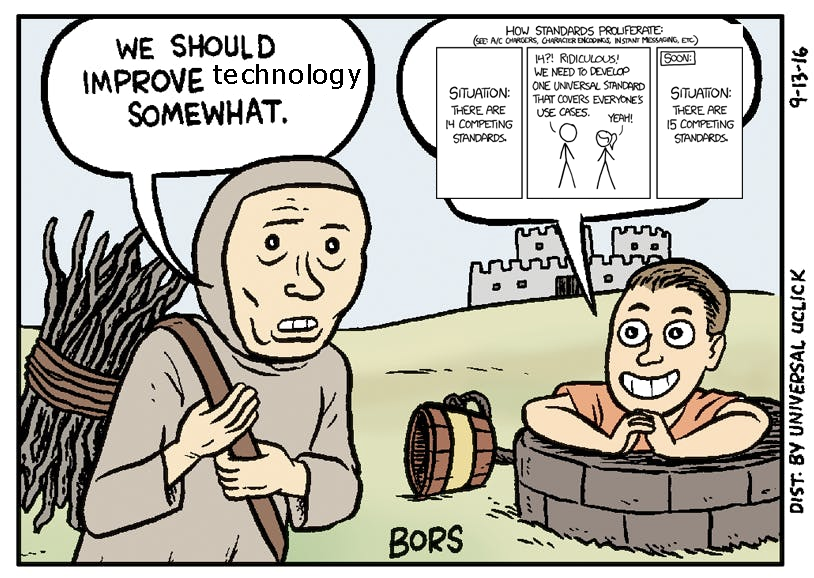
When the revolution comes we need to unify the programming languages
(lemmy.dbzer0.com)
When the revolution comes we need to unify tools
Hammer? Screwdriver? Spanner? One of these should be enough
Single handle with interchangeable heads.
All these cutting edge new languages are just wrappers around the same C libraries some anonymous grad students wrote in the 70s funded by some tiny government grants.
"You could not live with your own failure. Where did that bring you? Back to C."
All these cutting edge new languages are just wrappers around the same assembly code by Kathleen Booth in the 1940s for her university computer.
part of project 2025 is making javascript the only programming language
Never thought I'd say this, but we gotta vote Biden.
Rust

"  but rust is woke!!!"
Rust got trans women's seal of approval, that's how you know it's the real deal.
Arc<Box>
Can we ban all tools that aren't hammers while we are here?
After the revolution we should just unify english. Theres so many spoken languages around.
Hearies when there's more than one sign language type beat
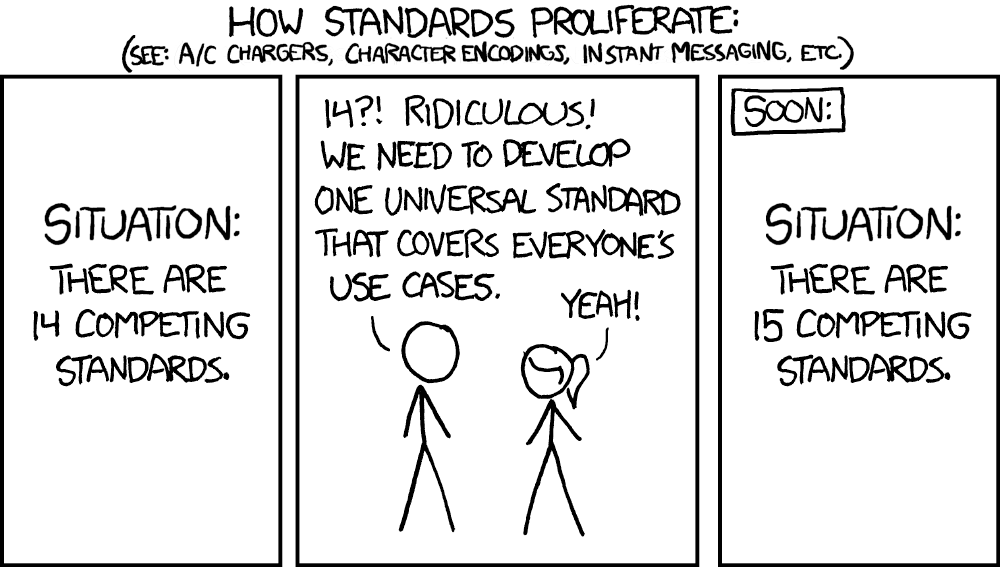
Language design and theory has made some legitimate gains over the past couple decades. And different languages have different strengths suited for different problems. I think the issue is that even people who agree with this aren’t gonna agree on the language to standardize on. It’s the XKCD comic.
there are 28 coding languages
"We need to invent a universal language that brings all these together so everybody can just use one"
there are 29 coding languages
And then we can use our unified programming language to write a program so tall it breaches Heaven itself
learn more languages - it makes the code you write more effective on the human level. like learning Haskell taught me how to conceive of ideas that you would just solve by duplicating code or building a shitty interface that falls apart when you need to combine it with anything else. code is math and code is a means by which you communicate with other people. and you need to learn to express yourself in more ways in order to come to a deeper understanding of both of those facets.
I don't want fewer languages. I want more diversity and more experimentation. I'd love to see more domain-specialized languages that borrow ideas from the more academic languages and refine them. look at Elm and how much ground it broke - so much so that it's impacted how new javascript UI frameworks are designed. but Elm couldn't exist without languages like Haskell and Ocaml. and those couldn't exist without ML, Miranda, etc, etc.
putting limits on human creativity defeats the entire purpose of the left. we dream of being unshackled, of the genuine freedom that can only come from the defeat of capitalism and the dawn of a new, socialist political economy. perhaps if one day I write a better Lean, it will inspire someone to write a web language that brings proofs into the developers' lexicon and we will all have less shitty, poorly conceived, brittle code to maintain. and maybe you'll inspire me with a great idea of your own.
I like Guile with its compiler tower. You can use multiple languages on the same VM, even using libraries from one language on another, which is fucking cool. The core language for Guile is Scheme, and it supports standards from R4RS-R7RS, along with plenty of built-in SRFIs, some implemented out-of-tree and many of its own Guile-specific extensions.
For the compiler tower, so far we've got the aforementioned ballin' Scheme implementation, Emacs Lisp, an unfinished JavaScript implementation that doesn't even fully implement ES3, Brainfuck, Python, wonky Lua, and Guile-specific Clojure. Hopefully there's more to come and there's some I missed.
While the main purpose for the compiler tower is to lower a language into the IR (Tree-IL) (although you can lower a language into another language too, which then itself can be lowered into IR), which gets lowered to more verbose IR (CPS), then bytecode - we can also raise IR through decompilation. For example, Guile-JavaScript compiles Scheme to IR, then decompiles the IR and raises it to JavaScript.
Then there's also Guile Hoot, which I believe lowers the IR into WASM. In theory, when its complete, the above languages could work with Hoot and he compiled to Hoot, but I'm not entirely sure on this.
Terrible take tbh
You can pry Julia out of my cold dead hands but if you make me work with other people in it I'll start sobbing
Rust
In my communist future it's all Torqur3D, Python, and BASIC. No, I do not know any of those.
Banning programming languages seems like a bad idea to me, humanity has come to regret all that language standardization and cultural genocide that happened with the imposition of one universal linguistic language. My official (so the communist position) on programming languages is let a thousand alternates to C+ bloom, then crush them all under the jackboot of the communist party. THEY WILL ALL BE THE LANGUAGE OF COMMUNISM!
such decisions will be made scientifically, without the liberal farce of the voting ritual.
it's javascript
Unless you are writing a hard-realtume system, Common Lisp is the only language you will ever need.
Be quiet parentheses diddler, (((((()((((((())((do-thing (())(())))))0((( who the fuck wants to look at that all day.
But seriously tho how do you get used to the syntax? I've read some moderately complex Lisp code and it was very hard to read for me, do you just kinda get used to it over time or is there extra tooling involved?
OK fair point actually. You just gotta write some lisp code yourself (I'm a fairly new lisper although I had emacs for a while now and have dabbled in some elisp to edit my config) to appreciate how the parentheses are actually helpful when you write things. To read things, well-written lisp code will be properly indented, or else a reasonably powerful editor (emacs with sly, etc) is able to indent the code for you
Take a look at my (shameless plug) eratosthenes sieve function i wrote just yesterday
(defun range (start end)
  (if (< start end)
      (cons start (range (1+ start) end))))

;; Checks if d is a factor of n
(defun factorofp (d n)
  (zerop (rem n d)))

;; Sieve in lisp??
(defun sieve (n)
  (let ((primes (range 2 n))
        (curprime 2))
    (maplist (lambda (tail)
               (delete-if (lambda (n)
                            (factorofp curprime n))
                          (cdr tail))
               (setf curprime (cadr tail)))
             primes)
    primes))
u don't have to understand it. But the general principle is, things that are indented at the same level are arguments to the same function. In other words, notice that the delete-if and the setf are indented together. So they must be part of the same "argument:" namely, the body of the anonymous function lambda. So really, you don't have to count the parentheses or anything. The indentation makes things clear and unambiguous.
Other things that aid in reading are, obviously, patterns that you pick up along the way. Do not fear the parentheses. Embrace them
I can read it if I really focus but even with the nice indentation the syntax doesn't make it easy, it's probably way easier with proper syntax highlighting tho, whatever the Lemmy renderer did here seems wrong.
I still don't really see why I would suffer the syntax over using a more readable language, I've heard this syntax makes the macro system way more elegant/powerful but I can't see it being THAT much better than whatever other languages are doing.
I'm only familiar with Python...
Banned? DM Wmill to appeal.
No anti-nautilism posts. See: Eco-fascism Primer
Slop posts go in c/slop. Don't post low-hanging fruit here.