1584
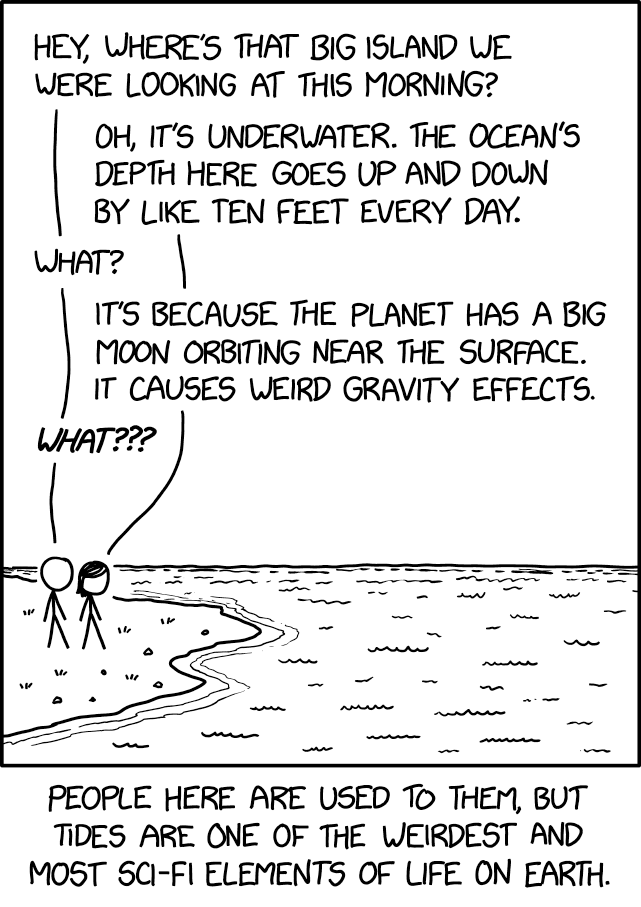
Sea Level
(imgs.xkcd.com)
Alt text: They're up there with coral islands, lightning, and caterpillars turning into butterflies.

I think it’s more wild that not only are big moons rare, ours is literally the same size as the sun from our point of view.
It also makes almost exactly 13 laps for every lap the earth makes.
Which is why a 13 month calendar all having 28 days would have made more sense
It makes 12 months because the lap the Earth makes is deducted from the 13 the moon makes, so effectively it makes 12 cycles around the Earth.
You don't know what you're talking about
13x28=364. The moon makes 14 sidereal orbits, not 13. The reason the year is split into 12 months is a combination of Roman dipshittery and the fact that 12 is divisible by 2, 3, 4, and 6. The number of factors of 12 made 12 and 60 way easier to work with for societies that hadn't invented the decimal point yet.
Then please explain how the Hebrew calendar, and all other lunisolar calendars (calendars which follow both the solar year and the lunar cycle) have 12 months most years? https://en.wikipedia.org/wiki/Lunisolar_calendar
"The majority of years have twelve months but every second or third year is an embolismic year, which adds a thirteenth intercalary, embolismic, or leap month."
Not who you asked, but after looking into it it's because the moon takes about 29.5 days to complete a full cycle of phases (one synodic month), giving it time to do so roughly 12 times per year.
I can't quite wrap my head around it, but I think the explanation for why sidereal and synodic months differ lines up with your initial explanation. Because we're also moving, the moon has to move further to achieve the visual change of moon phases.
Thanks. I think the user who replied to me is the one with no idea that they're talking about. No way of measuring it comes close to 14.
Can you provide a source for 14 orbits? Everything in my search results says 13 and some change.
Wikipedia says one sidereal month is 27.321661 days and a sidereal year is 365.256 days.
365.256/27.321661 ≈ 13.37
No. A sidereal year is 366.24 days.
And 11 days isn't "and some change"
The figures in my post are ephemeris days since that's the way Wikipedia lists them.
https://en.wikipedia.org/wiki/Sidereal_year
https://en.wikipedia.org/wiki/Lunar_month#Sidereal_month
"And some change" is a phrase to refer to a number following a decimal point, meaning the sources I find claim there are thirteen point something sidereal months per year, at a figure too low to round to 14. Here are some example sources:
https://en.wikipedia.org/wiki/Orbit_of_the_Moon#Lunar_periods
http://scienceline.ucsb.edu/getkey.php?key=1126
I still can't find a source which says the moon makes 14 sidereal orbits per year, using any definition of year.
12 is an easier number to work with because of how many factors it has
hmm, how about 12 months each with 30 days, plus 5 days every year that's not part of any month?
Those are called intercalary months. They had them in the ancient egyptian calendar (5 every year, 6 in leap years) and were usually used for rest and religious ceremonies.
https://en.wikipedia.org/wiki/Intercalary_month_(Egypt)
I'm pretty sure they're being cheeky and we're referencing exactly this ;)
https://forgottenrealms.fandom.com/wiki/Calendar_of_Harptos
Whereas my year starts with Hammer and ends with Fall.
Just add a leap month every six years
You'd have 12 30-day months most years, and an extra in the sixth! While we're at it, we can redefine a week to be six days, so there's a perfectly rounded number of weeks per month/year! Days, hours, minutes and seconds are already fine, but maybe we should also replace units shorter than a second with something more dozenal/hexal(?), too…
While a novel idea, a leap month would throw the concept seasons and therefore agriculture off significantly. Relatively predictable seasons and being able to track our place in it with calendars was a great help to agrarian communities, helping them know when to plant and harvest most effectively.
Every 7 or 6 years for a leap week 12 month calendar, it would be four times longer for a leap month, and the formula is a bit too complex for people to do in their heads, but we all refer to computer calendars anyway
A 364 day calendar with 13 even months, or 12 months alternating between 35 and 28 days or whatever would also let you use the same calendar every year (as opposed to my tea towel that has a calendar that is only useful in leap years that start on a Tuesday — the last was 2008 when it was bought, next is 2036)
Though it would be too expensive to change the calendar, and a 364 + leap weeks calendar doesn't track the seasons as well as 365 + leap day calendar, I really like the symmetry 454 calendar
Get this Roman bullshit outta here
13*28=364 so even 13 months and 28 days doesn't work.
If we had 28 days in a month then the week needs to be something other than 7 days. Three out of four times February / March fucks me over by having the same weekday/ day of the month.
There is a calendar that uses 28, 35, 28 day months each quarter for 364 days, with the last quarter having an extra week (or having an intercalary week so they can pretend quarters will be all equal) in leap years
Only for pre-decimal society. Nowadays it's not a problem
Landlords would love it, at least. I personally would hate it, being a renter.
Haha great point. I never thought of that
Your rent right now can be thought of as a large payment split into 12 equal pieces (even though months aren’t actually equal) and your rent payment is just 1/12 of that. If there were 13 months it would just be split into 1/13 so each months payments would be slightly smaller to be the same total
If we transitioned it would take years and for at least some amount of time of overlap they would show both prices so it would be much harder for them to just jack up the price like they would prefer to do
Don't worry, they ain't ever gonna replace the Gregorian calendar.
It's a shame, though. That Jeromian 13 month one sounds like a better fit, whether or not you're in Vancouver!
And I thought you ment because the pubs would be full that week :-(
13 is a unlucky superstition number.
Only in Western cultures. In East Asia, it’s 4.
They have a different calendar too, no?
Nope, theirs is also the same. Just another same than ours.
In China, it's 8 due to the number sounding like the Mandarin word for death
In my understanding, 4 sounds like the word for death and 8 sounds like the word for wealth, so 8 is considered lucky.
But I don’t speak any version of Chinese, and could very well be wrong.
Didn’t some cultures do that?
And from what I have heard on science podcasts, the moon is, and has been, and still will be, moving away from the earth. Making the perfect solar eclipse only for a segment of the earth's history.
It honestly makes me feel lucky being born when I was.
We also get to see the after effects of the big bang which won’t be detectable for the majority of the lifetime of our universe.
The big bang part is interesting, because, if humans become successful and manage to somehow make some sort of long-lasting archive that would survive on universal scales, we would be the ancients with old revelations to a potential future species. Able to impart knowledge that would have been undetectable for them, and an ancient map of the stars containing visions of countless other galaxies, and a peek into the very beginnings
Though, realistically, it's likely that a hypothetical hyper-advanced technological species would have their ways of prodding the true nature of our universe, despite the greater challenges
Child you elaborate on the second point? Why is it only visible in a short period?
Cause the expansion of the universe. Eventually we won’t be able to see beyond our own galaxy.
Aha I see
A bit late, but the moon does not make "almost exactly 13 laps". Info from https://en.wikipedia.org/wiki/Lunar_month
If going by phases of the moon (synodic month), it makes 12.37 laps in a year. Not close to a round number.
If going by position in the sky relative to the stars (sidereal month), it makes 13.37 laps - one more than the former measure, because of Earth's year cancelling out one month.
There are also other ways to measure it, but none of them get anywhere close to an integer number per year.
It's almost like someone put it there on purpose 😉
Gross