802
Lmao
(mander.xyz)

According to Wikipedia this planet has an estimated surface gravity of 12.43 m/s^2 with a margin of error of about 2 m/s^2. That's only up to 50% higher than Earth's 9.8 m/s^2 (on the high end of the error margin) so it probably would be possible to get into orbit.
That said we don't actually know much about it for sure. We don't know if it's a terrestrial planet for example. It could be composed mostly of gases and liquids like Neptune.
(Not a rocket scientist or mathematician, but I spent 100s of hours playing KSP RP-1)
Just doing some estimates using data from the wikipedia page:
The dV (delta-V) needed to get into low Earth orbit is around 9.4km/s.
The dV for K2-18b might be around 19km/s, more than double that of Earth's.
It's practically impossible I think, you would need such a massive launch vehicle. For double the dV, you would need exponentially more fuel assuming current rocketry tech (fuel+oxidizer tanks and engines). There wouldn't be any single-stage or two-stage rockets that could do this. With a 3 or 4 stage rocket maybe? But you would be sending nearly 100% fuel off the launchpad with virtually zero payload.
Check out the "tyranny of the rocket equation". The more propellant you need to lift heavier rockets, the more propellant you need to lift that extra propellant and so on and so on.
I tried to factor in:
spoiler
The density of K2-18b is about 2.67+0.52/−0.47 g/cm3—intermediate between that of Earth and Neptune—implying that the planet has a hydrogen-rich envelope. [...] Atmosphere makes up at most 6.2% of the planet's mass
Since the atmosphere is so thick and takes up a lot of mass, I've picked 500km as the low orbit altitude (comparing to Earth's ~100km Karman line, it makes you appreciate how thin our atmosphere is ).
Rotational assist - I'm assuming it's tidally locked since it orbits so closely to its star (33 day years), and so you wouldn't get the assist from rotation like you do on Earth:
The planet is most likely tidally locked to the star, although considering its orbital eccentricity, a spin-orbit resonance like Mercury is also possible.
Kerbal Space Program is such an amazing game that secretly teaches you physics.
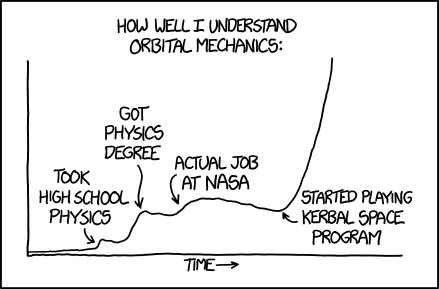
game that secretly teaches you physics.
those are the best!
What about something like nuclear pulse propulsion, or some kind of massive spin launch?
Nuclear propulsion, like Project Orion, would probably make it more likely they'd manage to get out of orbit. No idea on the math here, tho
https://en.wikipedia.org/wiki/Project_Orion_%28nuclear_propulsion%29
With a denser atmosphere, wouldn't that mean that you could get more lift from a traditional aerofoil than on earth? And if so, wouldn't that technically make it easier to start from a high enough altitude that at least some of the gravity is mitigated?
That's what i was thinking - the dense atmosphere might even allow for platforms which are permanently suspended in the air like an inverse submarine, offsetting a large amount of needed fuel for a space launch
It's probably still a lot harder though. You're not just heavier, but also slower which means you'll spend more time fighting gravity. And all the extra fuel you bring for that makes the rocket heavier which means you need even more fuel to launch the fuel. Higher surface gravity likely means a thicker atmosphere too which is a big issue and a more massive body also has a faster orbital velocity. Although in this case the larger diameter might counteract that a bit because higher orbits have slower velocities.
My point is that this would probably still be a lot harder than just building a 50% bigger rocket. If you've ever tried launching from Eve in Kerbal Space Program you know the pain. Although in that case you also have to fly the entire rocket there first which is its own challenge.
you'll spend more time fighting gravity
Aw man. This is already a significant portion of my day.
It would actually be impossible for them to get to orbit using chemical rocketry, like we use. They could theoretically do it with nukes.
Imagine a terrestrial planet that is Earthlike in all respects, but it simply has more persistent cloud cover, such that seeing an open cloudless sky is miraculously unlikely, as unlikely as humans directly witnessing an asteroid impact.
No ground based astronomy.
No technological discoveries or culture that derives from ground based astronomy.
No celestial navigation on the ground.
Very different / stunted / more difficult cartography.
Technological civilization is capable of emerging, but it would not be able to well understand anything beyond the terra firma, not untill it generated aircraft capable of breaching the cloud cover layer, and then developed airborne observatories.
Have you read Hitchhiker's Guide to the Galaxy?
Yea but they were playing cricket with the Galaxy
I wrote and tried publishing a short story about a species like that.
where only occasionally people on top of mountains see stars, and they chuck it as a consequence of low pressure. eventually they invented flight, and assume pilots going high enough to see stars are having cognitive issues due to lack of air.
They asked pilots to draw the stars they see, and they get different drawings (they sent pilots at different times of the year because they couldn't ever expect stars to shift) and assume its proof that thise stars are a cognitive artifact.
Eventually a pilot swears they are real and can actually use then to navigate, skepticism, he proves it. brand new research field emerges.
Although the story focuses more on deep DEEP time an omniengineering. (A term I just made up because mega engineering is a concept way too small compared to the one in the story).
If you want I don't mind putting that story in the conversation.
"Nightfall", by Arthur C. Clarke is a short story based on this premise.
Except in the story it's a complex multiple-star solar system that makes it very rare for all suns to set at once.
Edit: It's actually Isaac Asimov.
Well, the church threw us back about a millenia, so what's a few centuries.
Is there a particular instance you're referring to here? Because contrary to popular belief, the church has historically been big on investing in what we now call science.
For instance, although the trial of Galileo is often characterised as "big bad church holds us back because religion is opposed to heliocentrism", there was actually a lot of legitimate scientific beef against Galileo. Although he ended up being right about heliocentrism, he didn't really have good evidence to support his claims; He didn't understand Kepler's laws of planetary motion, and his telescope produced so many aberrant artifacts that astronomers who use it were reasonable to be dubious of his claims.
If you'd like to learn more, here's an excellent video by Dr Fatima, an astrophysicist turned science communicator. The philosopher of science, Paul Feyerabend also uses Galileo as a case study in his book Against Method
Project Hail Mary has a bit about this, don't want to say more to keep it spoiler free.
Well, as soon as they invent radio and experience interferens radio astronomi will evolve... I guess?
Jokes on us: Because of the gravity issue, alien life on such planets jumps right to stargate technology.
"They spent almost a thousand years fooling around with rockets!"
Uhh, one stargate doesn’t go anywhere.
You can accelerate it into space at g forces which would liquify living beings, perhaps?
If the planet is massive enough, getting to orbit becomes a real challenge because fuel consumption scales roughly exponentially with the mass of a planet (delta-v formula, rocket equation).
This leads to an almost sharp cut-off for the maximum mass that a planet can have so that a rocket which utilizes chemical fuel (e.g. methane+oxygen) can still reach orbit successfully. This maximum mass is roughly 10^26 kg.
For reference: Earth's mass is around 6*10^24 kg.
While other propulsion types exist, such as nuclear + ion drive, these propulsion types are significantly more complicated.
Interestingly, if a planet is too small, it cannot hold an atmosphere. There is a surprisingly sharp cut-off minimum mass for this as well, at roughly 10^21 kg.
We really are in the Goldilocks Zone, aren't we?
Well, yes. In the middle of the goldilocks zone that is based on the environment we are adapted to is where you would expect to find us :p
I've been wondering this for years now. Sci fi and even actual scientific speculation tends to assume aliens would be way ahead of us in terms of technology because their planets may have been formed earlier. I don't think time alone matters. If they don't have resources, if fhey don't evolve the same way, if they have more difficulties in doing shit due to any number of reasons... They could be far less advanced than us. Maybe nobody in the entire universe has figured out how to realistically travel between stars yet. Maybe we are the only ones who have even managed to get off our rock.
Imagine humanity in 1000 years. We would be among the stars.
Now imagine humanity in 10000 years, 100000 years or even 1000000 years.
A million years is still a fraction in the cosmic timescale.
It would be nearly impossible to have other civilizations be on exactly the same technological level as us. They would indeed be either much less advanced, or much more advanced.
This is just arrogance.
We have only been announcing our intelligence for 100 years. It takes 100,000 years just to cross our galaxy. No-one knows we are here yet.
Maybe they just don't want to leave their planet because it's dope af
I assume the amount of energy required for 'only' 50% more is massive.
Apparently with 50% higher gravity it would be pretty much impossible with chemical rockets, but with the median of the estimate (so about 12.43 m/s^2^) it would be possible, you'd just need an incredibly large rocket, or non-chemical propulsion (e.g. nuclear).
A space program on that planet would definitely advance much slower than on Earth.
How well funded have our space programs been? Maybe they aren't diverting massive portions of their resources to war and can actually focus on space.
They were well funded back when their real goal was to develop ICBMs capable of delivering nukes.
The tallest people on that planet

The interesting thing about this is that it could be a double whammy. The collision that formed the Moon not only made Earth smaller, it also ejected a lot of material away from the orbit. This made Earth even smaller than it would otherwise have been, had the two bodies merged. And the Moon also formed in the process. The Moon causes the tides which are theorized to have a significant beneficial effect on evolving more complex forms of life.
So just being small might not be enough and having a big moon might also not be enough, but Earth was lucky enough to have both. And that's just some of the things in a long list of things that have to go right to get complex life on a planet.
My feeling is that life is pretty rare, but given there are so many star systems in our galaxy there might be a lot of it still. But most of it is probably very simple stuff. Getting to where Earth is, might be a once every couple of millions of years event within our entire galaxy. So there really might be nothing intelligent out there at this moment in time, there might have been earlier and there might be in the future, but for right now we are it.
Yup, I wonder sometimes, all those sci-fi tales about a long lost ancient civilisation that spread throughout the galaxy before everyone else did, what if we’re set to become that, before space-faring life eventually emerges, then thrives and flourishes all over the galaxy?
One can dream anyway…
Imagine all the room for activities! (Trench warfare)
We make a mistake by assuming that life forms would likely be at the same scale as us. Larger planets would likely develop life forms appropriate for those planets instead of appropriate for ours.
I wonder at what point it is worth building a ~~space elevator~~ space pyramid.
Just keep stacking rocks until you're a few dozen miles away from the edge of space.
Maybe it was """too easy""" for us to get to space so that chemical propulsion was good enough. Who knows where we would be if that wasn't the case.
A place for majestic STEMLORD peacocking, as well as memes about the realities of working in a lab.

Rules
This is a science community. We use the Dawkins definition of meme.